
In the fast-paced world of business, understanding your financial health is crucial. Some entrepreneurs use the terms “revenue” and “profit” interchangeably, which can cause misunderstandings and inaccurate financial evaluations. This guide clarifies the distinction.
Key Takeaways
- Revenue is the top-line total of all sales. It does not account for any expenses.
- Profit is what remains after deducting all business expenses from revenue. It is the true measure of financial health.
- A business can have high revenue but very low or even negative profit if operating costs are high.
- In the bakery example: $10,000 revenue, $5,000 COGS, $3,000 operating expenses = $2,000 net profit.
Understanding both revenue and profit accurately is essential for setting prices, managing expenses, forecasting growth, attracting investors, and planning strategically. This guide explains what each metric means, how to calculate it, and why the difference matters.
Revenue vs Profit: Definitions
What Is Revenue?
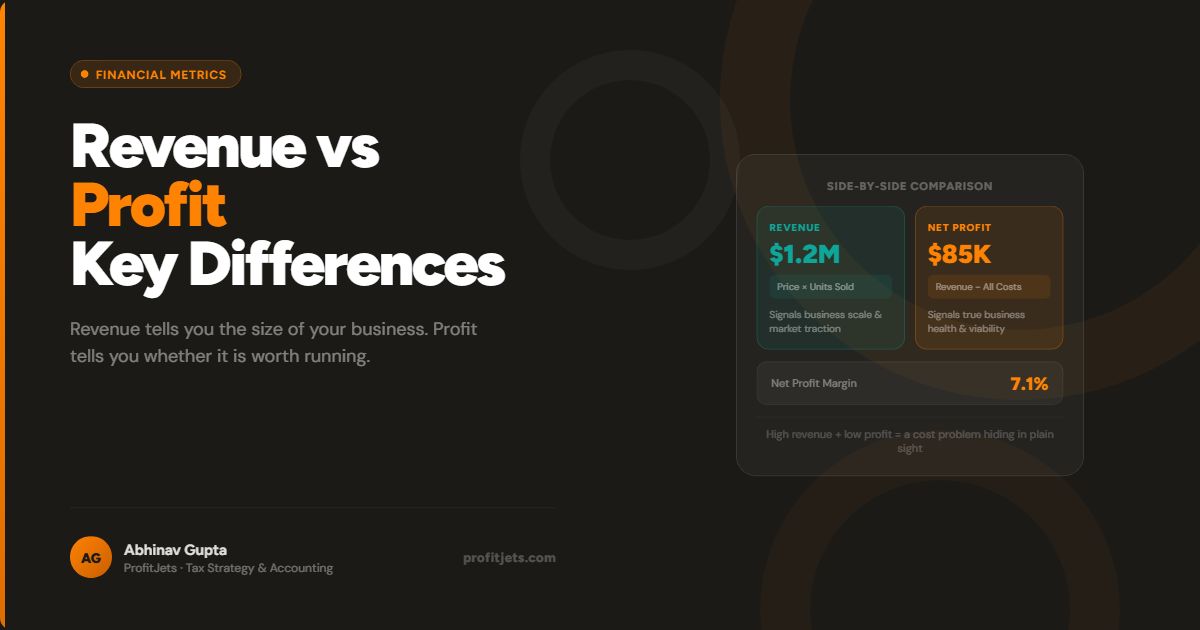
The income earned by selling goods or services is referred to as revenue for your business. The top-line figure on your income statement reflects the overall sales activity. Revenue does not account for any of the costs incurred to generate those sales.
What Is Profit?
Profit represents the net income remaining after you deduct all your business expenses from your revenue. It is the bottom line, indicating whether your business operates profitably. While revenue shows sales volume, profit reveals whether those sales are financially sustainable.
Revenue is often called the “top line” because it sits at the top of the income statement. Profit is the “bottom line” because it appears after all deductions. Growing both together is the goal; growing only revenue while profit shrinks is a warning sign.
Revenue vs Profit: Types
Types of Revenue
- Operating Revenue: Income directly from core business activities, such as product sales and service fees. This is the primary source for most businesses.
- Non-Operating Revenue: Income from sources outside the core business, such as investment interest, rental income, or asset sales. Important to track separately from operating revenue.
Types of Profit
- Gross Profit: The gross profit of your operations is acquired by subtracting the cost of goods sold from your revenue. It measures how efficiently you produce or deliver your product before accounting for overhead.
- Net Profit: Net profit is the remaining profit after deducting all the operating expenses, overhead costs, and other fees from gross profit. This is the true measure of overall business profitability.
Revenue vs Profit: Key Differences
| Feature | Revenue | Profit |
|---|---|---|
| Focus | Volume of sales activity | Profitability of operations |
| Expenses | Does not consider expenses | Accounts for all expenses |
| Calculation | Total sales (units sold x price) | Revenue minus total expenses |
| Location on P&L | Top line (first line) | Bottom line (last line) |
| What it signals | Sales performance and market demand | Financial health and efficiency |
| Decision-making value | Limited strategic information alone | Crucial for pricing, hiring, and growth decisions |
How to Calculate Revenue vs Profit
Calculating Revenue
Revenue calculation depends on your business model:
- For products: Units sold x price per unit
- For services: Hourly rate (or project fee) x hours worked (or projects completed)
Calculating Profit
Profit comes in two main forms, calculated sequentially from revenue:
- Gross Profit = Revenue – Cost of Goods Sold (COGS)
- Net Profit = Gross Profit – All Operating Expenses (rent, utilities, marketing, salaries, taxes)
A business can have high revenue but low or negative profit if operating costs are substantial. Growing revenue while profit shrinks is a common early-warning sign that costs are outpacing sales growth and need to be addressed immediately.
Use Case Example: The Bakery
Consider a bakery that sells cakes. Here is how the numbers work from revenue down to net profit:
| Line Item | Detail | Amount |
|---|---|---|
| Revenue | 100 cakes x $100 each | $10,000 |
| Cost of Goods Sold | 100 cakes x $50 ingredient cost | ($5,000) |
| Gross Profit | Revenue – COGS | $5,000 |
| Rent and Utilities | Monthly overhead | ($2,000) |
| Marketing | Advertising spend | ($1,000) |
| Net Profit | Gross Profit – Operating Expenses | $2,000 |
Using Both Metrics for Better Decisions
Understanding both revenue and profit is essential for business owners. Each metric serves a different purpose in decision-making:
- Pricing decisions: If gross profit margins are thin, you may need to raise prices or reduce COGS before you can improve net profit.
- Expense management: If gross profit is healthy but net profit is low, overhead costs are the problem. Tracking both helps you identify where to cut.
- Growth forecasting: Revenue growth that does not translate to profit growth signals a scaling problem that needs attention before it compounds.
- Investor attraction: Investors look at both. High revenue proves market demand; improving net profit proves the business model works at scale.
- Strategic planning: Combining both metrics helps you model how changes in pricing, volume, or costs will affect the bottom line before you commit resources.
Consulting a certified bookkeeper or accountant to ensure accurate financial reporting and analysis helps you act on reliable numbers rather than estimates. Inaccurate revenue or expense categorization can make profit look healthier or weaker than it really is.
Want clarity on your revenue, gross profit, and net profit figures?
Talk to a Profitjets ExpertFrequently Asked Questions
Is revenue the same as profit?
Can a business have high revenue but low or negative profit?
Why is profit more important than revenue?
What are the different types of profit?
How does understanding these metrics help in business decision-making?
Conclusion
Business owners must comprehend the differences between revenue and profit to make informed decisions. Revenue tells you how much your business is selling; profit tells you how much value those sales are actually creating after every cost is accounted for. Understanding both provides the insights you need to set prices, manage expenses, plan for growth, and attract investors. For accurate financial reporting and analysis, work with a certified bookkeeper or accountant who can ensure your numbers are reliable and decision-ready.
Ready to get accurate revenue and profit reporting for your business?
Schedule a Free ConsultationProfitjets Editorial Team
The Profitjets team writes practical financial guides to help small and mid-sized business owners understand key metrics, improve cash flow, and make smarter decisions.