
Bookkeeping is the process of recording every financial transaction in your business. This guide covers what bookkeeping means, why it matters, the types of bookkeeping, the 5-step process, and how Profitjets helps small businesses stay tax-ready and financially in control all year long.
Key Takeaways
- Bookkeeping is the systematic recording of a company's financial transactions. It is the backbone of accurate financial reporting, tax compliance, and business growth.
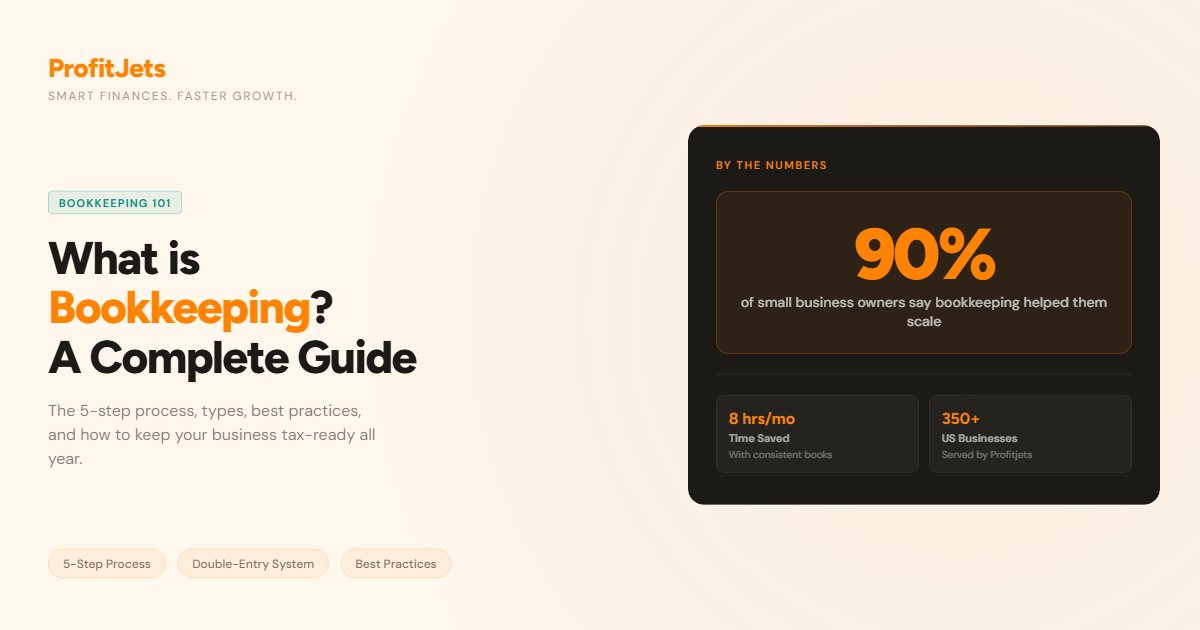
- Almost 90% of small business owners say their bookkeeper helped them scale, per QuickBooks research. Profitjets clients save an average of 8 hours per month by maintaining consistent books.
- There are two main types: single-entry (simple, limited) and double-entry (accurate, complete). Most businesses need double-entry bookkeeping.
- Bookkeeping and accounting are not the same. Bookkeeping records transactions; accounting analyzes them. Both are essential for financial management.
- Virtual bookkeeping gives small businesses access to expert support at lower cost, with real-time access to financial data from anywhere.
Bookkeeping is the process of recording the financial transactions of the business. This clearly reports the business's accurate financial status by tracking the information recorded. As precise and ongoing financial management is required for businesses as a key factor, bookkeeping becomes increasingly essential for businesses to navigate the process. Based on the latest research from QuickBooks, the report states almost 90% of the small business owners reported their bookkeeper helped them scale their business.
At Profitjets we have experience with businesses waiting for the last minute to handle the bookkeeping, and by doing that, they end up missing out on deductions that would otherwise save them money. Our team of experts at Profitjets has extensive experience of working with 350+ businesses across the US, and the businesses that could scale faster are the ones that maintained their books consistently. This article covers what bookkeeping means, the underlying importance of bookkeeping, and different types of bookkeeping.
What is Bookkeeping?
Bookkeeping is the systematic recording of a company's financial transactions. It entails documenting income, expenses, assets, liabilities, and equity to provide a clear and accurate picture of the business's financial position.
Consider it the business language. Just like a writer needs words to tell stories, a business needs accurate financial records to understand its performance, make informed decisions, and achieve its goals. In essence, bookkeeping serves as the backbone of any successful business. By meticulously tracking every financial detail, you gain valuable insights into your company's financial health, allowing you to identify areas for improvement, maximize profitability, and navigate the ever-changing economic landscape. Think of it as a roadmap for financial stability and sustainable growth. The more accurate and detailed your financial records are, the better equipped you are to chart a course for success and steer your business to its full potential.
At Profitjets, almost 40% of our clients often report that they have not noticed their profit and loss statement. They assumed what they earned and what they spent approximately, but never a clear record. Their profit and loss statement kept getting postponed for months and they finally approached us. We helped small businesses to maintain their books consistently and by doing that they get to save 8 hours on average per month. By outsourcing our bookkeeping services, more than 90% of our clients were able to file taxes without extension compared to 60% when they first approached us.
What is the Importance of Bookkeeping?
Bookkeeping is much more than numbers. It is about controlling your business. Here are a few reasons why bookkeeping is essential for success:
- Accurate Financial Reporting. Bookkeeping offers dependable data for generating accurate financial statements such as income statements, balance sheets, and cash flow statements. These reports provide valuable insights into the company's financial health and enable informed decision-making.
- Tax Compliance. Any firm must avoid penalties and fines. Bookkeeping enables correct and timely tax preparation and filing, allowing you to comply with tax laws.
- Financial Control. Bookkeeping allows you to manage income and expenses, uncover cost-cutting opportunities, and make informed budgeting decisions. This will enable you to deploy resources while maintaining financial stability.
- Attractiveness to Investors and Lenders. Well-maintained books attract investors and lenders by exhibiting transparency and confidence in the company's financial stability. This can make obtaining money for growth and expansion easier.
- Improved Cash Flow. By analyzing your cash flow patterns, you may foresee probable cash shortages and surpluses, allowing you to properly manage your finances and minimize financial strain.
- Business Expansion. Accurate financial data lets you discover patterns and analyze business performance. This data may be utilized to create strategic plans for growth and expansion, ensuring your company stays ahead of the competition.
KPIs are crucial tools for measuring the success of bookkeeping services. They support making data-driven decisions, monitoring advancement, and identifying areas of strength and weakness. If you do not know which KPIs your bookkeeper tracks, ask.
What Does a Bookkeeper Do?
A bookkeeper is responsible for recording and tracking all business transactions and handling an organization's data-entry-related and finance-related tracking. While a bookkeeper requires skills like attention to detail and a love for numbers, in today's time, any bookkeeper should have the knowledge and skills to use software that assists and streamlines an organization's numbers into a visual aid.
Here are some of the day-to-day tasks of a bookkeeper:
- Record daily transactions like sales, purchases, receipts, and payments into various accounts
- Tracking all transactions linked to accounts receivable and accounts payable
- Maintaining a general ledger and using it to produce financial statements for the organization
- Preparing budget and financial plans
- Issuing invoices to customers
- Payroll processing
A bookkeeper aims to help businesses make informed financial decisions by producing the current organization's economic health. Bookkeepers will keep your books tax-compliant, allowing you to focus on the bigger picture for your business.
How is Bookkeeping Beneficial for Businesses?
It takes time to do bookkeeping. The motto of digitalization is to make machines simple enough for dedicated tasks, and repetitive tasks can be automated, reducing the time consumption rate. This is why bookkeeping is of such value. Investing in effective bookkeeping practices offers a multitude of benefits for businesses of all sizes:
- Enhanced Productivity: By saving time and simplifying financial procedures, you can concentrate on your primary business operations.
- Decreased Costs: Profitability is increased, and expenses are reduced when needless spending is found and removed.
- Better Decision-making: Having timely access to accurate financial data gives you the confidence to make well-informed choices.
- Increased Profitability: Reaching financial objectives and maximizing profits are made possible by cost management and resource allocation optimization.
- Better Financial Health: Being aware of possible issues early on enables you to take preventative action and keep your finances stable.
- Enhanced Investor Confidence: Well-kept books encourage confidence in lenders and investors, making it easier to obtain funding for expansion and growth.
For small businesses, bookkeeping has undeniable advantages, such as:
- Reduced Costs: Eliminate the need for expensive in-house bookkeeping staff and associated overhead expenses.
- Increased Efficiency: Automate time-consuming tasks and streamline financial processes, freeing up valuable time to focus on core business operations.
- Enhanced Accuracy: Minimize human error through automated data entry and reconciliation features.
- Improved Decision-making: Gain real-time financial insights to make informed and data-driven business decisions.
- Greater Flexibility: Access your financial data from anywhere, anytime, allowing for unparalleled flexibility and work-life balance.
Are Bookkeeping and Accounting the Same?
Although bookkeeping and accounting are sometimes used synonymously, they are different. Despite their differences, both are essential components of financial management. Consider bookkeeping as a building's foundation. Gathering and arranging all financial data is similar to how bricks and mortar make up the foundation. Accounting is the architect who examines and deciphers this data, applying their understanding to construct and enhance the framework.
| Feature | Bookkeeping | Accounting |
|---|---|---|
| Focus | Day-to-day financial transactions | Overall financial health |
| Activities | Recording income and expenses, managing accounts and reconciling bank statements | Analyzing financial data and preparing financial statements |
| System | Single-entry or double-entry bookkeeping | Only double-entry |
| Output | Financial reports and basic reports (e.g., income statements) | Financial reports, financial analysis, and insights for decision-making |
| Purpose | Track financial health and maintain compliance with tax regulations | Inform strategic decision-making, attract investors and secure funding |
| Target Audience | Internal stakeholders (e.g., business owners or managers) | Internal and external stakeholders (e.g., investors, lenders, and creditors) |
Who Needs Each Service?
Bookkeeping: All businesses, regardless of size, need bookkeeping to maintain accurate financial records. It's a vital part of any business operation.
Accounting: While some smaller businesses might handle basic bookkeeping, most benefit from professional accounting services. This is especially true for companies with complex financial needs or those seeking tax advice and financial planning.
What are the Types of Bookkeeping?
There are two main types of bookkeeping, each catering to different needs and complexities. The bookkeeping your business requires is defined by the complex amounts of transactions your organization does.
Single-Entry Bookkeeping
A more straightforward method that is ideal for small businesses with limited transactions.
- Records income and expenses only once
- It does not provide a complete picture of the financial health of a business
Double-Entry Bookkeeping
A more complex but accurate method.
- Records each transaction twice, once as a debit and once as a credit
- Provides a complete picture of the financial health of a business, including assets, liabilities, and equity
Most businesses, especially those with complex financial needs, utilize double-entry bookkeeping for its accuracy and comprehensiveness.
Who Uses Bookkeeping?
All businesses, no matter their size or field of work, need bookkeeping services to stay tax-paying and record all money matters. Keeping books right and complete gives companies accurate reports about their financial situation. By having a clear view of how well different parts of the business are doing and good financial records, business owners can make critical decisions for both short-term and long-term needs.
Every growing business should focus on good bookkeeping basics. This can be done efficiently by outsourcing qualified bookkeeping experts. Good financial records help with money flow checks, tax filing, and growth strategies in today's busy business world.
Ready to unlock the power of accurate bookkeeping and take your business to the next level?
Learn About Our Services →What is Virtual Bookkeeping?
Virtual bookkeeping has revolutionized the way businesses manage their finances. It refers to using online tools and software to manage a business's finances remotely. This allows companies to access their financial information and work with bookkeepers from anywhere in the world.
What are the Benefits of Virtual Bookkeeping?
Embrace convenience and control with virtual bookkeeping: access your finances anytime, anywhere, and benefit from expert support, all with reduced costs and increased efficiency. Here are some of the additional benefits of virtual bookkeeping:
- Reduced costs: Eliminate overhead expenses associated with in-house bookkeeping staff
- Increased efficiency: Access your financial data and collaborate with your bookkeeper anytime
- Improved accessibility: Work with specialized bookkeepers regardless of location
- Increased scalability: Easily adapt your bookkeeping services as your business needs change
- Enhanced security: Enjoy enhanced data security through cloud-based solutions
What is the Bookkeeping Process?
Whether you choose traditional or virtual bookkeeping, the basic process remains the same:
- Gather Documents. Collect all receipts, invoices, bank statements, and other financial records.
- Record Transactions. Enter all transactions into your chosen bookkeeping system. Categorize transactions into relevant income and expense categories.
- Reconcile Accounts. Regularly compare your records with bank statements to ensure accuracy.
- Generate Reports. Create financial reports such as income statements, balance sheets, and cash flow statements.
- Analyze Reports. Review your financial reports regularly to gain insights into your business performance and identify areas for improvement.
Best Practices of Bookkeeping
Here are some best practices to ensure accurate and efficient bookkeeping:
- Choose the right system: Select a bookkeeping system that meets your needs and budget.
- Use consistent methods: Establish clear and consistent procedures for recording and managing financial data.
- Automate tasks: Take advantage of technology to automate repetitive tasks like data entry and reconciliation.
- Regularly back up your data: Protect your financial information by periodically backing up your data to a secure location.
- Seek professional help: Consider working with a certified bookkeeper or accountant.
Top Bookkeeping Companies for 2026
Profitjets
Profitjets is a technology-driven accounting solution provider that empowers businesses of all sizes through seamless and efficient bookkeeping services. Teams of seasoned professionals specialize in bookkeeping, accounting, advisory, payroll, and tax compliance. Leveraging cutting-edge cloud-based software ensures your financial data is secure, accessible, and always up-to-date.
QuickBooks Live
QuickBooks Live offers cleanup bookkeeping services for small businesses using the popular QuickBooks software. They specialize in catching up on neglected books, reconciling accounts, and ensuring financial data accuracy. This service is ideal if you need to get your books in order before tackling other accounting tasks.
Botkeeper
Botkeeper provides full-service bookkeeping solutions for accounting firms. They leverage skilled bookkeepers and advanced technology to handle all aspects of bookkeeping, including accounts payable and receivable, bank reconciliations, and financial reporting.
Ignite Spot Accounting
Ignite Spot Accounting specializes in connecting businesses with qualified, certified bookkeepers. They offer a platform for businesses to search for and hire bookkeepers based on their specific needs and budget.
1-800Accountant
1-800Accountant provides a range of bookkeeping services for businesses of all sizes. They offer customized solutions and scalable plans to accommodate individual needs and budgets. Their services include bookkeeping, payroll, tax preparation, and financial reporting.
What Bookkeeping Services Do We Offer?
At Profitjets, we pride ourselves in our timely delivery of your financial health and ensure your company is tax-compliant and ready well before the deadline. We provide services like:
Catchup Bookkeeping
We offer top-grade catchup bookkeeping services to meet the specific needs of your business enterprise. We explore all kinds of poor historical accounting and bookkeeping, along with all other monetary transactions for a specified time, and accordingly offer the right solution so that your business organization stays in adherence with the government guidelines.
Tax Services
Our specialized tax consultants offer the best solutions for all your tax-related matters. By collaborating with Profitjets, you can peacefully focus on other aspects of your business, as our certified tax consultants will pay all your taxes on time and meet all deadlines.
Payroll Processing Services
Managing employee payrolls can become a task, especially for a business owner with multiple tasks. Leave the payroll processing to Profitjets and be worry-free regarding your employee's payroll.
CFO Services
Our specialized CFO services are meant to help you achieve your business growth objectives. We offer strategic financial support to meet your business requirements and help you with economic forecasting, fundraising, and other financial services.
Need help keeping up with your bookkeeping? Let us help! Book a free consultation today and discover how our expert bookkeepers streamline your finances and give you valuable time back.
Bookkeeping FAQs
What is the difference between bookkeeping and accounting?
Do I need a bookkeeper or an accountant for my small business?
How much does bookkeeping cost for a small business?
Can I do my own bookkeeping?
How often should I update my books?
Wrapping Up
Remember, accurate and efficient bookkeeping is essential for the success of any business. Implement best practices and ensure your financial records are organized, precise, and available for making informed business decisions.
Ready to streamline your bookkeeping and stay tax-ready all year?
Book a Free Consultation →Abhinav Gupta
Abhinav writes practical guides that help small and mid-sized business owners understand financial fundamentals, stay tax-compliant, and make smarter money decisions.