
Most agency owners would be able to tell you their monthly revenues without a second thought. Fewer could tell you which clients contribute to revenues and profits. If we take a closer look at their P&L statement, we may see that the top-line number is high, their team is consistently busy, but there is still not enough cash at the end of the quarter.
A closer inspection of the books usually reveals the problem: advertising spend by clients that is recorded as revenue, retainers and project fees mixed together, and hours banked on a demanding client that do not reflect the proportion of the billable rate for that account.
Agency finances are usually far more complex than one would expect from a simple P&L statement, which typically follows the format used for manufacturers or other consistent goods producers.
Agencies have three types of revenues, from ongoing retainers to project costs, and media budgets that technically belong to clients circulate through their books. Salaries or freelance expenses may fluctuate greatly depending on the number of active projects and available headcount. A competent all-rounder bookkeeper will be able to record all these expenses with ease, but the resulting numbers will say little about the actual state of the agency’s finances.
This guide covers the financial problems agencies run into most often, the KPIs worth tracking, how outsourced bookkeeping addresses each problem, and how the cost compares with hiring in-house.
The damage is done long before the books are closed and the P&L statement is ready for print. Too many profitable clients and too many unprofitable ones exist on paper, cash from contractors’ hourly rates is incorrectly recorded as salary, and decisions about expansion and new hires are made based on revenues that theoretically belong to the agency but ultimately belong to clients.
Common Financial Problems for Digital Marketing Agencies
- Revenue recognition complexity: retainers are recognised monthly; project fees are recognised on completion or milestone; performance-based fees may depend on results achieved. All three require different recognition approaches
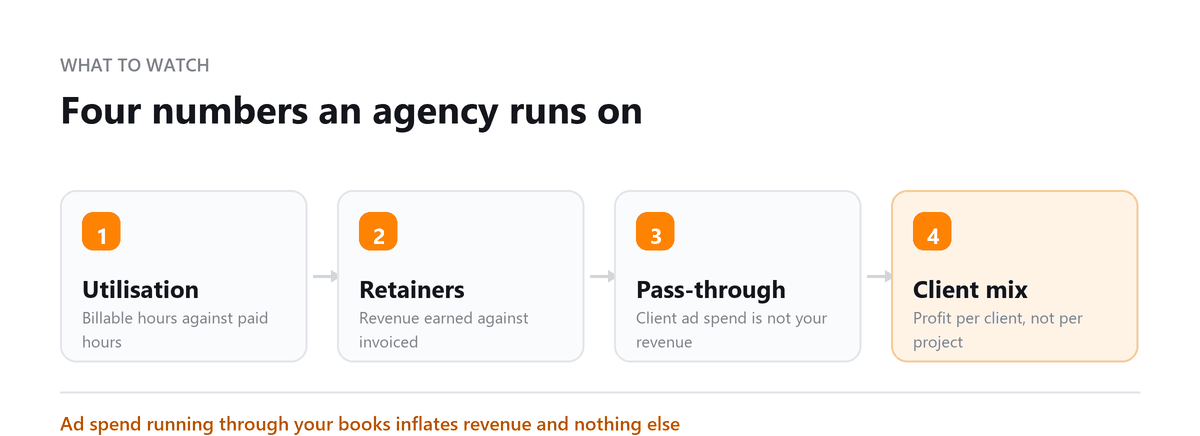
- Pass-through media spend: when an agency buys Google/Meta/LinkedIn ads on a client's behalf, this spend must be tracked separately from agency revenue, failing to do so inflates revenue and obscures actual agency profitability
- Contractor vs employee classification: agencies often use a mix of staff and freelancers. Misclassification creates payroll tax exposure and, if IRS-audited, significant back taxes and penalties
- Project profitability blind spot: without time tracking linked to project costs, agency owners do not know whether individual clients are profitable after staff time is allocated
- Cash flow volatility: retainer clients are predictable; project clients are not. Cash flow forecasting must account for project pipeline, not just contracted retainer revenue
The mistake I see hurt agency profitability most is running client media spend through revenue as if it were agency income. The top line looks impressive, gross margin looks terrible, and the owner has no clear view of what the team is really earning. Almost none of them realize it until someone separates those numbers out, and then the whole conversation about pricing and which clients to keep changes.
Abhinav Gupta, CPA, CA, MBA · LinkedInKey KPIs Digital Marketing Agencies Should Track
| KPI | Formula | Target |
|---|---|---|
| Gross margin | (Revenue - Direct staff/contractor costs) / Revenue | 50-65% for well-run agencies |
| Revenue per employee | Total revenue / number of employees (FTE) | >$150K-$200K per FTE is healthy |
| Client concentration | Largest client revenue / total revenue | <25%, no single client should be >25% of revenue |
| Utilisation rate | Billable hours / total available hours | 65-75% is the typical target |
| Retainer as % of revenue | Recurring retainer revenue / total revenue | >60% retainer provides strong cash flow predictability |
| Churn rate | Clients lost in period / clients at start of period | <10% annual churn for retainer clients |
How Outsourced Bookkeeping Solves These Pain Points
- Revenue recognition schedules: outsourced accountants set up deferred revenue tracking for retainers and milestone-based recognition for projects, ensuring revenue is not overstated in any period
- Pass-through tracking: separate cost codes for media spend vs agency fees ensure gross margin is measured on agency-value work, not inflated by client media budgets passing through the books
- Monthly P&L by client: with proper time tracking integration, outsourced bookkeepers can produce monthly profitability reports by client, identifying loss-making clients before they erode the overall margin
- Contractor management: 1099 tracking, W-9 collection, and year-end 1099 filing handled by the outsourced team, reducing compliance risk
- Cash flow forecasting: monthly 13-week cash flow forecasts based on contracted retainer revenue, project pipeline, and historical project close rates
In-House vs. Outsourced Accounting for Digital Marketing Agencies
| Factor | In-House | Outsourced |
|---|---|---|
| Monthly cost | $5,000-$8,000+ (salary + benefits + overhead) | $800-$3,500 depending on complexity |
| Industry expertise | Depends on individual hire | Specialists with agency-specific experience |
| Scalability | Hire when overwhelmed; redundant when slow | Scales with agency revenue month to month |
| Software | Must train and manage | Brings platform experience (QBO, Xero, Harvest, etc.) |
| Coverage | Single point of failure (illness, resignation) | Team, continuity guaranteed |
Profitjets has supported more than 30 agency clients with project-level financial reporting, helping separate pass-through costs from agency revenue and identify projects that were generating weaker margins. In these reviews, agencies have typically found that 10 to 20% of client accounts were contributing significantly less to profitability than their headline revenue suggested.
Book a free consultation and we will separate spend from revenue.
Frequently Asked Questions
How do I track profitability by client at my agency?
You need time tracking software such as Harvest, Toggl, or Clockify that logs hours by client and project, connected to your accounting platform so staff costs can be allocated to each client. An outsourced accounting team can set up that connection and produce a monthly client-level P&L showing revenue, direct costs, and contribution margin.
Should a digital marketing agency use cash or accrual accounting?
Accrual is the better choice for any agency with retainer clients. Cash accounting records revenue when it's collected, so a large upfront payment can make one month look great and the next look empty. Accrual recognizes revenue as it's earned and matches costs to the same period, which gives you monthly P&Ls you can actually compare.
Should client ad spend count as agency revenue?
In most cases it shouldn't be treated as income your agency earned. Whatever the reporting treatment, it needs to be tracked separately from your agency fees in the books. Otherwise your revenue looks inflated and your gross margin looks far worse than it is, which makes it hard to judge how the business is really performing.
When should an agency switch from a generalist bookkeeper to agency-focused accounting?
The usual signals are cash feeling tight despite steady revenue, not knowing which clients are profitable, a growing roster of freelancers, or mixing retainers with project work. If you're making pricing or hiring decisions without client-level numbers, it's time.
What's a healthy gross margin for a digital marketing agency?
Well-run agencies generally aim for 50 to 65%, calculated as revenue minus direct staff and contractor costs, divided by revenue. That figure only means something if pass-through media spend has been excluded, since including it can make a healthy agency look like it's barely breaking even.

Written by
Abhinav Gupta, CPA, CA, MBA
Abhinav works with business owners across the US on industry-specific bookkeeping, from dental practices and restaurants to construction and e-commerce. He writes about what each trade's books actually need. Connect on LinkedIn
Free consultation
Ad Spend Distorting Your Books?
Book a free consultation and we will separate spend from revenue.