
Working from home has more of an impact on your taxes than you might think. That second bedroom converted into a home office. The internet bill. The laptop. The gas you have to purchase to visit that one client's house. For the self-employed, a portion of that can either be expensed out as deductions that reduce your taxable income on the tax side. In many cases, those deductions amount to a multi-digit tax deduction for the home-based business owner.
The thing with the IRS is that they have a particular set of rules concerning what you can and cannot write off, and they're not too keen with people claiming deductions that they don't really qualify for.
The home office has to pass a specific use test, and expenses between personal and business are expected to be separated and documented. In addition, if you're a W2 employee working at home for someone else, a majority of these deductions won't even appear on your federal income tax return.
This article covers what the ten most common tax deductions for people who work at home are, in detail, including a description of how each one works and what regulations apply to them.
Expert Perspective
This guide covers who can claim work-from-home deductions, the ten most valuable write-offs for 2026, and the records you'll need to support them.
10 Most Valuable Tax Deductions to Consider in 2026 If You Work From Home
1. Home Office Deduction
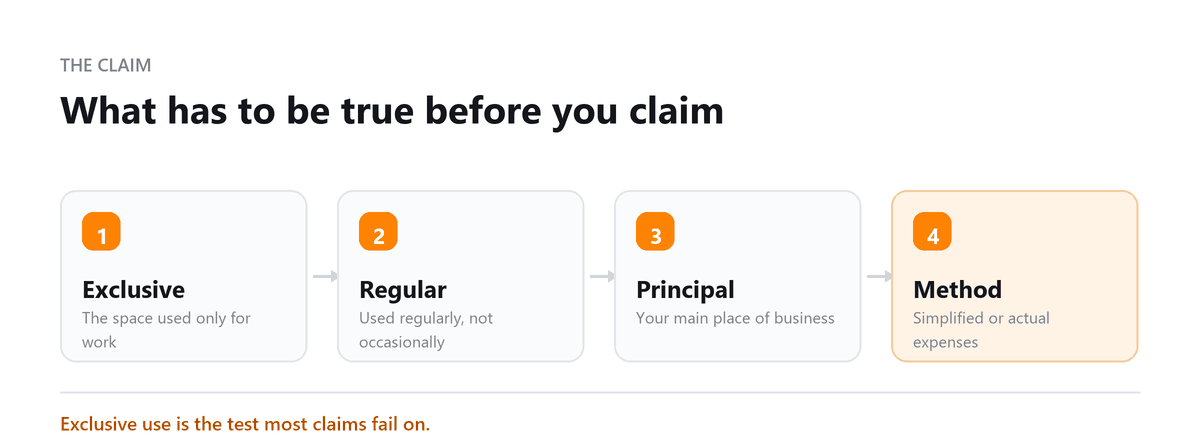
If you use a portion of your home exclusively and regularly for business, you can deduct a proportional share of housing costs. Two calculation methods:
- Simplified method: $5 per square foot, up to 300 sq ft = maximum $1,500 deduction
- Regular method: actual housing expenses (rent, mortgage interest, utilities, insurance) x percentage of home used for business
Critical rule: 'exclusive use' is strict, the space must be used only for business, not shared with personal activities.
Simplified method is easier and avoids depreciation recapture. The regular method often produces a larger deduction, especially for renters in higher-cost areas or anyone with a larger office. Many business owners calculate both and use whichever gives the better result.
The home office rule people misunderstand most is exclusive use. They think a desk in the corner of the guest room qualifies because they work there every day. But if that room also hosts visiting family or holds the kids' computer, it fails the test, and the whole deduction can be disallowed. The fix is simple: dedicate a clearly defined space only to the business, measure it, and take a couple of photos. That small step turns a claim that looks shaky into one that's easy to defend.
Ankit Sarawagi, CPA, CA, MBA · LinkedIn2. Half of Your Self-Employment Tax
Self-employed people pay self-employment tax to cover Social Security and Medicare, since there's no employer paying half. The rate is 15.3 percent, made up of 12.4 percent for Social Security and 2.9 percent for Medicare, and it's calculated on 92.35 percent of net self-employment earnings. The Social Security portion stops once earnings reach an annual wage base that adjusts each year.
You can deduct half of your self-employment tax as an adjustment to income. That lowers your income tax, though it doesn't reduce the self-employment tax itself. It's claimed on Schedule 1, and you don't need to itemize to take it.
3. Internet and Phone
If you use your home internet and phone for business, you can deduct the business-use percentage of those costs.
Work out a reasonable percentage based on how you actually use each service, and keep the monthly bills along with a note explaining how you arrived at the split. If you use one phone for both personal and business calls, a few weeks of tracked usage gives you a solid basis for the percentage.
One rule to know: the basic cost of the first landline in your home isn't deductible, even if you use it for business. Business long-distance charges on it, a separate business line, and the business share of your cell phone are.
4. Utilities for Your Home Office
If you use the regular home office method, you can deduct the business share of electricity, gas, water, trash collection, and similar household utilities.
The share is usually based on square footage. If your office takes up 200 square feet of a 2,000-square-foot home, you can generally deduct 10 percent of your utility bills.
If you use the simplified method, utilities are already included in the $5-per-square-foot rate, so you can't deduct them separately.
5. Self-Employed Health Insurance Premiums
If you're self-employed and pay for your own health insurance, you can generally deduct the premiums as an adjustment to income, rather than as an itemized medical expense. That means you get the benefit even if you take the standard deduction.
The deduction can cover medical, dental, and qualifying long-term care insurance for you, your spouse, your dependents, and children under age 27 at the end of the year. Two limits apply. You can't claim it for any month you were eligible for a subsidized health plan through an employer, including your spouse's employer. And the deduction can't exceed your net self-employment income from the business.
6. Retirement Plan Contributions
Contributions to a self-employed retirement plan reduce your taxable income while building savings for the future. The main options are:
Solo 401(k). Designed for business owners with no employees other than a spouse. You can contribute as both the employee, through salary deferrals, and the employer, through profit-sharing contributions, which often allows the highest total contributions at moderate income levels.
SEP-IRA. Simple to set up and run. Contributions are made as the employer, generally up to 25 percent of compensation, which works out to roughly 20 percent of net self-employment earnings for sole proprietors, subject to an annual dollar cap.
SIMPLE IRA. Useful for small businesses with employees, with lower contribution limits than a Solo 401(k).
For 2026, the combined limit on Solo 401(k) and SEP-IRA contributions is $72,000, and the Solo 401(k) employee deferral limit is $24,500, with additional catch-up contributions available if you're 50 or older. Limits change every year, and the right plan depends on your income, whether you have employees, and how much you want to put away.
7. Business Equipment and Technology
Computers, monitors, printers, desks, office chairs, and software you use for business are deductible. If you use an item for both business and personal purposes, you can only deduct the business-use percentage.
You don't always have to spread these costs over several years. Legislation passed in 2025 raised the Section 179 expensing limit to $2.5 million, adjusted for inflation, and restored 100 percent bonus depreciation for qualifying property acquired after January 19, 2025. Most home-based businesses will never approach those limits.
For smaller purchases, the de minimis safe harbor can make things even simpler. If you make the election each year, you can generally expense items costing up to $2,500 each without tracking them as fixed assets.
8. Business Meals
Meals with a clear business purpose, such as a lunch meeting with a client or a working meal with a business associate, are generally 50 percent deductible. Record who attended, the business relationship, and what was discussed.
Meals you eat alone while working from home aren't deductible. Neither is entertainment, such as concert or sports tickets, which has been generally nondeductible since 2018. The temporary 100 percent deduction for restaurant meals applied only in 2021 and 2022.
9. Vehicle Expenses
If you use your personal vehicle for business, you can deduct the business portion of the cost.
Working from home can make this deduction more valuable. When your home office is your principal place of business, trips from home to meet clients, visit suppliers, or run business errands generally count as business travel rather than commuting.
Two Ways to Calculate It
Standard mileage rate. Multiply your business miles by the IRS rate for the year. The rate was 70 cents per mile for 2025, and the IRS publishes the new rate at the end of each year. Parking and tolls for business trips can be deducted on top of it.
Actual expense method. Add up gas, insurance, repairs, maintenance, registration, and depreciation, then multiply by your business-use percentage.
Whichever method you use, keep a mileage log showing the date, destination, business purpose, and miles for each trip. Without one, vehicle deductions are hard to support.
10. Professional Development, Memberships, and Subscriptions
Costs that maintain or improve the skills you use in your current business are generally deductible. That includes online courses, industry conferences, professional association dues, trade publications, business books, and business software subscriptions.
Education that qualifies you for a new trade or business, or courses that are mainly personal, don't count. A freelance web designer taking a course on a new coding framework can deduct it. The same designer taking a course to become a licensed real estate agent generally can't.
Records to Keep for Work-From-Home Deductions
Good records are what turn legitimate deductions into deductions that hold up if the IRS asks questions. Keep:
- For your home office: measurements of the office and total home, photos of the space, and, for the regular method, bills for rent or mortgage interest, utilities, insurance, and repairs.
- For shared expenses: phone and internet bills, plus a short written explanation of how you calculated the business percentage.
- For equipment: receipts, the date each item was placed in service, and an estimate of business use.
- For meals and vehicles: receipts, attendee and purpose notes for meals, and a mileage log.
The general rule is to keep records for at least three years from the date you file the return. For home office depreciation and assets, keep them as long as you own the home or asset, plus three years.
Conclusion
Working from home can meaningfully lower your tax bill if you're self-employed, but only when you follow the rules and keep the records to back up your claims. The home office deduction, half of self-employment tax, health insurance premiums, and retirement contributions are often the biggest opportunities, with equipment, vehicle use, phone, internet, and professional development adding more.
Dedicate your office space to business only, separate personal from business use, document as you go, and review your deductions each year as your income and the rules change.
I had worked from home for several years but wasn't claiming all of the business expenses I was eligible to deduct. Profitjets reviewed my home-office setup, business-use expenses, and other deductible costs and identified approximately $7,500 in annual tax savings. We also put a system in place to track those expenses throughout the year so I wouldn't miss them again.
Book a free consultation and we will tell you what you can claim.
Frequently Asked Questions
Can W-2 remote employees deduct a home office?
Not on their federal return. The deduction for unreimbursed employee expenses was eliminated starting in 2018, and 2025 legislation made that permanent. Some states still allow it on the state return. The better option for many employees is to ask their employer to reimburse home office costs under an accountable plan, which is tax-free.
What is the home office deduction for 2026?
Under the simplified method, it's $5 per square foot of qualifying office space, up to 300 square feet, for a maximum of $1,500. Under the regular method, you deduct the business percentage of actual home expenses, such as rent or mortgage interest, utilities, insurance, and depreciation, limited to your business income.
Is self-employment tax fully deductible?
No. You can deduct half of your self-employment tax as an adjustment to income on Schedule 1. It reduces your income tax, but not the self-employment tax itself.
Does claiming a home office deduction increase my audit risk?
There's no official figure showing that it does, and a legitimate, well-documented claim shouldn't worry you. What matters is meeting the exclusive and regular use tests and keeping records. If you're unsure whether your space qualifies, the simplified method with clear measurements and photos is an easy way to claim what you're entitled to.
What if I only work from home part of the time?
Self-employed people can still qualify if the space is used exclusively and regularly for business and it's your principal place of business, even if you also work at client sites. If you have another fixed location where you do most of your administrative work, such as a rented office, your home office may not qualify.

Written by
Ankit Sarawagi, CPA, CA, MBA
Ankit leads the finance team at Profitjets, where he has worked with 500+ businesses across the US on bookkeeping, tax and CFO-level strategy. He writes about the habits that keep small business books accurate all year. Connect on LinkedIn
Free consultation
Working From Home?
Book a free consultation and we will tell you what you can claim.