
Most small business owners think about taxes twice a year: when the quarterly estimate is due and when the return is filed. By the time the return is being prepared, though, most of the decisions that shape the bill have already been made. Tax filing is mostly a record of what happened. Planning is what changes the outcome.
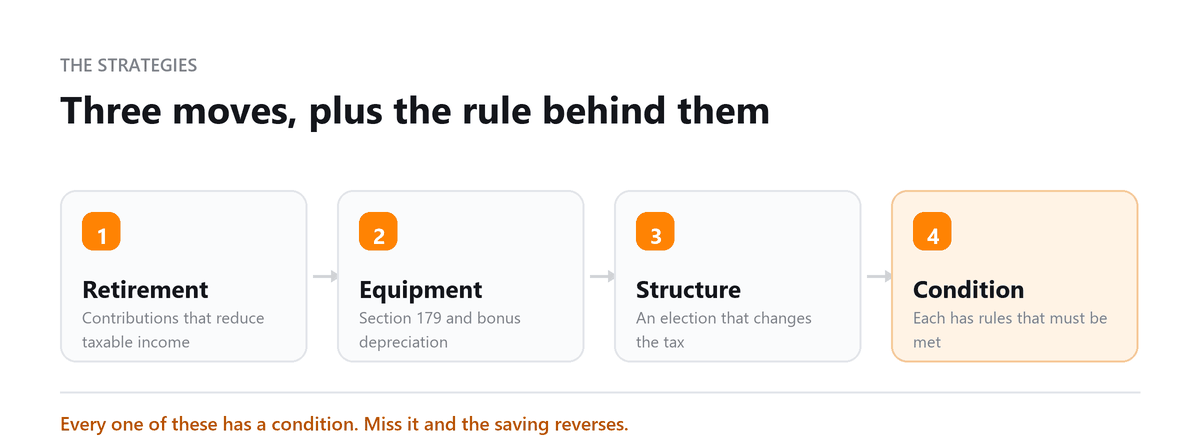
The good news is that you don't need complicated schemes to pay less. For most small businesses, the largest legitimate savings come from three areas. Claim every deduction the business is entitled to, set up the business in a structure that suits your level of profit, and put money into a retirement plan that cuts taxable income while building long-term savings.
None of these requires changing how you run the business day to day. What they require is attention during the year, good records, and a willingness to revisit the setup as profits grow. A structure that made sense at $40,000 of profit may be costing you thousands at $150,000.
Expert Perspective
This guide walks through the three core tax saving strategies for small business owners, with realistic numbers for 2026, and the year-round habits that make them work.
For an owner making $80,000 to $150,000 in net profit, retirement contributions usually deliver the fastest dollar impact, because you can decide on them late in the year and the deduction is immediate.
The S corporation election can save more at the upper end of that range, but only once profit is high enough to cover a reasonable salary, payroll costs, and the extra compliance.
I see a lot of owners elect too early on the strength of a $50,000 rule of thumb, and they end up paying more in fees and payroll admin than they save.
Ankit Sarawagi, CPA, CA, MBA · LinkedInStrategy 1: Claim Every Deduction You're Entitled To
A deduction reduces your taxable income, so what it saves depends on your tax rate. For a sole proprietor in the 22 percent federal bracket, a $1,000 deduction saves about $220 in income tax, plus roughly $140 in self-employment tax if it reduces business profit. That's meaningful money, repeated across every expense that goes unclaimed.
Deductions Small Business Owners Most Often Miss
Home office. If part of your home is used regularly and exclusively for business, you can deduct $5 per square foot up to 300 square feet with the simplified method, or a share of actual housing costs with the regular method.
Vehicle expenses. Business mileage can be deducted at the IRS standard rate, which was 70 cents per mile for 2025, or by using actual costs multiplied by your business-use percentage. A mileage log is essential either way.
Self-employed health insurance. Premiums for you, your spouse, and dependents can generally be deducted as an adjustment to income, as long as you weren't eligible for an employer-subsidized plan and the deduction doesn't exceed your business profit.
Business meals. Meals with a clear business purpose are generally 50 percent deductible. Entertainment, such as event tickets, generally isn't deductible at all.
Equipment and technology. Legislation passed in 2025 raised the Section 179 expensing limit to $2.5 million, adjusted for inflation, and restored 100 percent bonus depreciation for qualifying property acquired after January 19, 2025. Most small businesses can deduct the full cost of equipment in the year they buy it.
Software, subscriptions, and professional fees. Accounting software, industry subscriptions, bookkeeping and tax preparation fees, and legal fees related to the business are all deductible.
Education and professional development. Courses, conferences, and memberships that maintain or improve skills used in your current business count.
The Qualified Business Income Deduction
Many owners of sole proprietorships, partnerships, LLCs, and S corporations can deduct up to 20 percent of qualified business income. Legislation passed in 2025 made this deduction permanent. It's claimed on your personal return, doesn't require itemizing, and comes with limits for higher earners, especially in professional service businesses. It also interacts with the S corporation strategy below, since salary paid to yourself isn't qualified business income.
A Word of Caution
Buying something just for the deduction rarely makes financial sense. Spending $10,000 to save $3,000 in tax still leaves you $7,000 poorer. Deductions are most valuable when they capture costs you were going to incur anyway.
Strategy 2: Choose a Tax-Efficient Business Structure
Your business structure has a large effect on how much self-employment tax you pay. For many profitable small businesses, the most valuable change is electing S corporation tax treatment.
How the S Corporation Election Saves Tax
As a sole proprietor or single-member LLC, all net profit is subject to self-employment tax of 15.3 percent, calculated on 92.35 percent of net earnings, with the Social Security portion capped at an annual wage base.
As an S corporation, you pay yourself a reasonable salary through payroll. That salary is subject to payroll taxes. Remaining profit can be taken as distributions, which aren't subject to Social Security and Medicare taxes. You still pay income tax on all of the profit.
A Worked Example
A consultant has $120,000 of net business profit and pays herself a $60,000 salary as an S corporation.
| Sole Proprietor | S Corporation | |
|---|---|---|
| Income subject to Social Security and Medicare | $110,820 (92.35% of $120,000) | $60,000 salary |
| Self-employment or payroll tax | About $16,955 | About $9,180 |
| Approximate difference before other costs | About $7,775 |
That gap isn't the whole story. The S corporation will pay for payroll processing, a separate business tax return, and often higher bookkeeping and tax preparation fees, commonly $2,000 to $4,000 a year or more. Some states add their own entity-level taxes or fees. And because salary isn't qualified business income, the QBI deduction may shrink. After those costs, the real saving in this example is more likely in the range of a few thousand dollars.
When the S Corporation Election Makes Sense
As a general guide, the election starts to pay off once net profit consistently reaches the low six figures. Below that, the required salary, payroll costs, and added compliance often wipe out most of the benefit.
The salary has to be reasonable, meaning comparable to what the business would pay someone else to do your job. Setting it artificially low to maximize distributions is one of the areas the IRS scrutinizes most closely. The right decision depends on your profit, industry, state, and plans for the business, so it's worth modeling the numbers with a CPA before filing the election.
State Pass-Through Entity Tax Elections
Many states let partnerships and S corporations pay state income tax at the business level. Because the business pays it, that tax is generally deductible for federal purposes without counting toward the individual state and local tax deduction cap. For owners in higher-tax states, it can add meaningful savings on top of the structure decision.
Strategy 3: Use a Retirement Plan
Contributions to a self-employed retirement plan reduce taxable income in the year you make them and build savings that grow tax-deferred. For many owners, it's the most flexible tax saving tool available, since contribution amounts can often be decided close to the filing deadline.
Retirement Plan Options for Small Business Owners
| Plan | How Contributions Work | Best For |
|---|---|---|
| SEP-IRA | Employer contributions only, generally up to 25% of compensation, which is about 20% of net self-employment earnings for sole proprietors, subject to an annual cap | Owners who want simple setup and flexible contributions |
| Solo 401(k) | Employee deferrals of up to $24,500 for 2026, plus employer profit-sharing contributions, up to a combined annual limit of $72,000, with catch-up contributions for owners 50 and older | Owners with no employees besides a spouse who want to contribute as much as possible, especially at moderate income levels |
| SIMPLE IRA | Employee deferrals plus a required employer match or contribution, with lower limits than a 401(k) | Small businesses with employees that want a low-cost plan |
Why a Solo 401(k) Often Wins at Moderate Incomes
With a SEP-IRA, contributions are limited to a percentage of earnings. A Solo 401(k) lets you contribute a flat employee deferral on top of the percentage-based employer contribution. For an owner with $80,000 of net earnings, that often means a Solo 401(k) allows a significantly larger contribution than a SEP-IRA. Many Solo 401(k) plans also offer a Roth option for owners who prefer to pay tax now and withdraw tax-free later.
Plans for Businesses With Employees
If you have eligible employees, most plans require you to include them. A SEP-IRA, for example, requires contributing the same percentage of pay for eligible employees as you contribute for yourself. That changes the cost of the plan, so the right choice depends on how many employees you have and how much you want to contribute on their behalf.
Make Tax Saving a Year-Round Habit
These strategies work best when they're built into how the business operates, not rushed together in March.
Keep Business and Personal Finances Separate
Separate bank accounts and credit cards make every deduction easier to track and far easier to support if the IRS asks.
Keep Your Books Current
Monthly bookkeeping gives you an accurate view of profit throughout the year. Without it, you can't tell whether an S corporation election makes sense, how much to put into a retirement plan, or whether a purchase should happen before year-end.
Pay Quarterly Estimated Taxes
Most business owners who expect to owe $1,000 or more need to make estimated payments. Paying enough during the year avoids underpayment penalties and prevents a large balance due at filing.
Hold a Tax Planning Review in the Fourth Quarter
A review in October or November, while there's still time to act, lets you decide whether to buy equipment before year-end, time invoices or payments, open or fund a retirement plan, or prepare for an S corporation election the following year.
Conclusion
Deductions, business structure, and retirement contributions are the three foundations of small business tax planning. Deductions make sure you're not paying tax on money you spent running the business. The right structure keeps self-employment and payroll taxes proportionate to your profit. Retirement contributions cut taxable income while building your own wealth. Put all three in place, keep your books current, and review the setup every year as the business grows, and your tax bill will reflect deliberate choices rather than whatever happened to be on the return.
Book a free consultation and we will check which ones you qualify for.
Frequently Asked Questions
What are the most effective tax saving strategies for small businesses?
For most small business owners, the biggest savings come from claiming every legitimate deduction, choosing a business structure that fits your profit level, and contributing to a retirement plan. The right mix depends on your income, industry, and whether you have employees, so it's worth reviewing each year.
Are business meals still deductible?
Yes, most business meals with a clear business purpose are generally 50 percent deductible. Keep a record of who attended and what was discussed. Entertainment expenses, such as tickets to sporting events or concerts, are generally not deductible. The temporary 100 percent deduction for restaurant meals applied only in 2021 and 2022.
When is an S corporation election worth it?
Generally once net business profit consistently reaches the low six figures. At that point, the payroll tax savings on distributions usually outweigh the cost of running payroll, filing a separate return, and meeting additional compliance requirements. Model the savings against the costs, and your reasonable salary, with a CPA before electing.
Can I still contribute to a retirement plan after the year ends?
Often, yes. Employer contributions to a SEP-IRA or Solo 401(k) can generally be made up to your tax filing deadline, including extensions. Solo 401(k) employee deferrals usually must be elected by year-end, and a new Solo 401(k) generally needs to be set up by the end of the tax year to accept deferrals for that year.
How much can these strategies save?
It depends on your profit, tax bracket, state, and current setup. A well-timed retirement contribution or equipment purchase can save thousands in a single year, and an S corporation election can save several thousand dollars annually for owners with higher profits. The best way to know is to model your own numbers before year-end.

Written by
Ankit Sarawagi, CPA, CA, MBA
Ankit leads the finance team at Profitjets, where he has worked with 500+ businesses across the US on bookkeeping, tax and CFO-level strategy. He writes about the habits that keep small business books accurate all year. Connect on LinkedIn
Free consultation
Want These Applied to Your Business?
Book a free consultation and we will check which ones you qualify for.