
Limited liability company(LLC) adoption is the initial step every startup founder takes. Classifying under S corporation or C corporation and managing taxation as sole proprietor or partnership is the major milestone that decides the overall profitability of your business. The small business owners think that adopting LLC by default gives the financial benefits in operating a business. It is not entirely wrong but gives legal benefits in compliance but does not recover the losses on bookkeeping mistakes.
The need is vital for LLC firms and small business owners to create an accurate, organized and reconciled infrastructure to streamline their financial operations for growth. Maintaining accurate and reconcile records is not optional for LLC firms to gain momentum in their traffic and increase efficiency for growth. Tracking and monitoring the income based on categories and expense is required to avail their eligible deductions and benefits.
Without maintaining financial hygiene it becomes very complex to track their profitability and structure growth strategy. The blog explains the underlying process that bookkeeping and accounting firms follow to provide reliable services for LLC firms So that they can focus on functions that require their time and effort
One of the biggest accounting mistakes LLC owners make is forgetting that pass-through taxation does not mean simple taxation. The income still needs to be tracked accurately, deductions still need to be documented, and the books still need to be clean. The structure does not do that work for you.
Abhinav Gupta, CPA, CA, MBA · LinkedInWhat is an LLC?
A limited liability company (LLC) is a business structure that combines the liability protection of a corporation with the tax flexibility and administrative simplicity of a partnership or sole proprietorship. LLCs are the most popular business structure in the US for small and medium-sized enterprises because they:
- Protect members' personal assets from business liabilities
- Allow pass-through taxation, business income flows through to members' personal returns
- Require less administrative formality than corporations
- Can be owned by one person (single-member LLC) or multiple members
What is Bookkeeping for an LLC?
Bookkeeping for an LLC means maintaining accurate, organised records of every financial transaction the business conducts. Core bookkeeping tasks for LLCs include:
- Income tracking: recording all revenue from sales, services, or other business activities
- Expense tracking: recording all business costs with proper categorisation
- Bank reconciliation: matching accounting records against bank and credit card statements monthly
- Invoicing and accounts receivable: issuing invoices and tracking payments from clients
- Accounts payable management: tracking amounts owed to suppliers and vendors
- Payroll: if the LLC has employees, managing wages, withholding, and payroll tax remittances
What is Accounting for an LLC?
While bookkeeping captures the transactions, accounting interprets them. LLC accounting includes:
- Financial reporting: producing profit-and-loss statements, balance sheets, and cash flow reports
- Tax preparation: filing federal and state returns, calculating self-employment taxes, managing estimated quarterly payments
- Financial analysis: reviewing performance against budget, identifying trends, and informing business decisions
- Budgeting and forecasting: planning for future revenue and expenses based on historical data
Why Financial Management Matters for LLCs
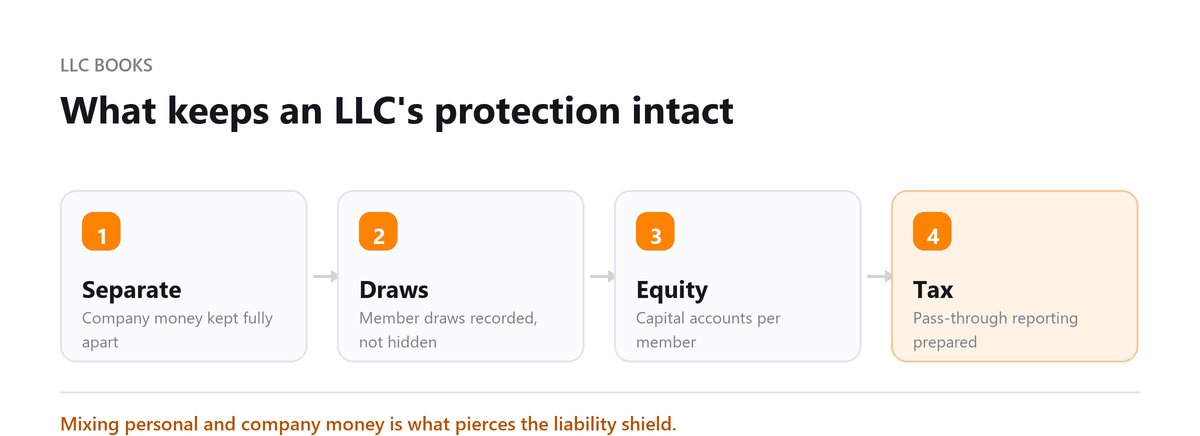
- Compliance and Risk: Maintaining a clear separation between personal and business finances is essential to preserve the liability protection the LLC structure provides. Commingling funds is one of the ways the 'corporate veil' can be pierced.
- Better Decision-Making: Accurate financial data reveals which products, services, or clients are most profitable, and informs pricing, hiring, and investment decisions.
- Tax Advantages: LLCs can claim a wide range of deductions, but only if expenses are properly documented and categorised.
- Cash Flow Management: Understanding when money comes in and when it goes out is essential for planning and avoiding shortfalls.
- Attracting Investors: Clean, organised financial records are a prerequisite for bringing in outside investors or applying for business financing.
Bookkeeping Tips for LLCs
- Choose your accounting method: Cash basis is simpler and common for small LLCs; accrual basis is required above certain revenue thresholds and gives a more accurate picture of profitability.
- Use cloud accounting software: QuickBooks Online, Xero, or similar platforms automate bank feeds and reduce manual work.
- Automate recurring tasks: Set up rules for categorising regular transactions, subscriptions, rent, payroll, to save time and reduce errors.
- Outsource specialist work: Tax preparation, payroll, and complex accounting analysis are best handled by professionals.
- Maintain strict account separation: Business bank account, business credit card, business PayPal, never mix with personal accounts.
- Reconcile monthly: Compare accounting records against bank statements every month without exception.
- Document all expenses: Keep receipts, contracts, and invoices for every business expense.
- Stay current on tax deadlines: LLCs with pass-through taxation require members to make quarterly estimated tax payments, missing these triggers penalties.
LLC Taxes, What You Need to Know
LLC taxation depends on how the entity is structured and how it elects to be taxed:
- Pass-through taxation (default for single-member and multi-member LLCs): Business income and losses flow through to members' personal tax returns. The LLC itself does not pay federal income tax.
- Payroll taxes: If the LLC has employees, it must withhold and remit federal and state payroll taxes. If members take a salary (possible in S-corp elected LLCs), payroll obligations apply to those payments.
- Self-employment taxes: Single-member LLC owners and active members of multi-member LLCs are generally subject to self-employment tax (15.3% on net earnings up to the Social Security wage base) on top of income tax.
- State-specific requirements: Many states impose annual LLC fees, franchise taxes, or gross receipts taxes regardless of profitability. Know your state's specific requirements.
Best Accounting Software for LLCs
| Software | Best For | Starting Price |
|---|---|---|
| QuickBooks Online | Full-featured accounting for growing LLCs, payroll, invoicing, reporting | $38/month |
| Xero | Multi-currency, strong bank reconciliation, good for multi-entity LLCs | $25/month |
| FreshBooks | Invoicing-heavy service businesses, simple time tracking and billing | $23/month |
| Wave | Very small LLCs with basic income/expense needs, free for core features | Free |
| Zoho Books | Cost-effective with strong automation, good for LLCs wanting more features at lower cost | $20/month |
Common LLC Bookkeeping Mistakes
- Mixing personal and business finances: The most common and most damaging mistake, undermines liability protection and creates tax complications.
- Neglecting documentation: Expenses without receipts cannot be defended in an audit and may not be deductible.
- Inaccurate expense categorisation: Miscategorised transactions distort financial reports and miss deductions.
- Procrastinating on tax filings: LLCs with pass-through taxation require members to file personal returns and make quarterly estimated payments, delays create penalties.
- Ignoring industry-specific regulations: Some industries have specific financial reporting, licensing, or tax requirements that apply to LLCs operating in that sector.
- Weak internal controls: Even small LLCs should have basic controls, account access management, receipt approval processes, and regular reconciliation, to prevent errors and misappropriation.
At Profitjets, we work with LLC owners across a wide range of industries, and one theme appears consistently: many entrepreneurs assume that forming an LLC simplifies their accounting responsibilities. In reality, the LLC simplifies the legal structure, but the financial side of the business still requires attention, discipline, and accurate recordkeeping. We frequently help business owners establish bookkeeping systems that provide visibility into performance while reinforcing the separation between personal and business finances.
We have also seen LLC owners struggle with tax preparation, cash flow management, and financial reporting because bookkeeping was treated as an afterthought during the early stages of growth. Once proper systems are implemented, business owners gain a much clearer understanding of their financial position and are better equipped to make decisions about hiring, investment, expansion, and tax planning.
Conclusion
An LLC provides an excellent foundation for building a business, but the financial discipline required to run one successfully is the same regardless of the legal structure. Clean bookkeeping, proper tax management, and organised records protect your liability shield, support growth, and keep the IRS at a comfortable distance.
Profitjets helps LLC owners build the bookkeeping and accounting systems that match the ambition of their business. Get in touch to find out how we can support your LLC's financial management.
Book a free consultation and we will get the capital accounts right.
Frequently Asked Questions
How is an LLC taxed?
By default, a single-member LLC is taxed as a sole proprietorship and a multi-member LLC is taxed as a partnership, income passes through to members' personal returns. LLCs can elect S-corp taxation to reduce self-employment taxes above a certain income level. Consult a CPA to determine the optimal tax structure.
Does an LLC need an accountant?
Not legally, but practically, yes, for most LLCs. Tax preparation, quarterly estimated payments, self-employment tax calculations, and state-specific filing requirements are difficult to manage accurately without professional help. The cost of an accountant is typically recouped in tax savings and avoided penalties.
What records does an LLC need to keep?
LLCs should retain bank statements, invoices, receipts, contracts, payroll records, tax filings, and the operating agreement. Most financial records should be kept for at least seven years. The operating agreement and state registration documents should be kept permanently.
Can LLC members take a salary?
In a standard pass-through LLC, members typically take owner's draws rather than a salary. LLCs that elect S-corp taxation must pay member-employees a reasonable salary before distributing remaining profits, this is a key mechanism for reducing self-employment taxes.
What is the difference between a single-member and multi-member LLC for tax purposes?
A single-member LLC is taxed as a disregarded entity, income is reported on the owner's personal Schedule C. A multi-member LLC is taxed as a partnership by default, the LLC files Form 1065 and issues K-1s to each member. Both can elect S-corp or C-corp taxation.

Written by
Abhinav Gupta, CPA, CA, MBA
Abhinav works with business owners across the US on industry-specific bookkeeping, from dental practices and restaurants to construction and e-commerce. He writes about what each trade's books actually need. Connect on LinkedIn
Free consultation
Want the LLC's Books Clean?
Book a free consultation and we will get the capital accounts right.