
C Corporation Taxes Guide: The 21% Rate, Double Taxation, Estimated Payments, QSBS and Form 1120
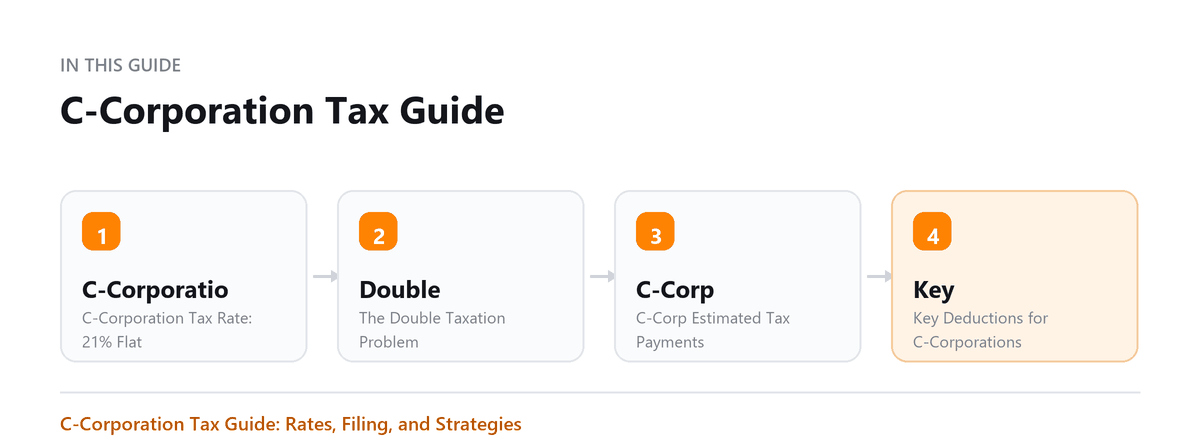
C-Corporation Tax Rate: 21% Flat, The Double Taxation Problem, and C-Corp Estimated Tax Payments
A C-corporation is taxed in its own right, which is simple to state and has consequences owners consistently underestimate.
The company pays on its profits, and then the owners pay again when money reaches them. How and when that second layer applies depends on how the money comes out, which is a decision worth making deliberately rather than discovering at the first distribution.
This covers how the corporate charge works, what the second layer actually means in practice, how estimated payments are handled, the deductions that matter most, and the relief that can apply when shares are eventually sold.
C-Corporation Tax Rate: 21% Flat
The Tax Cuts and Jobs Act (TCJA) of 2017 replaced the graduated corporate tax structure with a flat 21% federal corporate income tax rate. This rate applies to all C-corporation taxable income regardless of size.
Owners focus on the rate and overlook the second layer, which is where the real planning sits: how money actually comes out of the company, and in what form. Decide that deliberately rather than discovering it when the first distribution is made.
Anu Gupta, CA, EA, B.Tech · LinkedInThe Double Taxation Problem
C-corporations face double taxation:
- The corporation pays 21% federal tax on its net income
- When profits are distributed as dividends, shareholders pay tax on those dividends at their individual rate
- Qualified dividends: taxed at 0%, 15%, or 20% depending on the shareholder's income
- Ordinary dividends: taxed as ordinary income (up to 37%)
Pro Tip: Avoiding double tax: pay reasonable salaries to owner-employees (wages are deductible). But watch FICA taxes on wages. Consult a tax advisor before structuring compensation.
C-Corp Estimated Tax Payments
C-corporations must pay estimated taxes quarterly using Form 1120-W. Deposit dates:
| Quarter | Due Date |
|---|---|
| Q1 (Jan-Mar) | April 15 |
| Q2 (Apr-May) | June 15 |
| Q3 (Jun-Aug) | September 15 |
| Q4 (Sep-Dec) | December 15 |
Payments are made via EFTPS (Electronic Federal Tax Payment System). Large corporations (>$1M prior-year tax) must use annualized income installment method. Penalty for underpayment: IRS underpayment rate (currently 7-8% annualized).
Key Deductions for C-Corporations
- All ordinary and necessary business expenses (rent, payroll, supplies, professional fees)
- Depreciation and Section 179 / bonus depreciation on assets
- Research and development expenses (Section 174, amortized over 5 years domestic, 15 years foreign post-2022)
- Dividends Received Deduction (DRD): 50% deduction on dividends from less-than-20%-owned domestic corps; 65% if 20%+ owned; 100% if 80%+ owned
- Net Operating Loss (NOL): limited to 80% of taxable income; indefinite carryforward (no carryback for most)
- Charitable contributions: up to 10% of taxable income
Corporate Alternative Minimum Tax (CAMT)
The Inflation Reduction Act (2022) introduced a 15% CAMT on book income (financial statement income) for corporations with average annual adjusted financial statement income exceeding $1 billion over a 3-year period.
QSBS: Section 1202 Exclusion
Qualified Small Business Stock (QSBS) offers a major benefit for C-corporation investors:
- Excludes up to $10 million (or 10x basis) in capital gain from federal tax
- Stock must be in a domestic C-corporation with gross assets under $50M at time of issuance
- Must hold the stock for more than 5 years
- Not all industries qualify (service businesses in health, law, finance, etc. are excluded)
- Some states (California) do not conform to the QSBS exclusion
Pro Tip: QSBS is one of the most powerful tax benefits for startup founders and early investors. Structure your startup as a C-corp and issue stock early to maximize the exclusion window.
Filing: Form 1120
C-corporations file Form 1120 (U.S. Corporation Income Tax Return):
- Due: April 15 for calendar-year corporations (15th day of 4th month after fiscal year end)
- Extension: Form 7004 grants automatic 6-month extension to October 15
- Must e-file if assets exceed $10 million and filing 250+ returns annually
- Attach Schedule M-1 or M-3 to reconcile book income to taxable income
Book a free consultation and we will take the return off your desk.
Frequently Asked Questions
Is an S-corp better than a C-corp for taxes?
For small businesses: S-corps avoid double taxation. For venture-backed startups or companies retaining earnings: C-corps may be preferred. QSBS only applies to C-corps.
Can a C-corp carry losses backward?
For most C-corps, NOLs generated after 2017 can only carry forward (no carryback). Pre-2018 NOLs had a 2-year carryback / 20-year carryforward.
What states have corporate income taxes?
Most states impose a corporate income tax ranging from 2.5% (North Carolina) to 11.5% (New Jersey). Nevada, South Dakota, Wyoming, and Texas have no corporate income tax on net income.
What records support the positions taken on a corporate return?
The accounts they were derived from, and the schedules that bridge between them. A corporate return is built from the financial statements with adjustments, and it is the adjustments that need supporting: which costs were treated differently for tax, how assets were depreciated, what was accrued and when it was paid. Keeping that reconciliation with the return, rather than reconstructing it later, is what makes a question straightforward to answer.
Does the entity still file in a year with no activity?
Yes. The obligation attaches to the entity's existence rather than to whether it traded, so a company that did nothing all year still files. It is a short exercise and it keeps the filing history unbroken, which matters if the company is ever sold, financed or reinstated. The same generally applies to the state where it is registered, which has its own separate requirement.

Written by
Anu Gupta, CA, EA, B.Tech
Anu works with US businesses on tax and entity questions at Profitjets, from choosing a structure to the filings that follow it. She writes about the decisions owners make once and then live with for years. Connect on LinkedIn
Free consultation
Want the Filing Handled?
Book a free consultation and we will take the return off your desk.