

Georgia taxes personal income, and for most residents the state return is a short exercise built on the federal one.
For a business it is rarely the main event. Registrations for withholding, unemployment insurance, sales tax and the annual entity filing all arrive first, and each is triggered by an activity rather than by making a profit.
This covers how state income tax works here, the deductions and exclusions available, the corporate position, and everything else a business here has to keep on a calendar.
Georgia State Income Tax
Georgia moved to a flat state income tax rate under HB 1437. The rate for 2024 was 5.49% and is scheduled to step down over time toward a target of 4.99%.
Most of what a business here deals with is triggered by activity rather than by profit: hiring, selling, holding an entity. A company with no taxable income can still owe every one of those filings, and the consequences attach to the filing rather than to the amount.
Anu Gupta, CA, EA, B.Tech · LinkedInGeorgia Standard Deductions
Georgia conforms to many (but not all) federal tax provisions. Standard deduction amounts:
- Single: approximately $5,400
- Married Filing Jointly: approximately $7,100
- Georgia does NOT conform to the higher federal standard deduction ($14,600 single / $29,200 MFJ in 2024)
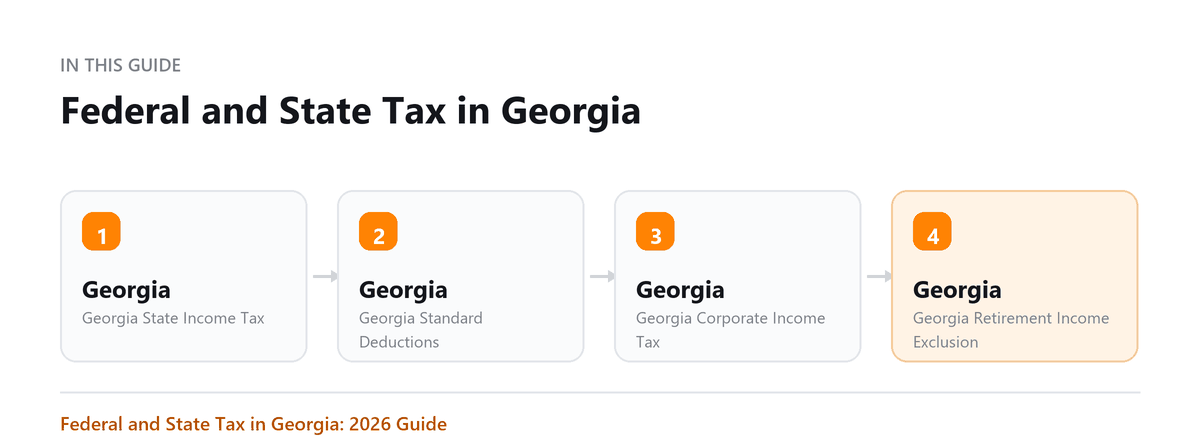
Georgia Corporate Income Tax
Georgia imposes a corporate income tax of 5.75% on net income apportioned to Georgia.
Georgia Retirement Income Exclusion
- One of Georgia's biggest tax benefits: taxpayers 62 and older may exclude up to $35,000 of retirement income from state taxes. Taxpayers 65 and older may exclude up to $65,000.
- Eligible income: Social Security, pension, IRA/401(k) distributions, interest, dividends, and capital gains. This makes Georgia highly attractive for retirees.
Other Georgia Taxes
| Tax | Rate / Details |
|---|---|
| Sales tax | 4% state rate + local rates (total typically 7-9%) |
| Property tax | Varies by county; Homestead Exemption available ($2,000 off assessed value statewide, local exemptions vary) |
| Estate tax | None (Georgia has no state estate tax) |
| Inheritance tax | None |
| Unemployment insurance | Employer-paid; new employer rate 2.7% |
Georgia Non-Conformity with Federal Tax Law
Georgia does not automatically adopt federal tax changes. Key non-conformity areas:
- Georgia may not conform to the full TCJA bonus depreciation provisions
- Georgia's standard deduction remains lower than federal
- Some federal credits may not have Georgia equivalents
- SALT deduction: Georgia has its own structure
What a Business Here Deals With Beyond Income Tax
The state income tax is the part that gets written about, and for most businesses it is not the part that generates the work. Several other registrations and filings arrive first, and each has its own timing.
If you have employees, the business registers to withhold state income tax and separately for unemployment insurance, and those are two different registrations with two different agencies. If you sell anything the state treats as taxable, there is a sales and use tax registration, which brings a filing frequency that depends on volume rather than on choice. If you hold an entity, there is an annual registration to keep it in good standing, independent of whether it traded.
The pattern worth noticing is that these are triggered by activities rather than by profit. A business with no taxable income can still owe every one of these filings, and the penalties attach to the filing rather than to the amount. Because thresholds, frequencies and forms change, take each one from the relevant agency's current guidance rather than from an earlier year.
- List the registrations that apply the moment you hire, sell or form, rather than when a notice arrives
- Diarise the annual entity registration separately from anything tax related, since it is administered separately
- Confirm your assigned filing frequency in writing, because it can change as the business grows
- Keep the registration numbers and login details somewhere other than one person's inbox
Book a free consultation and we will take the return off your desk.
Frequently Asked Questions
Does Georgia tax Social Security benefits?
Georgia does not tax Social Security benefits, and residents 65+ can exclude up to $65,000 of total retirement income from state taxes.
Who needs to file a Georgia state income tax return?
Georgia residents who earn above the filing threshold must file Form 500. Non-residents with Georgia-source income must also file. Part-year residents file Form 500.
How does Georgia's flat tax compare to neighboring states?
Florida: no income tax. South Carolina: graduated up to 6.5%. Tennessee: no income tax. North Carolina: flat 4.5% (2025). Georgia at ~5.39% is mid-range.
What if we moved into or out of the state during the year?
There is a filing route for part-year residents, and it generally splits the year so that income is allocated to the period you were resident. The detail matters more than people expect, particularly for income that does not arrive evenly, such as a bonus, an equity event or the sale of an asset. Take the rules from the state revenue department for the year in question, because the allocation method is specific.
What happens if we earn income in another state as well?
You may have a filing obligation in both, with a mechanism intended to stop the same income being taxed twice, usually a credit for tax paid elsewhere. The order of filing matters because one return feeds the other. This is a common situation for remote workers and for anyone with property in another state, and it is worth confirming the position for both states rather than assuming one cancels the other.

Written by
Anu Gupta, CA, EA, B.Tech
Anu works with US businesses on tax and entity questions at Profitjets, from choosing a structure to the filings that follow it. She writes about the decisions owners make once and then live with for years. Connect on LinkedIn
Free consultation
Want the Filing Handled?
Book a free consultation and we will take the return off your desk.