
Business owners often have the mindset that bookkeeping can be taken care of when the time demands. When the deadlines approach, when closing the fiscal year or when the situation needs accurate books to make important decisions. This is when they analyze their books are far behind, not updated or maintained properly throughout even up to years. Misclassification in expenses, poor reconciliations, discrepancies in financial statements are not updated for the current period.
Catch-up bookkeeping is resolving the business previous financial records and tracking accuracy and consistency throughout. All their backlogs and pending statements are brought to the present date. The main purpose is to create a structural workflow with clean records to enable financial clarity for the business. Catchup bookkeeping extends beyond helping businesses to update their records, it often associates with businesses whose transaction volume has increased and demands
In this guide, we'll explain exactly what catch-up bookkeeping is, when it's needed, how the process works, and why bringing your books up to date is one of the most important financial investments a growing business can make.
Catch-up bookkeeping is not just about fixing the past, it is about creating the foundation for a better future. Once we clean up the backlog, clients can see their financial position clearly for the first time, often in years.
Ankit Sarawagi, CPA, CA, MBA · LinkedInWhy Catch-Up Bookkeeping Matters
- Accurate Decision-Making: Clear financial snapshots enable informed strategic choices about pricing, hiring, and investment
- Tax Preparation: Organised, accurate records make tax filing straightforward and reduce the risk of errors or audit triggers
- Cash Flow Management: Understanding historical patterns helps identify spending inefficiencies and plan for future cash needs
- Peace of Mind: Resolving a financial backlog removes a significant source of business owner stress
Why Businesses Fall Behind on Bookkeeping
- New businesses: Starting without robust financial systems in place
- Rapid growth: Transaction volume outpacing bookkeeping capacity
- DIY bookkeeping errors: Self-managed books accumulating mistakes over time
- Life events or business disruptions: Personal circumstances, staff changes, or operational crises causing financial admin to fall behind
- Simply not prioritising it: Bookkeeping deprioritised in favour of growth activities, until it becomes unavoidable
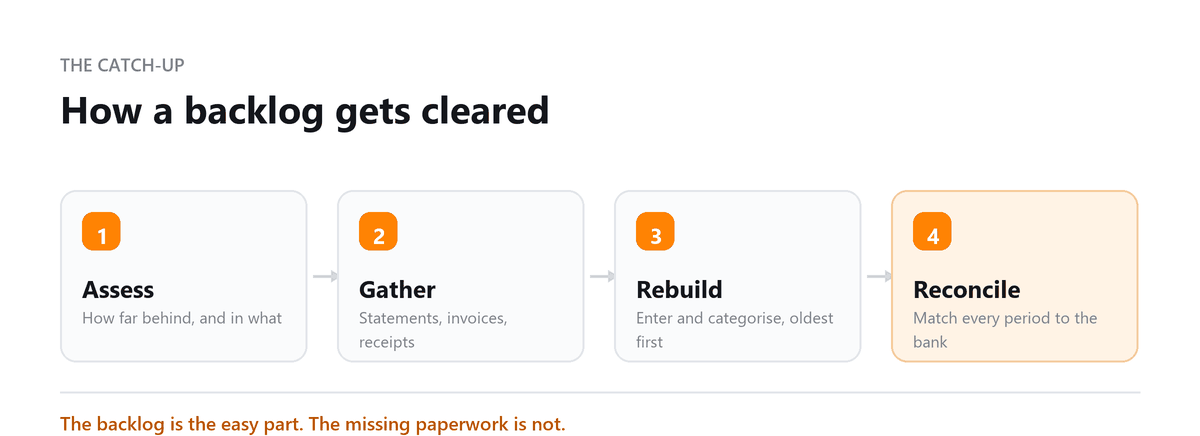
The Catch-Up Bookkeeping Process
Step 1: Data Gathering
Collect all available financial documents, bank statements, credit card statements, invoices, receipts, payroll records, and any existing accounting files. The more complete the documentation, the faster and more accurate the catch-up process.
Step 2: Transaction Classification
Every transaction is categorised correctly: income, expenses, assets, liabilities. This is the most time-consuming step in a significant backlog, but it is foundational, everything else depends on accurate categorisation.
Step 3: Account Reconciliation
Internal records are matched against bank and credit card statements to identify discrepancies, duplicate entries, and missing transactions. All differences are investigated and resolved.
Step 4: Financial Report Generation
Once the records are clean and reconciled, financial reports are produced: income statement, balance sheet, and cash flow statement. For the first time, sometimes in months or years, the business has a complete, accurate view of its financial position.
Step 5: Moving Forward
The final step is establishing systems to prevent the backlog from recurring. This may involve switching to cloud accounting software, setting up automated bank feeds, agreeing a regular reconciliation schedule, or engaging ongoing bookkeeping support.
Challenges in Catch-Up Bookkeeping
- Missing or incomplete records: Receipts lost, bank statements unavailable, or vendor invoices not retained
- Historical errors: Incorrect categorisations or duplicate entries from previous periods that must be identified and corrected
- Volume: A significant backlog is simply time-consuming, professional services complete it faster than self-managed catch-up
At Profitjets, catch-up bookkeeping services are among the most common projects we handle, particularly during the first quarter of the year when business owners begin preparing for tax filings and year-end reporting requirements. We regularly work with companies that have fallen several months behind and, in some cases, several years. While every situation is different, the message we give clients remains consistent: the problem is almost always fixable.
We have seen businesses arrive with missing reconciliations, incomplete records, and financial statements that no longer match reality, yet with a structured catch-up process, those books can be cleaned up, corrected, and brought fully up to date.
Book a free consultation and we will tell you what catching up will take.
Frequently Asked Questions
What is catch-up bookkeeping?
Catch-up bookkeeping is the process of organising and updating a backlog of financial records that have not been maintained regularly. It involves gathering historical documents, categorising transactions, reconciling accounts, and producing accurate financial statements for the periods covered.
How long does catch-up bookkeeping take?
It depends on the volume of transactions and the extent of the backlog. A few months of disorganised records may take a week to resolve with professional support; years of backlog may take longer. Professional catch-up services complete the work far faster than self-managed approaches.
Can I do catch-up bookkeeping myself?
Yes, but it requires time, attention to detail, and solid accounting knowledge. For significant backlogs, professional catch-up bookkeeping is almost always more efficient and more accurate than self-managed attempts, particularly given the risk of compounding errors.
How much does catch-up bookkeeping cost?
Pricing varies by provider, the volume of transactions, and the extent of missing documentation. Many firms charge a project fee based on the scope of the backlog. Always get a clear quote upfront with the scope defined before work begins.
How do I prevent needing catch-up bookkeeping in the future?
Implement cloud-based accounting software with automated bank feeds, establish a regular reconciliation schedule (weekly or monthly), and consider ongoing professional bookkeeping support. Prevention is always cheaper than catch-up.
Conclusion
Catch-up bookkeeping is not a sign of failure, it is a solvable problem that thousands of businesses face every year. The sooner it is addressed, the lower the cost and the smaller the impact on tax filings, financial reporting, and business decisions. If your books are behind, the most important thing you can do is start the process, and professional support makes it faster, more accurate, and far less stressful than tackling it alone.

Written by
Ankit Sarawagi, CPA, CA, MBA
Ankit leads the finance team at Profitjets, where he has worked with 500+ businesses across the US on bookkeeping, tax and CFO-level strategy. He writes about the habits that keep small business books accurate all year. Connect on LinkedIn
Free consultation
Books Behind?
Book a free consultation and we will tell you what catching up will take.