
Running a business entails handling a number of processes which requires payroll management effectively to keep the organization running smoothly and payoffs to workers on time. In addition, efficient payroll management is critical since it can prevent compliance problems with the Internal Revenue Service (IRS).
For example, misclassifying workers, failing to file Form 941 quarterly, and illegally depositing taxes with the state can impact a firm’s finances when discovered by the authorities.
Resolving these issues is essential to avoid the IRS Trust Fund Recovery Penalty and other consequences that would impede the firm’s growth due to loss of funds. As a result, proper payroll management is vital for a firm since it satisfies employees and promotes sustainable growth.
For small businesses, payroll is one of the highest-risk administrative functions: errors attract IRS penalties, underpayment creates employee dissatisfaction, and misclassification creates legal liability.
What is Payroll Management?
Payroll management is the process of calculating employee compensation: salaries, hourly wages, bonuses, commissions and ensuring all deductions (taxes, benefits, garnishments) are applied accurately, with net pay delivered to employees on time and all regulatory filings completed correctly.
Payroll management encompasses every step from the moment an employee earns compensation to the moment the employer has met all legal obligations related to that compensation:
Why Payroll Management Matters for Small Businesses
| Step | Description |
|---|---|
| Time and attendance | Track hours worked, overtime, PTO taken, and absences, the inputs to payroll calculation |
| Gross pay calculation | Apply rate x hours (hourly) or salary/pay periods (salaried); add bonuses, commissions, shift differentials |
| Deductions | Subtract mandatory deductions (federal/state income tax, FICA, Social Security and Medicare) and voluntary deductions (health insurance, 401k, HSA, garnishments) |
| Net pay calculation | Gross pay minus all deductions = net pay (take-home pay) per employee |
| Payment | Distribute net pay via direct deposit, cheque, or pay card |
| Tax deposits | Remit withheld employee taxes plus employer-share payroll taxes to the IRS on the required schedule (semi-weekly or monthly) |
| Payroll filings | File Form 941 (quarterly), Form 940 (annual FUTA), and state equivalents |
| Year-end | Issue W-2s (employees) and 1099-NECs (contractors) by January 31 |
- Legal compliance, failure to withhold or remit payroll taxes on time triggers Trust Fund Recovery Penalty (TFRP), the IRS can hold business owners personally liable for 100% of undeposited taxes
- Employee trust, late or incorrect pay is among the top causes of voluntary employee turnover
- Cash flow planning, payroll is typically the largest single cash outflow; accurate forecasting prevents surprises
- State compliance, each state has its own unemployment insurance (SUTA) rates, wage payment laws, and filing deadlines
- Contractor vs employee, misclassifying an employee as a contractor triggers back taxes, penalties, and benefits liability
The single most common payroll error small businesses make is misclassifying W-2 employees as 1099 independent contractors, which automatically triggers retroactive FICA and FUTA tax liabilities, interest assessments, and potential IRS Trust Fund Recovery Penalties equal to 100% of the unpaid employment taxes.
Ankit Sarawagi, CPA, CA, MBA · LinkedIn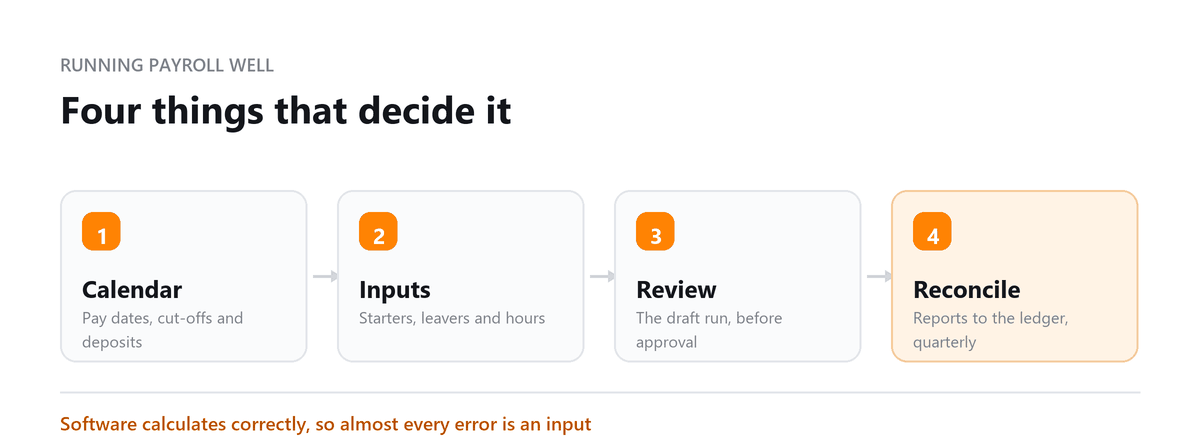
Methods of Payroll Management
Managing payroll management accurately is essential to keeping operations smooth and paying employees on time. Beyond processing routine paychecks, a clean system shields your business from heavy IRS fines and late tax penalties.
Automating withholdings, tracking employee hours, and keeping tax filings current protects cash flow and prevents costly compliance mistakes. Ultimately, organized payroll builds team trust and lays down a solid, audit-ready financial foundation for scaling your business.
| Method | Best For | Risks |
|---|---|---|
| In-house (manual or spreadsheet) | Very small businesses (1 to 3 employees) with simple, consistent payroll | High error risk; time-intensive; no automatic tax table updates |
| Payroll software (Gusto, QBO Payroll, ADP) | Small-to-mid businesses wanting automation with control | Requires setup accuracy; employer still responsible for all filings |
| Outsourced payroll (PEO or payroll service) | Businesses wanting full-service handling; limited HR bandwidth | Higher cost; less direct control; quality depends on provider |
| Bookkeeping firm (Profitjets) | Businesses wanting payroll integrated with bookkeeping and tax | Requires clear communication on employee changes each cycle |
Best Payroll Management Software for 2026
| Software | Best For | Approx. Starting Price |
|---|---|---|
| Gusto | US small businesses; clean UX; strong benefits management | ~$49/month + $6/employee (Simple plan) |
| QuickBooks Payroll | Businesses already using QBO, tightly integrated | ~$50/month + $6/employee (Core plan) |
| ADP RUN | Growing businesses; full HR suite available | Custom quote, contact ADP |
| Paychex Flex | Mid-market; compliance focus; dedicated support | Custom quote, contact Paychex |
| OnPay | Simple, affordable; strong for restaurants and farms | ~$40/month + $6/employee |
Tips to Manage Payroll Efficiently
- Set a payroll calendar at the start of each year, mark all pay dates, tax deposit deadlines, and filing due dates
- Reconcile payroll to the general ledger every pay period, catch discrepancies before they compound
- Separate payroll bank account, fund the payroll account each cycle; never mix with operating funds
- Automate tax deposits, all major payroll platforms handle federal tax deposits automatically
- Update payroll for every employee change immediately, new hire, termination, pay raise, benefits change, garnishment order
- Run payroll register review before approving, one extra check catches most errors before funds are released
- Keep I-9s and W-4s current, audit readiness requires up-to-date employment authorisation forms
By implementing automated payroll tax schedules and ledger reconciliations, Profitjets helps client businesses avoid an average of $6,200 annually in potential IRS and state late-filing penalties.
When a 12-person marketing agency came to Profitjets, they had been running payroll manually through static spreadsheets for two years. A missed state unemployment filing deadline and an miscalculated quarter of Form 941 deposits triggered an unexpected $8,400 IRS late-payroll tax penalty.
We stepped in, audited their ledger, communicated with tax authorities to abate $2,100 in administrative interest, and transitioned their setup to an automated cloud payroll system. Today, their monthly close takes hours instead of days, and their tax deposits run completely error-free.
Over 82% of new small business clients joining Profitjets previously managed payroll manually or with unlinked systems, with worker misclassification (1099 vs. W-2) and delayed state tax registration standing as the most frequent errors identified during initial compliance reviews.
Building the Payroll Calendar
Payroll is the one process in a small business where the deadlines are set by someone else and missing them costs money immediately. A single calendar, built once a year, removes almost every avoidable problem.
- Pay dates for the year, agreed and published to staff in advance
- The cut-off for timesheets and changes before each run, which is what actually determines whether a run is calm
- Deposit dates for withheld taxes, which follow a schedule set by the size of your payroll rather than by preference
- Quarterly return dates, and the annual statements to employees and agencies
- State filing dates for every state you have an employee in, which rarely match the federal ones
Put a named person against each line and a reminder several days ahead. The most common cause of a late deposit is not disagreement about the rule, it is that the person who normally does it was away.
Where Payroll Errors Actually Come From
Payroll software calculates correctly. Almost every error in a small business payroll is an input problem, and the inputs arrive from people rather than from the system.
New starters set up with the wrong pay rate, wrong start date or wrong tax details. Leavers not removed, so a payment goes out after someone has gone. Hours submitted late, or submitted twice. A change agreed verbally and never entered. A benefit or deduction set up with the wrong tax treatment, which then repeats every period until someone notices.
The control that catches most of these is a review of the draft run before it is approved, comparing each person's gross against the previous period and querying anything that moved. It takes minutes and it catches the errors that are expensive to reverse once the money has left.
In-House, Outsourced, or Somewhere Between
The choice is usually framed as cost, and cost is the least useful part of it. What matters is where the risk sits and who has the knowledge.
Running it in-house keeps control and keeps the knowledge in one person's head, which is fine until that person is unavailable. Using a provider brings continuity and specialist knowledge of multi-state rules, and creates a dependency on getting information to them on time.
Either way, the compliance responsibility stays with the employer. A provider that files on your behalf does so from the data you gave it, and an error in that data becomes your filing error. That is the argument for reviewing the output rather than assuming it, whichever model you use.
Book a free consultation and we will run it and reconcile it for you.
FAQs
What is the most important part of payroll management?
Accurate and timely payroll tax deposits are among the most critical parts of payroll management. Late or missed deposits can trigger significant IRS penalties, including the Trust Fund Recovery Penalty, which can make responsible individuals personally liable for certain unpaid payroll taxes. Accurate wage calculations, deductions, filings, and employee records are also essential.
How often should small businesses run payroll?
Small businesses can generally choose weekly, bi-weekly, semi-monthly, or monthly payroll schedules, depending on their workforce and applicable state laws. Bi-weekly payroll is common in the U.S., but some states require employers to pay employees at specific minimum frequencies.
How can small businesses avoid payroll tax penalties?
Businesses can reduce payroll tax risks by calculating payroll accurately, depositing federal and state payroll taxes on time, filing required returns by their deadlines, and keeping employee and payroll records up to date. Using payroll software or professional payroll services can also help automate calculations, reminders, and filings.
What does payroll management include?
Payroll management typically includes calculating employee wages, overtime, deductions, and withholdings; processing payroll; depositing payroll taxes; filing federal and state payroll returns; issuing W-2s and other required forms; and maintaining accurate payroll records.
Should a small business outsource payroll management?
Outsourcing payroll management can be useful when a business lacks the time or expertise to manage payroll taxes, filings, employee payments, and compliance internally. A professional payroll provider can handle routine processing and compliance tasks while giving business owners more time to focus on operations and growth.

Written by
Ankit Sarawagi, CPA, CA, MBA
Ankit leads the finance team at Profitjets, where he has worked with 500+ businesses across the US on bookkeeping, tax and CFO-level strategy. He writes about the habits that keep small business books accurate all year. Connect on LinkedIn
Free consultation
Payroll Taking Too Long?
Book a free consultation and we will run it and reconcile it for you.