
Outsourced Restaurant Accounting: Why Restaurants Are Different, Key Metrics, Tax Issues and How to Choose a Provider
Why Restaurant Accounting Is Different, Key Restaurant Metrics, and Tax Issues Your Accountant Must Know
Restaurant accounting is not general bookkeeping with a different chart of accounts, and a provider who treats it that way produces accurate numbers nobody can use.
Margins here move weekly with ingredient prices and rostering, tips flow through payroll in their own way, and a meaningful share of sales arrives through delivery platforms that settle net.
This covers what makes the sector different, the metrics that actually run a restaurant, the tax issues a provider has to understand, and how to tell whether one genuinely knows the industry.
Restaurant accounting is not general-purpose bookkeeping. The industry has unique cost structures, POS reconciliation complexity, and specific tax treatments that a generalist accountant will miss. Here is what to look for in an outsourced restaurant accounting provider and how to evaluate them.
Why Restaurant Accounting Is Different
Daily POS Reconciliation
Restaurants process hundreds or thousands of transactions daily through point-of-sale systems (Toast, Square, Aloha, Micros). Every bank deposit must reconcile to POS reports by day and by tender type (cash, card, gift card, third-party delivery). Most general bookkeepers cannot do this.
Cash Handling Complexity
Cash restaurants face daily cash count reconciliation, tip pooling records, and over/short tracking. Over/short should be under 0.5% of cash sales. Patterns that deviate indicate a control problem.
Food Cost Tracking
Target food cost is 28-35% of food sales for most full-service restaurants. Your accounting provider needs to track food purchases, inventory counts, and calculated versus actual food cost. High food cost means waste, theft, or over-portioning. Low food cost means under-ordering or inaccurate counts.
Pro Tip: Calculate theoretical food cost from your recipes and compare to actual food cost. A gap greater than 2-3% requires investigation.
Labor Cost Tracking
Labor target is 25-35% of revenue for most restaurants, including both kitchen and front-of-house. Prime cost (food + labor) should be below 60% of sales for a healthy operation. Your accounting provider needs to pull labor cost from your payroll system and reconcile it to your POS sales weekly.
Margins here move weekly with ingredient costs and rostering, so a purely monthly service is compliance rather than management information. A problem found six weeks later has already cost six weeks of margin.
Abhinav Gupta, CPA, CA, MBA · LinkedInKey Restaurant Metrics
| Metric | Formula and Target |
|---|---|
| Food cost % | Food COGS / Food Revenue; target 28-35% |
| Labor cost % | Total labor (including payroll taxes) / Revenue; target 25-35% |
| Prime cost | Food COGS + Total labor / Revenue; target < 60% |
| RevPASH | Revenue / (Available seats x hours open); measures table productivity |
| Table turns | Number of parties served / Available tables per service period |
| Check average | Total revenue / Number of covers served |
| Controllable income | Revenue - Prime cost - Controllable expenses; owner's operating return |
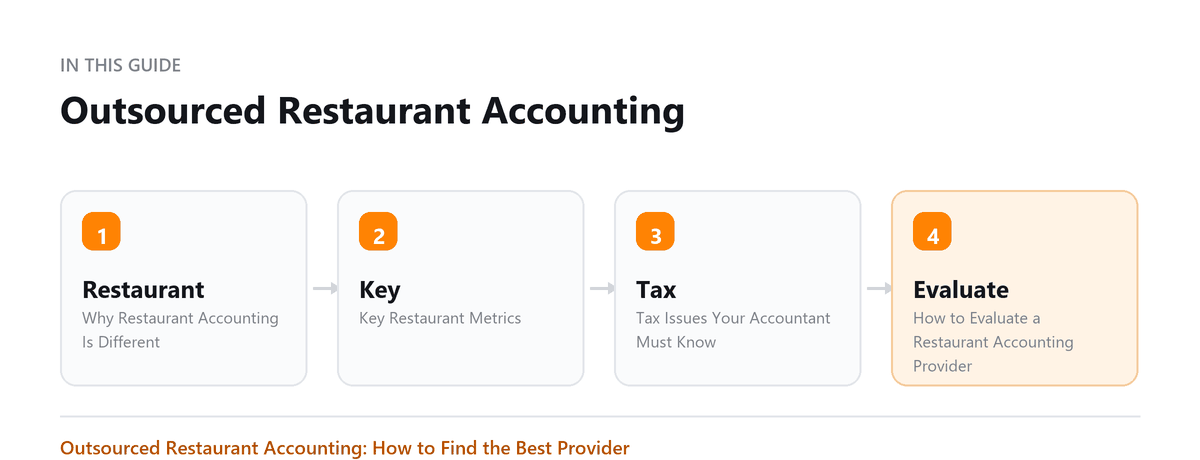
Tax Issues Your Accountant Must Know
Tip Reporting (Form 8027)
Large food and beverage establishments (10+ employees, tipping customary) must file Form 8027 annually to report total receipts and tips. The IRS uses this to check whether tip allocation is adequate.
FICA Tip Credit (Form 8846)
Employers who pay FICA taxes on tips that bring an employee above minimum wage can claim a credit equal to 7.65% of those excess tips. This is a dollar-for-dollar credit against federal income tax and is one of the most valuable and most missed credits in the restaurant industry.
Gift Card Liability
Gift card sales are not revenue at the point of sale. They are a liability (deferred revenue) until the card is redeemed. Breakage (unredeemed cards) is recognized as revenue over time or when redemption is remote, following ASC 606.
How to Evaluate a Restaurant Accounting Provider
- Ask for a list of current restaurant clients (types, sizes, cuisines)
- Ask how they handle daily POS reconciliation: manually or with software integration
- Confirm they know Form 8027 and Form 8846 specifically
- Ask how they track food cost and whether they integrate with your inventory system
- Ask how often you receive reports (weekly labor flash, monthly P&L)
- Ask about their experience with your specific POS system
- Confirm they have worked with your state's sales tax and tip-allocation rules
Book a free consultation and we will put senior eyes on your numbers.
Frequently Asked Questions
How often should my restaurant accountant give me reports?
Weekly labor flash and food cost report, and a monthly full P&L with prime cost breakdown. Annual financial statements for tax purposes. If your provider only gives you monthly reports, you are flying blind on cost control.
Can I use QuickBooks for my restaurant?
QuickBooks works as a back-office ledger, but you need a POS-to-QBO integration (MarketMan, Restaurant365, or manual export) and a bookkeeper who knows the restaurant chart of accounts. Restaurant365 is purpose-built for restaurant accounting and worth evaluating if you have 3+ locations.
What does outsourced restaurant accounting cost?
Single-location restaurants typically pay $500-$1,500/month for bookkeeping and reporting. Multi-location groups with complex inventory and payroll run $2,000-$5,000/month. Specialized restaurant accountants charge more than generalists but save more in tax credits and cost control insights.
What should we expect to provide each week rather than each month?
Sales by day, labour hours and purchases, because in this business a monthly rhythm is too slow to act on. Margins move with the cost of ingredients and with rostering, both of which change weekly, and a problem found six weeks later has already cost six weeks of margin. Any provider quoting a purely monthly service for a restaurant is offering compliance rather than management information.
How do we know whether a provider really understands restaurants?
Ask how they handle the things that are specific to it: tips and how they flow through payroll, comps and voids, stock counts on food and drink, delivery platform settlements, and the split between food and beverage margin. A provider who answers those fluently has done this before. One who treats it as general bookkeeping with a different chart of accounts will produce accurate numbers that tell you nothing you can use.

Written by
Abhinav Gupta, CPA, CA, MBA
Abhinav works with business owners across the US on industry-specific bookkeeping, from dental practices and restaurants to construction and e-commerce. He writes about what each trade's books actually need. Connect on LinkedIn
Free consultation
Want CFO-Level Clarity?
Book a free consultation and we will put senior eyes on your numbers.