
Construction companies are navigating a volatile landscape. Where the majority of them still face challenges in managing their financial operations. Opportunities on projects aren’t less however they struggle to see the clear view of their financial activity. Lack of visibility consumes their decision making process. Construction businesses have underlying requirements to evaluate the customer acquisition costs (CAC) alongside their return on investment (ROI) and the productivity of their projects.
When costing is evaluated wrong, it directly impacts the progress of the live projects. The disruptions aren’t visible until the damage is done. Projects showing profitability status can quickly turn to loss inflicting ones when books are left unresolved. Compared to conventional bookkeeping practices, construction bookkeeping requires expertise to track the expenses and evaluate the decisions aligning strategy.
Job costing is the engine of a profitable construction company. Without it, you are guessing at which contracts are making money. Most construction companies that fail do not fail because they ran out of work they fail because they did not know they were losing money on their projects.
Abhinav Gupta, CPA, CA, MBA · LinkedInWhat is Construction Bookkeeping?
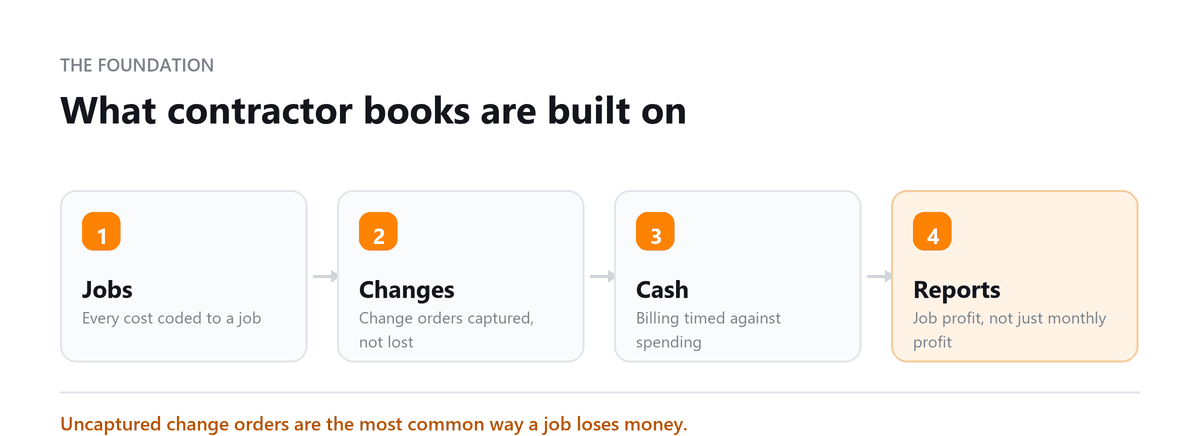
Construction bookkeeping is a specialised form of financial record-keeping that accounts for the unique nature of construction projects. It is built around four core components:
1. Job Costing
Job costing tracks all income and expenses associated with a specific project or contract. It ensures profitability on a per-project basis, identifies budget variances in real time, and provides the data needed to bid future projects accurately.
2. Progress Billing
Progress billing manages invoices tied to project milestones or percentage-of-completion. It ensures cash flows in line with work completed, supports accurate revenue recognition, and reduces the risk of over-billing disputes.
3. Inventory Management
Construction inventory management tracks the movement of materials and equipment across project sites. It minimises waste, prevents theft, ensures materials are costed to the correct project, and supports accurate COGS calculations.
4. Subcontractor Payments
Managing subcontractor payments requires accurate calculation of amounts owed, timely disbursements per contract terms, correct tax handling (1099-NEC for US subcontractors), and retention tracking where applicable.
Construction Bookkeeping vs Regular Bookkeeping
| Feature | Regular Bookkeeping | Construction Bookkeeping |
|---|---|---|
| Focus | Overall company finances | Individual project profitability |
| Cost Tracking | Aggregate expense categories | Detailed per-project cost analysis |
| Revenue Recognition | Based on sales invoices | Based on project milestones (percentage-of-completion) |
| Inventory Management | Not typically needed | Crucial for materials and equipment across multiple sites |
| Subcontractor Payments | Not relevant | Complex tax and payment considerations including 1099 reporting |
Why Construction Bookkeeping Matters
- Boosted profitability: Know which job types, clients, and contract structures deliver the best margins
- Enhanced cash flow: Progress billing and accurate receivables management prevent cash crunches mid-project
- Informed decisions: Bid more accurately, staff appropriately, and invest in the right equipment
- Tax compliance confidence: Accurate records for bonding, surety, and tax filings
- Investor and lender attraction: Clean, construction-specific financials are required for bonding capacity increases and project financing
Basic Principles of Construction Bookkeeping
- Separate business and personal finances, use a dedicated business bank account and credit card for every project-related transaction
- Use construction-specific accounting software (Sage 100 Contractor, QuickBooks with job costing, Procore, Foundation Software)
- Track all expenses to specific projects from the moment they are incurred
- Embrace job costing as the primary management tool, not an afterthought
- Reconcile all accounts monthly, bank, credit card, and retainage accounts
- Seek expert guidance from a CPA familiar with construction accounting
How to Do Construction Bookkeeping: Step by Step
Step 1: Lay the Foundation
Set up your chart of accounts with construction-specific categories: labour, materials, subcontractors, equipment, overhead, and project-specific income accounts. Each job should have its own cost code structure.
Step 2: Track the Flow of Expenses
Record every project-related expense against the correct job and cost code as it occurs, not at month end. This real-time data is what makes job costing useful.
Step 3: Manage Your Workforce and Payroll
Allocate labour costs to specific jobs using time tracking. Handle certified payroll requirements for public projects. Correctly classify employees vs subcontractors.
Step 4: Secure Revenue with Progress Billing
Issue progress invoices at agreed milestones or percentages-of-completion. Track retainage receivable separately. Follow up on overdue invoices promptly.
Step 5: Reconcile Regularly
Reconcile bank accounts, bonding accounts, and retainage accounts monthly. Compare WIP (Work in Progress) schedules to actuals to identify overbilled or underbilled positions.
Step 6: Gain Insights from Reports
Review job cost reports weekly, income statements monthly, and WIP schedules monthly. Use variance reports to identify projects trending over budget before they become losses.
Bonus Tips for Construction Bookkeeping
- Automate recurring tasks: payroll runs, recurring supplier invoices, and bank feed imports
- Use a mobile receipt scanning app so field supervisors can capture expenses on-site immediately
- Back up all financial data, construction records are required for surety bonding and may be requested in legal disputes
- Attend industry events and training to stay current on construction accounting standards and software updates
At Profitjets, we have worked with construction companies that appeared profitable on paper but were actually losing money on several major projects. In many cases, the issue was not a lack of revenue but the absence of proper job costing and project-level financial tracking. Once accurate bookkeeping systems were implemented, business owners gained visibility into project profitability, improved cash flow management, and made better decisions that strengthened their bottom line.
Book a free consultation and we will build the reporting around your jobs.
Frequently Asked Questions
What is job costing in construction bookkeeping?
Job costing is the process of tracking every cost, labour, materials, subcontractors, and equipment, against a specific project. It allows you to compare actual costs to the original estimate in real time, giving early warning of cost overruns before they erode your margin.
What accounting software do construction companies use?
Common choices include Sage 100 Contractor, Foundation Software, Procore (with accounting integration), and QuickBooks Online with a construction-specific job costing setup. The right choice depends on company size, project complexity, and integration requirements.
What is the percentage-of-completion method?
The percentage-of-completion method recognises revenue proportionally as work is completed, rather than waiting until a project is finished. It is the standard approach for long-term construction contracts and is required under GAAP for companies with revenue above certain thresholds.
How do construction companies handle retainage?
Retainage (typically 5 to 10% of each invoice) is withheld by the client until project completion or a specified milestone. Record retainage receivable as a separate asset account. Track retainage payable to subcontractors in a separate liability account.
When should a construction company outsource bookkeeping?
Consider outsourcing when your bookkeeping is falling behind, when job cost reports are not being reviewed regularly, when payroll is error-prone, or when your CPA is spending significant time cleaning up records before tax filing.
Conclusion
Construction bookkeeping is not an administrative function, it is a core business capability. The companies that get it right build more profitable projects, manage cash flow through long contract cycles, and grow with confidence. Building that capability, whether in-house or through a specialist partner, is one of the most valuable investments a construction business owner can make.

Written by
Abhinav Gupta, CPA, CA, MBA
Abhinav works with business owners across the US on industry-specific bookkeeping, from dental practices and restaurants to construction and e-commerce. He writes about what each trade's books actually need. Connect on LinkedIn
Free consultation
Want Job Profit You Can See?
Book a free consultation and we will build the reporting around your jobs.