
Business owners track overdue invoices by gut feeling. Some of your customers are always late, one of your larger clients pays whenever their accounts team gets around to it, and as long as things seem to be flowing sufficiently in terms of cash each week nobody really worries about it.
The issue is that late payment rarely comes as a sudden blow, but rather a slow drip which, before you know it, has bled cash away from a month which had the potential to make a significant profit.
Days sales outstanding (DSO) is a metric that attempts to quantify that feeling in your gut. It measures how many days, on average, it takes to collect payment following a sale made on credit. By comparing it to your payment terms it is possible to see if customers are paying on time, and by tracking it from month to month it is possible to see if collections are improving or deteriorating.
For any business that invoices customers rather than taking payment up front, DSO is one of the most useful metrics there is for tracking cash flow. This guide will cover how to calculate and interpret the figure, and what you can do to lower it if it proves to be too high.
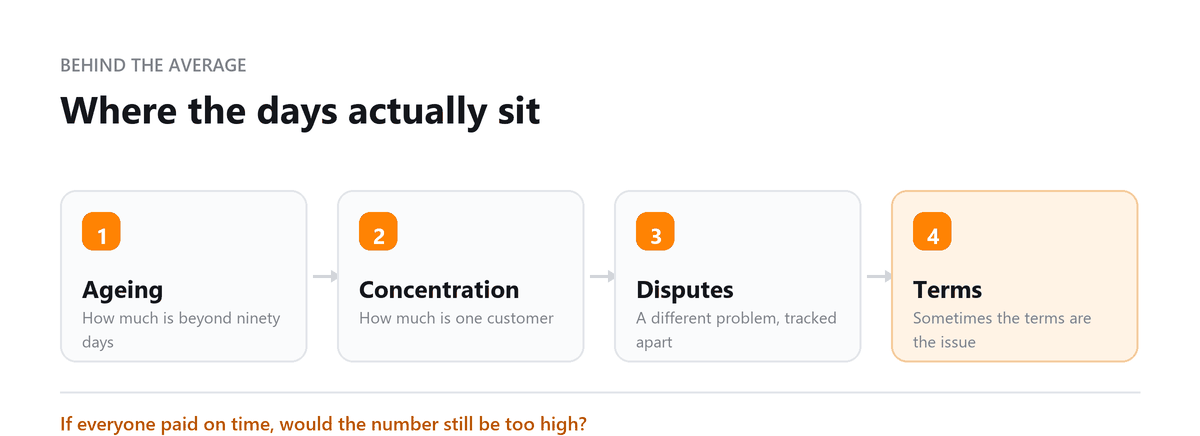
The DSO level that should worry an owner isn't a fixed number. It's the gap between DSO and your own payment terms, and whether that gap is growing. If you bill on Net 30 and DSO moves from 35 to 50 over two quarters, you've effectively given customers an extra two weeks of free credit, funded from your own cash.
The single action that makes the biggest difference is almost always the most basic one: invoice the day the work is delivered and follow up the day an invoice becomes overdue. Most collection problems start with invoices that went out late.
Abhinav Gupta, CPA, CA, MBA · LinkedInDSO Formula
Days Sales Outstanding (DSO) measures how long, on average, it takes your business to collect payment after making a sale. A rising DSO means customers are taking longer to pay, tightening your cash flow even as revenue grows. It is one of the most important receivables metrics for any business that invoices customers.
DSO = (Accounts Receivable / Total Credit Sales) × Number of Days in Period
For a monthly DSO: DSO = (Accounts Receivable / Monthly Credit Sales) × 30
For an annual DSO: DSO = (Accounts Receivable / Annual Credit Sales) × 365
Worked Example
| Input | Value |
|---|---|
| Accounts Receivable (end of month) | $85,000 |
| Credit Sales for the Month | $120,000 |
| Days in Period | 30 |
| DSO | ($85,000 / $120,000) × 30 = 21.25 days |
This business collects payment in roughly 21 days on average. If payment terms are Net 30, a DSO of 21 days is good. If terms are Net 15, it means customers are consistently paying late.
DSO Benchmarks by Industry
| Industry | Typical DSO Range | Notes |
|---|---|---|
| Retail (B2C) | 0 to 5 days | Customers pay at point of sale; near-zero DSO |
| Professional Services (consulting, legal, accounting) | 30 to 60 days | Net 30 to 45 payment terms typical; watch for slow-paying corporate clients |
| Healthcare | 30 to 70 days | Insurance claim processing delays extend DSO significantly |
| Construction | 45 to 90 days | Progress billing and retention create long collection cycles |
| Manufacturing (B2B) | 30 to 60 days | Trade credit terms common; varies by customer size |
| Government contracts | 45 to 90+ days | Government agencies notoriously slow payers |
DSO vs Payment Terms: The Gap
The most useful DSO analysis compares DSO to your stated payment terms:
DSO Gap = DSO − Payment Terms (days)
Example: If your payment terms are Net 30 and your DSO is 47 days, the gap is 17 days, meaning customers are paying on average 17 days late. This gap directly quantifies late payment behaviour.
How to Reduce DSO
- Invoice immediately, many businesses delay invoicing; same-day or next-day invoicing after delivery shortens the collection clock
- Offer early payment discounts, 2/10 Net 30 (2% discount if paid within 10 days) incentivises faster payment
- Automate payment reminders, send reminders at Day 15, Day 25, Day 30, and Day 7 overdue via accounting software
- Require deposits upfront for large projects, 30 to 50% upfront reduces the outstanding balance at risk
- Review credit terms for slow payers, tighten terms or require prepayment from customers with a history of late payment
- Consider invoice financing, if DSO is high due to large B2B clients, invoice financing unlocks cash immediately at a small fee
Our customers were taking much longer to pay than our agreed terms, and our DSO had climbed well above what we were comfortable with. Profitjets introduced a more structured invoicing and collections process, including regular aging reviews and follow-ups on overdue accounts. Over the following months, our DSO came down significantly, and we had much better visibility into which invoices needed attention.
Book a free consultation and we will build the collections routine.
FAQs
What is a good DSO?
A DSO close to your payment terms is a good sign. If you bill on Net 30 and DSO is in the low 30s, customers are generally paying on time. A DSO that's well above your terms, or rising month after month, points to a collections problem worth fixing.
Can DSO be too low?
Rarely a problem for most small businesses. A very low DSO can sometimes mean terms are stricter than competitors offer, which could cost sales in markets where credit terms are expected. For most businesses, though, faster collection is simply better for cash flow.
Why did my DSO jump even though customers are paying on time?
Usually because of timing. A large invoice sent near month-end, a strong sales month, or a seasonal spike can all push DSO up temporarily. Check the AR aging report. If most balances are still current, the increase is timing, not late payment. A rolling three-month DSO will show whether the trend has actually changed.
What's the difference between DSO and AR turnover?
They measure the same thing in different ways. AR turnover is how many times a year you collect your average receivables balance, calculated as credit sales ÷ average receivables. DSO converts that into days. Most small businesses find DSO easier to interpret because it compares directly with payment terms.
How often should I calculate DSO?
Monthly, as part of the month-end close, with a rolling three-month figure alongside it. Review the AR aging report at the same time, so you can see not just whether DSO is changing but which customers are behind it.

Written by
Abhinav Gupta, CPA, CA, MBA
Abhinav works with business owners across the US on industry-specific bookkeeping, from dental practices and restaurants to construction and e-commerce. He writes about what each trade's books actually need. Connect on LinkedIn
Free consultation
Waiting Too Long to Get Paid?
Book a free consultation and we will build the collections routine.