
Published employer of record fees in India range from $199 to $699 per employee per month. A discrepancy of this size can be explained by the fact that agencies often include different services in their pricing.
Statutory costs, onboarding, offboarding, and additional expenses are all extra in some agencies offerings and base prices in others. This partly explains the difference between $199 and $699, although the gap is too big to be fully justified by statutory costs alone.
Our price at Profitjets is $75 per employee per month. Statutory costs are passed on to the client at cost and no additional expenses are included in the price. That is why we prefer transparency by disclosing all additional costs up front.
Here is a list of expenses that an employer of record should include in their pricing, and a breakdown of what you should ask for when considering EOR services in India
The three layers of the bill
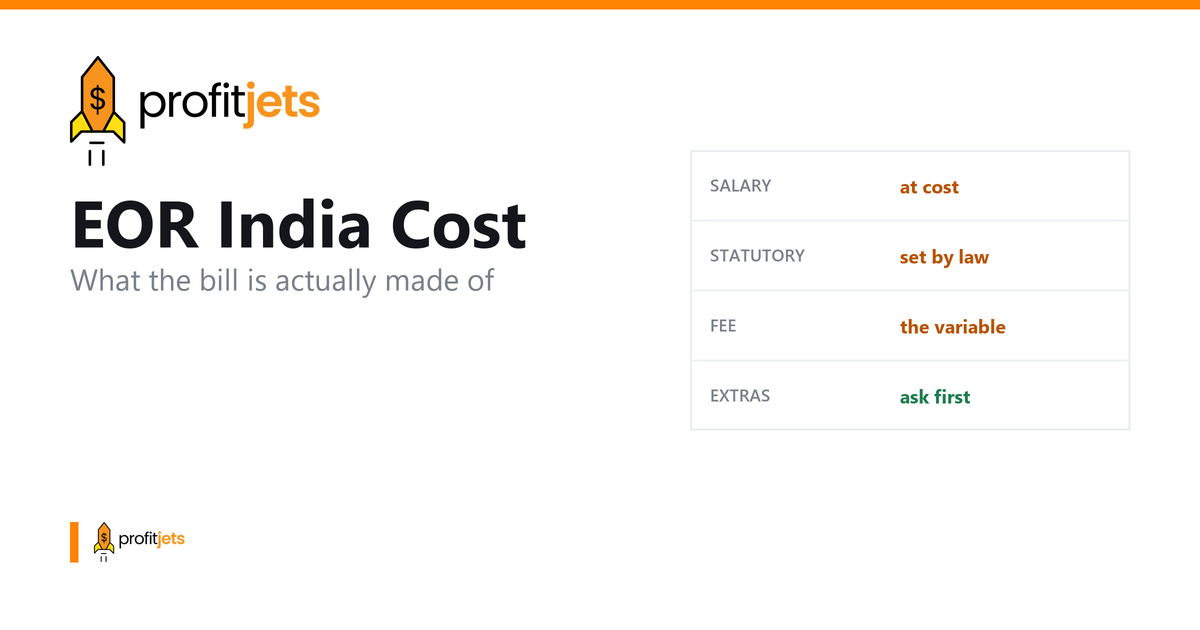
| Layer | What it is | Who sets it |
|---|---|---|
| Salary | What you agreed with the candidate | You |
| Statutory employer contributions | Provident fund, ESI, gratuity, professional tax, statutory bonus | Indian law |
| Provider fee | What the employer of record charges you | The provider |
The first two are the same whoever employs your team. Provident fund does not change because you picked a different platform. The third layer is the only one that is actually negotiable, and it is the only one worth comparing providers on.
That sounds obvious written down. It is routinely missed, because vendor pricing pages compare themselves on the layer that varies and stay quiet about the layer that does not.
Layer two: what Indian law adds on top of salary
These are the components an Indian employer owes. The exact rates and ceilings move, and some depend on the state, so treat the list as the shape of the cost rather than a calculator.
- Provident fund. An employer contribution on basic pay plus dearness allowance, with part of it routed to the pension scheme
- ESI. An employer contribution on gross wages, which applies only below a wage ceiling, so it affects junior roles and not senior ones
- Gratuity. A lump sum that becomes payable on exit after a qualifying period, and which a careful employer provisions for monthly rather than meeting as a shock
- Professional tax. A state level tax, so it varies by where the employee sits
- Statutory bonus. An annual entitlement under the Code on Wages, subject to eligibility limits
As a planning figure, published industry guidance puts the employer side of this at roughly 15 to 20 percent of gross for mid-level roles, and suggests budgeting higher once private medical cover is added. It is proportionally lighter for senior hires, because the largest components are capped or tied to basic pay.
Any provider should give you a full cost-to-company breakdown for the exact package you are considering, showing each statutory component separately. If the answer is a single blended number with no components, that is a reason to ask again rather than a reason to relax.
Layer three: what the providers charge
These are list prices from the providers' own pricing pages, checked in October 2026. Prices move, so re-check before you decide.
| Provider | Published price | Notes |
|---|---|---|
| Remote | $699 per employee per month | A single global price, the same for India as anywhere else |
| Deel | $599 per EOR employee per month | Also a single global price |
| Papaya Global | From $499 per employee per month | Quoted, and a deposit is typically held |
| Payoneer Workforce | From $199 per employee per month | Flat fee, tiered by product |
| Profitjets | $75 per employee per month | Flat, India only |
The detail worth noticing is in the notes column. The large platforms publish one worldwide price. A hire in Bengaluru carries the same fee as a hire in Berlin or Boston, because the number reflects the cost of running a hundred-country platform, not the cost of employing one person in India.
That is the whole reason an India-only provider can charge less. It is not a discount, and it is not a lesser service. It is a narrower problem.
Clients come to us having compared four platforms on the monthly fee and none of them on the statutory layer, which is the bigger number. Then the first invoice arrives and it is nothing like the budget. Compare the full cost to company, not the headline.
Ankit Sarawagi, CPA, CA, MBA · LinkedInThe extras that turn a quote into a bill
The fee is the start of the conversation, not the end of it. These are the charges worth asking about explicitly, because they are where a cheap-looking quote stops being cheap.
- A setup or onboarding fee, charged once per employee or once per account
- An offboarding fee when someone leaves, which is easy to agree to at signing and annoying to meet later
- A percentage of salary layered on top of a flat fee, which turns a predictable cost into one that rises with every raise you give
- A deposit, sometimes a month or two of gross salary per employee, which is a genuine cash flow item even when it is refundable
- Currency conversion. You pay in dollars, your employee is paid in rupees, and the spread on that conversion is a cost whether or not it appears as a line
- Per-payslip or per-document charges for payslips, Form 16 or employment letters
Our employer of record service in India is a flat $75 per employee per month with none of these: no setup fee, no onboarding or exit fee, no percentage of salary and no charge per payslip. Salary and statutory contributions are billed at cost.
How to compare two quotes properly
Fix the package first
Pick one real role at one real salary. Comparing providers on different assumed salaries tells you nothing.
Ask each provider for cost to company, itemised
Salary, each statutory component separately, and the fee. Not a blended monthly total.
Add a year of extras
Setup, offboarding, any percentage, any per-document charge. Annualise them, because that is how you will feel them.
Price the deposit as cash, not cost
It may come back, but it is money you cannot use in the meantime.
Then compare only the fee line
Once the first two layers are shown to be the same, the decision becomes simple and you can see what you are actually paying for.
What the fee should buy you
Price only means something next to what is included. At minimum, a fee should cover the employment contract and offer letter, payroll run on a fixed date, every statutory deduction calculated, deposited and filed on time, Form 16 at year end, onboarding and full and final settlement, and somewhere your employee can get their own payslips without asking anyone.
If any of those sit outside the fee, they are not savings. They are deferred charges.
The short version
Salary and statutory contributions are fixed by Indian law and are identical whichever route you take. The provider fee is the only variable, it ranges from under a hundred dollars to about seven hundred for the same India hire, and the top of that range is mostly paying for global coverage you are not using.
Compare cost to company, ask about every extra in writing, and judge the fee against what it includes rather than against another headline number.
The first thing founders ask us about an employer of record in India is the price. The second is what the fee leaves out. Published fees run from $199 to $699 per employee per month. Some charge extra for onboarding, exit and payslips. Others take a percentage of salary, so the fee rises with every raise.
At Profitjets, EOR fee is $75 per employee per month, flat. It covers onboarding, exit and payslips, takes no cut of salary, and shows salary and statutory costs on their own lines, billed at cost.
So we ask founders to compare what is inside the fee, not just its size: is it flat, what is billed on top, and are salary and statutory costs shown separately?
A provider who answers all three clearly gives the clear roadmap without any overrides.
Frequently Asked Questions
How much does an employer of record cost in India?
Published list prices for the same India hire run from about $75 to around $699 per employee per month, checked in October 2026. On top of the fee you pay the salary and the statutory employer contributions, which are set by Indian law and are the same whichever provider you use.
What are the statutory employer costs in India?
Provident fund, ESI below a wage ceiling, gratuity provisioned for exit, state professional tax and the statutory bonus. Published industry guidance puts the employer side at roughly 15 to 20 percent of gross for mid-level roles, and suggests budgeting higher once private medical cover is included. Rates and ceilings change, so confirm current figures before budgeting from them.
Why do global platforms charge more for an India hire?
Because most of them do not price India separately. Deel and Remote both publish a single worldwide fee, so a hire in Bengaluru costs the same as one in Berlin. The price reflects running a platform across many countries rather than the cost of employing one person in India.
Is a cheaper employer of record riskier?
Not inherently, but price should be judged against what is included and who carries the obligation. The questions that matter are whether the provider's own Indian entity is the legal employer, whether statutory deductions are deposited and filed on time, and what happens at offboarding. A low fee with four extras attached is not cheap.
Do employers of record charge a deposit?
Some do. Papaya is reported to hold around two months of gross salary per employee. A deposit is normal in this market, but it is a cash flow item worth pricing even when refundable, so ask what it is and when it comes back.
What is the cheapest way to hire one person in India?
For a single hire, an employer of record is almost always cheaper than incorporating, because a subsidiary brings an annual audit, ROC filings, FDI reporting and transfer pricing documentation regardless of headcount. The entity route starts to win once the per-employee fees exceed the fixed annual cost of running a company.

Written by
Ankit Sarawagi, CPA, CA, MBA
Ankit leads the finance team at Profitjets, where he has worked with 500+ businesses across the US on bookkeeping, tax and CFO-level strategy. He writes about the habits that keep small business books accurate all year. Connect on LinkedIn
Free consultation
Want the Real Number for Your Hire?
Send us the role and the package you have in mind and we will cost it line by line, salary, statutory contributions and fee, before you make the offer.