
Search for the best employer of record services, or for EOR solutions in India, and you get ranked lists, mostly written by the companies being ranked. They compare on country coverage and interface screenshots, which are the two things that matter least when you are hiring two people in Pune.
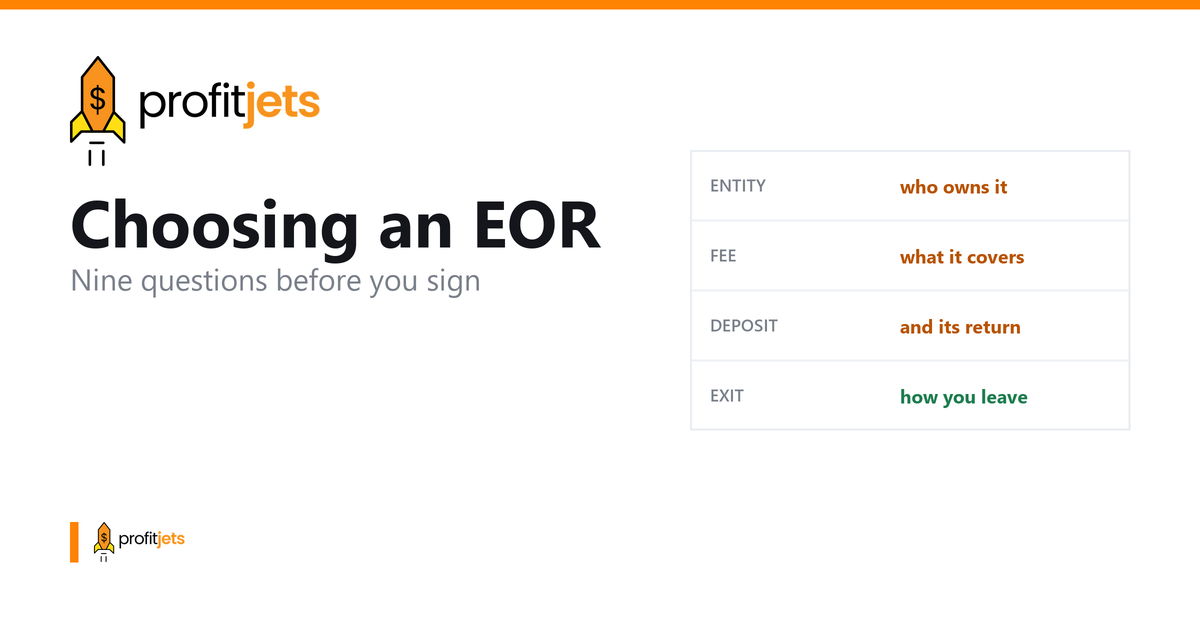
These are the nine questions that actually separate EOR service providers, and what a good answer to each one sounds like.
1. Do you own the Indian entity, or is it a partner
This is the question that matters most and it is asked least.
Many global EOR providers do not have an entity in every country they sell. They work through a local partner, which means the company employing your people is not the company you signed with, and there is a margin and a hand-off between you and the people doing the work.
A good answer names the entity, confirms it is owned by the provider, and does not get vague. A poor answer talks about a network or an in-country partner without naming who employs your staff.
2. What exactly does the fee cover
Ask for the list, in writing. At minimum it should include the employment contract and offer letter, payroll on a fixed date, every statutory deduction calculated, deposited and filed, Form 16, onboarding and full and final settlement.
Then ask what is outside it. Setup fees, offboarding fees, charges per payslip or per document, and any percentage of salary on top of the flat fee. A low headline with four extras is not cheap.
3. Is there a deposit, and when does it come back
Deposits are normal in this market. Papaya is reported to hold around two months of gross salary per employee. That is a real cash flow item even when it is refundable, so ask what it is, what triggers a draw on it, and what the process is for getting it back.
4. What happens when someone leaves
Offboarding is where the difference between providers shows, and it is the thing nobody asks about while they are excited about hiring.
- Who calculates and pays the full and final settlement
- Who handles notice period, leave encashment and gratuity where it is due
- Is there a fee for any of it
- What happens to the employee's documents and payroll records afterwards
5. How do my employees get paid, and on what date
A fixed pay date is a reasonable expectation and a good provider will commit to one. Ask what happens if your funding transfer is late, whether employees are paid regardless, and who carries that gap. The answer tells you how the provider treats your people when something goes wrong.
6. What do employees actually get
Your reputation as an employer is in their hands. A proper Indian offer letter, a payslip every month, provident fund and ESI where applicable, Form 16 at year end, and somewhere to download their own documents without having to ask anyone.
Ask to see a sample payslip and a sample offer letter. A provider that cannot show you those quickly is a provider that has not done it often.
The question I would put first is who owns the entity. If the provider is working through a local partner, you are two steps away from the people who actually run your payroll, and that distance is exactly where things go wrong at offboarding.
Abhinav Gupta, CPA, CA, MBA · LinkedIn7. Who answers when something is wrong
A payroll error, a provident fund query from an employee, a tax notice. Ask who handles it, what timezone they are in, and whether you get a named contact or a ticket queue. For a two person team, the difference between a person and a queue is most of the service.
8. How do we exit, and what happens to my people
Ask about notice period and what transfer looks like if you later incorporate and want to move employees onto your own payroll. A provider confident in its service will talk about this openly, because the alternative is a client who feels trapped.
Continuity of service, benefits and timing all need handling, and it is much easier to agree the shape of it at the start.
9. Why is your price what it is
Price is not a quality signal on its own, in either direction. But the provider should be able to explain the number.
Published list prices for the same India hire range widely. Remote publishes $699 per employee per month and Deel $599, both as a single worldwide price that is the same for India as for Germany. Papaya starts from $499 and Payoneer Workforce from $199. Checked on their own pricing pages in October 2026.
A good answer explains the difference. Global platforms are priced to cover a hundred countries, which is a real cost if you need a hundred countries and a strange one to pay if you need one. India-only providers are cheaper because the problem is narrower, not because the service is thinner.
A short checklist to take into the call
- Name the entity that will employ my people, and confirm you own it
- Send the inclusion list in writing
- Confirm every charge outside the monthly fee
- Tell me the deposit, and the conditions for its return
- Walk me through an offboarding
- Commit to a pay date, and tell me what happens if funding is late
- Show me a sample payslip and offer letter
- Give me a named contact and their working hours
- Explain your price against the alternatives
The short version
Country coverage and dashboards are what EOR providers compete on in marketing. Entity ownership, what the fee includes, offboarding and who picks up the phone are what you will actually live with.
Ask the nine questions, get the answers in writing, and the right provider usually becomes obvious. If you want to put them to us, our EOR services in India are a flat $75 per employee per month, our own Indian entity is the employer, and we will answer all nine before you commit to anything.
The first thing a founder sends us is usually a quote from another provider, with one question: what am I actually paying for?
So we tell founders to compare three things before they compare prices.
1. What the fee includes. 2. Whether it is flat or moves with salary. 3. Whether salary and statutory costs appear separately on the invoice. A provider who answers all three clearly is easier to trust than one with a lower number and vague answers.
Profitjets helps businesses understand their employment responsibilities and manage local hiring, payroll, and compliance through our EOR services in India. This gives companies a clearer picture of their hiring costs and the support they need before choosing an EOR provider.
Frequently Asked Questions
How do employer of record providers in India differ from each other?
Start with who owns the Indian entity that will employ your people, because many global providers work through a local partner rather than their own company. After that: exactly what the fee covers, every charge outside it, any deposit, how offboarding works, and who you speak to when something goes wrong.
Do all EOR providers own their Indian entity?
No. Some operate through local partners in countries where they have no entity of their own, which means the company employing your staff is not the company you contracted with. It is a fair question to ask directly, and a provider that owns its entity will answer it plainly.
What questions should I ask before signing with an EOR?
Who owns the entity, what the fee includes, what sits outside it, whether there is a deposit and how it is returned, how offboarding and full and final settlement are handled, what date employees are paid, what they receive, who handles problems, and how you exit if you later incorporate.
Are the cheapest EOR providers worse?
Not necessarily. Price reflects what the provider is covering as much as the quality of service. A platform spanning a hundred countries has costs an India-only provider does not. Judge the fee against what is included and who carries the employment obligation, not against another headline number.
How do I compare EOR providers fairly?
Fix one real role at one real salary, then ask each provider for a full cost to company breakdown showing salary, each statutory component and the fee separately. Add a year of any extras. Because salary and statutory contributions are the same whoever employs the person, the comparison then comes down to the fee and what it buys.
What is the difference between an EOR provider and an EOR agency?
In practice the words are used interchangeably in marketing. What actually matters is not the label but whether the organisation owns the Indian entity that employs your people, or is introducing you to someone else who does.

Written by
Abhinav Gupta, CPA, CA, MBA
Abhinav works with business owners across the US on industry-specific bookkeeping, from dental practices and restaurants to construction and e-commerce. He writes about what each trade's books actually need. Connect on LinkedIn
Free consultation
Put These Questions to Us
We will answer all nine in writing, including the ones about who owns the entity and what happens when someone leaves.