
You have found someone good in India. You do not have an Indian company, and you would rather not start one just to pay a single person.
Yes, it is possible to hire in India without setting up a company and many foreign businesses choose this route. These companies tend to have one of four options.
The first is to hire people as independent contractors. Although it seems simple, there is a risk that the contractor working on a regular and continuous basis on your behalf could be deemed an employment relationship.
The second is an employer of record who will employ the person in question via its Indian entity and take care of the payroll, tax and statutory liabilities and benefits, while you manage day-to-day working practices. The third is to have a PEO and the final is to have your own entity. Neither come without their costs.
Here’s an insight into four routes and what to consider before making your first hire.
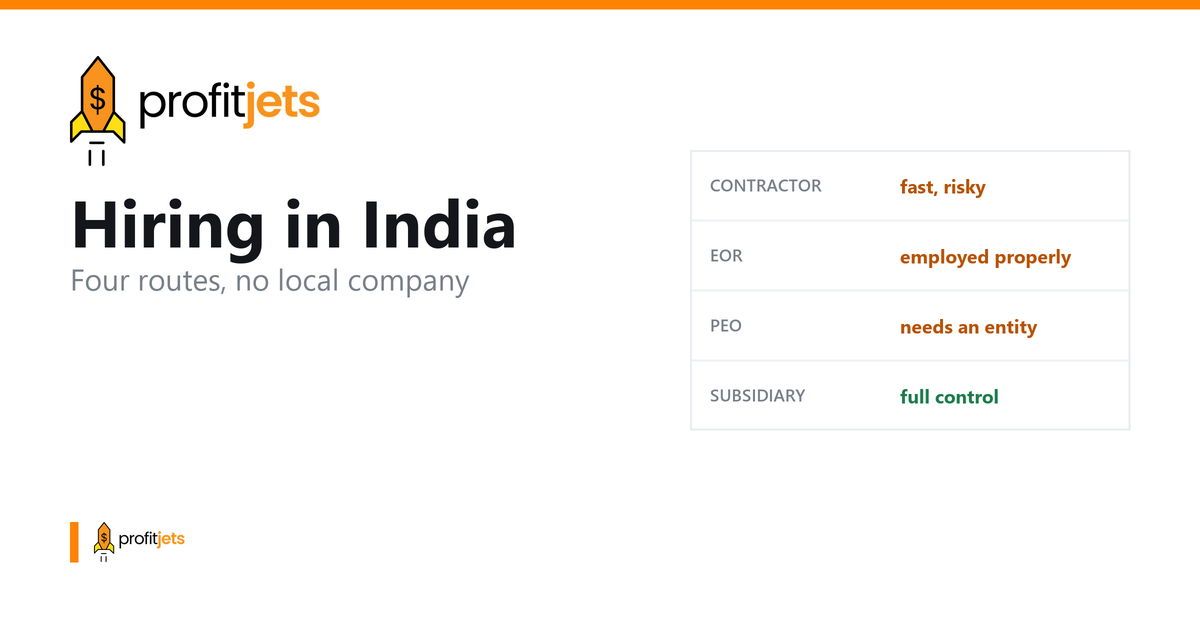
The four routes, at a glance
| Route | Entity needed | Who employs them | Best for |
|---|---|---|---|
| Contractor agreement | No | Nobody, they are self-employed | Genuinely independent, project-based work |
| Employer of record | No | The provider's Indian entity | A small team you want employed properly |
| PEO | Yes, your own | You, with support | Companies that already have an Indian entity |
| Your own subsidiary | You create one | You | Larger teams, or selling into India |
Route one: pay them as a contractor
The quickest thing to do, and the reason it is tempting is obvious. You sign a services agreement, they invoice you monthly, you pay into their account. No Indian entity, no payroll, no filings.
It is a legitimate arrangement when the relationship is genuinely a contracting one. The problem is that most of these arrangements are not, and the gap between the paperwork and the reality is where the risk lives.
Where it goes wrong
- Misclassification. If you set their hours, direct their daily work, give them a laptop, put them in your team structure and expect them at your standups, you have an employee with a contractor's contract. What the document says does not settle it; what the relationship looks like does
- No statutory benefits. A real employee in India is entitled to provident fund and the rest. A contractor arrangement that was really employment can leave those owed retrospectively
- Permanent establishment exposure. Directing people in India with no local structure is one of the fact patterns that can create a taxable presence for your company in India
- It gets harder to unwind the longer it runs. A two-month contractor is a different proposition from one you have directed daily for three years
If you would be uncomfortable if they took on another full-time client tomorrow, they are probably not a contractor. That discomfort is the tell: you are expecting the exclusivity and availability of employment.
Route two: an employer of record, or EOR
A company that already exists in India employs them on your behalf. Its name goes on the employment contract. It runs payroll, deducts and deposits provident fund, ESI, professional tax and TDS, files the returns and issues Form 16. You direct the work.
This is what a remote employer of record arrangement looks like in practice. Your person gets a proper Indian employment contract, statutory benefits, a payslip every month and a Form 16 at year end. You get one invoice and none of the filings.
What it does not do
- It cannot sign contracts with Indian customers for you, raise Indian invoices or collect Indian revenue
- It reduces permanent establishment exposure rather than removing it, because that depends on what your people actually do
- It is a per-employee cost, so at a large enough headcount your own entity becomes cheaper
Our employer of record in India service does this at a flat $75 per employee per month, with salary and statutory contributions billed at cost.
Route three: a PEO, which needs what you do not have
A PEO shares employment responsibilities with you as a co-employer. It is a genuinely useful model, and it is also the one most often confused with an employer of record in search results.
A PEO requires that you already have an Indian entity. It supports an employer; it does not replace one. If you have no Indian company, branch or liaison office, a PEO is not available to you, and any provider offering you one should be asked to explain exactly what they mean.
Route four: incorporate
You set up an Indian company, it employs them, and you own it. Full control, and the right answer for a large team or for selling into India.
It also brings an annual calendar that does not scale down: incorporation, PAN, TAN, GST where applicable, EPFO and ESIC registration, an Indian bank account, FC-GPR within 30 days of allotting shares, the yearly FLA return, a transfer pricing study, Form 3CEB certified by a practising Chartered Accountant, statutory audit, and ROC filings. Two employees carry most of the same calendar as fifty.
The pattern I see most often is a contractor agreement that was fine for three months and has been running for three years. Nobody decided to take the risk, it just never got revisited. The time to fix that is before it becomes a dispute, not after.
Abhinav Gupta, CPA, CA, MBA · LinkedInHow to choose
Decide whether the work is genuinely independent
If you direct their day, set their hours and expect exclusivity, it is employment, and the question is only how to do it properly.
Decide whether India is talent or market
If you will sell into India, you need your own entity. If you only want people, you do not.
Count the two year headcount
A small team points to an employer of record. A large one points to incorporating, because the fixed costs get spread.
Weigh how certain the plan is
An employer of record arrangement ends with notice. A subsidiary is considerably harder to close than it was to open.
If you already have an Indian entity, look at a PEO
That is the situation the model is built for, and it is a reasonable answer there.
If you are already paying contractors in India
You are not in trouble by default, and this is a very common place to be. It is worth a deliberate look rather than a drift.
- How long has it been running, and has the relationship changed since it started?
- Do you direct their hours, tools and daily priorities?
- Do they work for anyone else, in practice rather than in theory?
- Would you describe them to a customer as part of your team?
If those answers point towards employment, converting the arrangement is usually straightforward and far less disruptive than dealing with it once someone else raises it. Moving them onto an employer of record is the normal way to do that without incorporating.
The short version
You can hire in India without a company. The contractor route is the fastest and the one that quietly accumulates the most risk. An employer of record costs more than an invoice and removes most of that risk. A PEO needs an entity you do not have. Incorporating is right when India is a market or a large team, and heavy when it is one or two people.
Foreign founders who come to us for their first India hire assume they need an Indian company before they can pay anyone.
A subsidiary means incorporation, PAN, TAN, GST, EPFO and ESIC registrations, an Indian bank account (usually the slowest step), FDI filings, a transfer pricing study and an annual audit.
For a team of one or two, that is months of setup before the first salary goes out. We at Profitjets help foreign companies manage local employment, payroll, and compliance without paying a global platform fee.
Frequently Asked Questions
Can I hire an employee in India without a company?
Yes. An employer of record employs them through its own Indian entity on your behalf, so they get a proper Indian employment contract and statutory benefits while you direct the work. You can also engage someone as a genuine independent contractor, but that only holds up if the relationship really is independent.
Is it legal to pay someone in India as a contractor?
Yes, where the relationship is genuinely one of independent contracting. The risk is misclassification: if you set their hours, direct their daily work and expect exclusivity, the arrangement looks like employment whatever the contract says, and the statutory entitlements that were never paid can come back.
What is the difference between an EOR and a PEO in India?
An employer of record becomes the legal employer through its own Indian entity, so you need no entity of your own. A PEO shares employment responsibilities with you as a co-employer and requires that you already have an Indian entity. If you have no Indian company, a PEO is not an option.
How quickly can I get someone working in India?
Through an employer of record the entity and registrations already exist, so the timeline is onboarding paperwork rather than setup. If you incorporate, nobody can be paid until incorporation, PAN, TAN, EPFO and ESIC registration and an Indian bank account are all in place, and the bank account usually sets the pace.
Do I need to pay Indian provident fund for a remote employee?
If the person is employed in India, the statutory employer obligations including provident fund apply, and it is the employer of record or your own Indian entity that operates them. The fact that you are abroad does not remove the obligation, it only changes who carries it.
Can I convert my Indian contractors into employees?
Yes, and it is common. Moving them onto an employer of record gives them an Indian employment contract and statutory benefits without you incorporating. It is worth planning the timing, the package and how continuity is treated rather than switching mid-month.

Written by
Abhinav Gupta, CPA, CA, MBA
Abhinav works with business owners across the US on industry-specific bookkeeping, from dental practices and restaurants to construction and e-commerce. He writes about what each trade's books actually need. Connect on LinkedIn
Free consultation
Have Someone in India You Want to Hire?
Tell us the role and where they sit, and we will tell you the cleanest way to employ them and what it costs.