
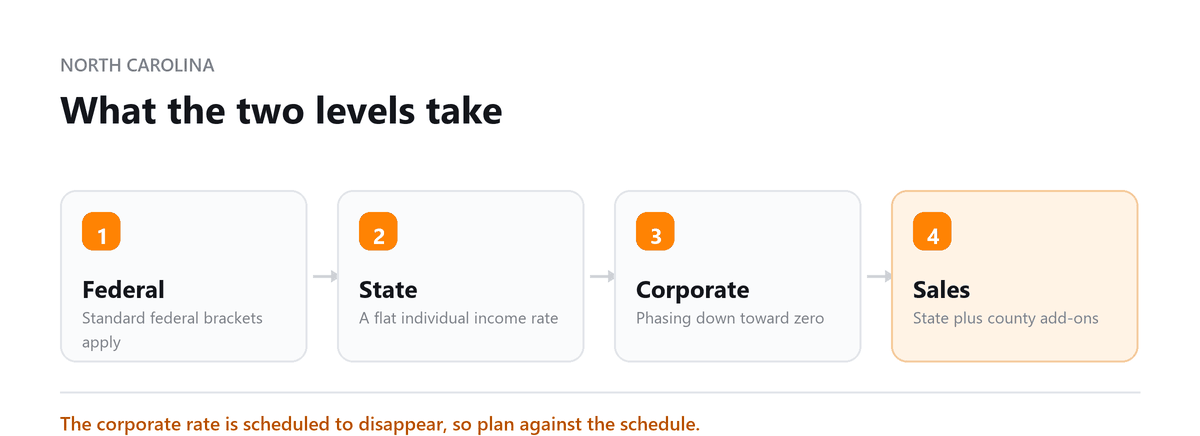
The challenge arises as we attempt to navigate through the complexities of meeting our federal tax obligations in North Carolina particularly with respect to the progressive nature of IRS regulations in contrast to our state’s continued drift toward a flat income tax scheme.
Yet despite all of these years of tax cuts which have benefited the citizens of NC, our good people still toe the line every year, diligently filling their federal forms according to standard Form 1040 schedules.
But if you want to keep up with upcoming schedule changes such as federal tax in north carolina including such things as standard deduction thresholds and strategies surrounding pass through entities and then you need to be sure that your business owner/individual filer is getting everything he/she earned. Coordination of deductions on both the state and federal levels ensures the highest level of tax efficiency available.
With North Carolina's flat personal income tax rate dropping from 4.25% in 2025 to 3.99% in 2026, small business owners who optimize their entity selection can compound these state-level savings directly with federal Pass-Through Entity Tax (PTET) deductions.
Anu Gupta, CA, EA, B.Tech · LinkedInThis guide covers both federal and state obligations for NC residents and businesses.
Federal Income Tax in North Carolina
North Carolina residents pay federal income tax using the same progressive brackets as all US taxpayers, plus North Carolina's flat 4.25% state income taxFederal tax applies identically to North Carolina residents as to all US taxpayers. NC residents file Form 1040 with the IRS and are subject to the same federal progressive brackets.
Federal Income Tax Rates in North Carolina (2025 Tax Year)
| Rate | Taxable Income, Single Filer (TY2025) |
|---|---|
| 10% | $0 to $11,925 |
| 12% | $11,925 to $48,475 |
| 22% | $48,475 to $103,350 |
| 24% | $103,350 to $197,300 |
| 32% | $197,300 to $250,525 |
| 35% | $250,525 to $626,350 |
| 37% | Over $626,350 |
Federal Tax Filing Requirements in North Carolina (2025 Tax Year)
Most individuals must file a federal return if income exceeds the standard deduction for their filing status. For Tax Year 2025:
| Filing Status | TY2025 Filing Threshold |
|---|---|
| Single (under 65) | $15,000 |
| Married Filing Jointly (both under 65) | $30,000 |
| Head of Household (under 65) | $22,500 |
| Single (65 or older) | $16,550 |
North Carolina State Income Tax
NC has a flat state income tax rate. The rate has been declining under legislation passed in 2021:
| Tax Year | NC Individual Income Tax Rate |
|---|---|
| 2023 | 4.75% |
| 2024 | 4.5% |
| 2025 | 4.25% |
| 2026 | 3.99% |
| 2030 (target) | 3.99% or lower (pending revenue triggers) |
Estimated Tax Payments in North Carolina
NC residents who expect to owe more than $1,000 in federal tax after withholding must make quarterly estimated tax payments:
· Q1 (Jan, Mar): due April 15
· Q2 (Apr, May): due June 15
· Q3 (Jun, Aug): due September 15
· Q4 (Sep, Dec): due January 15 of the following year
North Carolina has its own estimated tax payment requirement for state taxes, due on the same quarterly schedule, paid to the NC Department of Revenue.
Common Federal Tax Deductions for North Carolina Residents
· Standard deduction: $15,000 single / $30,000 MFJ for TY2025
· Mortgage interest and property taxes (Schedule A, SALT deduction capped at $40,000 for 2025)
· Retirement contributions: Solo 401(k), SEP-IRA, traditional IRA
· Self-employment tax deduction (50% of SE tax from AGI)
· Health insurance premiums (100% deductible for self-employed)
Federal Tax Filing Deadline in North Carolina
April 15, 2026 for Tax Year 2025. File Form 4868 for a 6-month extension to October 15, 2026. NC state return (D-400) is also due April 15.
· IRS mailing for NC residents: Department of the Treasury, IRS, Kansas City, MO 64999-0002 (no payment)
Across 2025 to 2026, Profitjets worked with over 180 North Carolina business clients, reducing their average combined federal and state effective tax rate from 26.8% down to 20.4% through proactive entity restructuring and multi-year tax planning.
Conclusion
North Carolina residents pay federal income tax at the standard progressive rates plus a declining state flat rate (4.25% in 2025). As NC's rate continues falling toward 3.99%, the combined burden is becoming more competitive among southeastern states.
As a growing healthcare consulting business owner in Raleigh, I was constantly caught off guard by end-of-year federal tax bills on top of my state filings. Partnering with Profitjets allowed us to capitalize on North Carolina's PTE tax election while restructuring our payroll and retirement distribution strategies. In our first full year, Profitjets helped us slash our overall tax bill by $28,200, permanently lowering our combined effective tax rate by 6.4%.
Registering Before You Trade
A flat rate makes the calculation simple and shifts the difficulty to registration, which is where new North Carolina businesses most often fall behind.
- Entity formation or foreign registration with the Secretary of State
- Account with the Department of Revenue for withholding and, where relevant, sales and use tax
- Unemployment insurance account with the state's employment agency once there are employees
- New hire reporting, which is separate from the unemployment registration
- Local privilege licences or permits where the city or county requires them
Each registration has its own timing rule, and obligations generally run from when the activity began rather than from the registration date. Registering late usually means filing the periods you missed as well as the current one.
Withholding and Sales Tax in Practice
The two ongoing obligations for most North Carolina businesses are withholding on wages and sales tax on taxable sales, and both run on their own calendars independent of the annual income tax return.
Withholding is deposited on a schedule set by the size of the payroll, with periodic returns and an annual reconciliation that has to agree to the statements issued to employees. The reconciliation is worth doing quarterly rather than annually, because a difference found in January covers twelve months of transactions.
Sales tax brings the question of what is actually taxable, which is rarely obvious for a service business or for anything sold as a bundle of goods and services. North Carolina also applies local rates on top of the state rate, so the correct rate depends on the transaction's location. The Department of Revenue publishes both the taxability guidance and the current rates, and those are the sources to rely on.
Where North Carolina Departs From the Federal Return
The state return begins from the federal figure and then adjusts, and the adjustments are where the return is either right or wrong.
- Some items deductible federally are added back for state purposes
- Some income taxable federally is deducted, with certain retirement and military-related income being the usual examples
- The state standard deduction and any itemised deductions follow their own rules and limits rather than the federal ones
- State-level credits exist that have no federal equivalent, and federal credits generally do not carry across
For a business, the corporate rate and the apportionment rules for income earned partly outside the state are separate questions again, and apportionment is the one that catches businesses selling across state lines. North Carolina has changed both its rates and its treatment of several items in recent legislative sessions, so work from the Department of Revenue's current instructions for the year you are filing.
Book a free consultation and we will plan around the rate changes.
FAQs
What is the North Carolina income tax rate in 2026?
North Carolina has a flat individual income tax rate of 3.99% for tax year 2026, down from 4.25% in 2025. The state has scheduled additional rate reductions that may apply in future tax years if statutory conditions are met. (NCDOR)
Does North Carolina have a flat or progressive income tax?
North Carolina uses a flat individual income tax rate, meaning the same state rate generally applies to taxable income rather than using multiple income-based brackets. For 2026, the rate is 3.99%. (NCDOR)
Do I have to pay both federal and North Carolina income tax?
Generally, yes, if you meet the applicable federal and North Carolina filing requirements. Federal income tax is administered by the IRS, while North Carolina income tax is administered by the North Carolina Department of Revenue. Your federal and state tax liabilities are calculated separately under their respective tax rules.
What is the North Carolina standard deduction for 2026?
The North Carolina standard deduction depends on filing status. For 2026, taxpayers should use the current North Carolina Department of Revenue guidance when determining the applicable deduction and filing requirement. The state standard deduction is separate from the federal standard deduction. (NCDOR)
What are the federal income tax rates for 2026?
Federal income tax rates for 2026 range from 10% to 37%, with the applicable rate depending on taxable income and filing status. These federal rates apply separately from North Carolina's 3.99% state income tax rate. (IRS)
Written by
Anu Gupta, CA, EA, B.Tech
Anu works with US businesses on tax and entity questions at Profitjets, from choosing a structure to the filings that follow it. She writes about the decisions owners make once and then live with for years. Connect on LinkedIn
Free consultation
Based in North Carolina?
Book a free consultation and we will plan around the rate changes.