
Understanding the basics of federal unemployment benefits and their impact on the state unemployment insurance program is essential to remaining compliant with payroll taxes and controlling labor costs. Set by the Federal Unemployment Tax Act (FUTA) and the state unemployment tax, unemployment insurance is designed to provide temporary income support to employees who have been laid off.
During our regular payroll tax workshops, we often discuss the importance of controlling costs and preventing spikes in your SUTA tax rate, which happens in almost a quarter of all cases we review. Maintaining good separation practices and ensuring timely responses to notices from your state’s employment security office will help you avoid unnecessary increases in taxable wages.
The eligibility detail that most surprises departing workers is that voluntarily resigning without good cause automatically disqualifies them from receiving benefits and for employers, failing to submit documented written warnings during a for-cause separation is the single biggest reason state agencies side with the claimant.
Ankit Sarawagi, CPA, CA, MBA · LinkedInIt is a state-federal partnership: FUTA (federal payroll tax) and SUTA (state payroll tax) fund the system; states administer benefits and set eligibility rules and benefit amounts within federal guidelines.
This guide covers how benefits are calculated, the state-by-state differences, and the tax implications of receiving unemployment.
How Are Unemployment Benefits Calculated?
Most states calculate the weekly benefit amount (WBA) as a fraction of the claimant's base period earnings typically the highest quarter's wages or average wages over the base period (usually the first 4 of the last 5 completed calendar quarters):
| Calculation Method | States Using It | Example |
|---|---|---|
| 1/26 of highest quarter wages | Most common approach | $13,000 highest quarter / 26 = $500 WBA |
| Fraction of average weekly wage | Multiple states | Average quarterly wages / weeks x replacement rate (e.g. 50%) |
| State-specific formula | Some states use unique approaches | See each state's UI agency for exact formula |
Average Weekly Benefit Amounts by State (2025)
| State | Max Weekly Benefit (2025 ) | Typical Duration |
|---|---|---|
| Massachusetts | ~$1,033/week | Up to 30 weeks |
| Washington | ~$1,079/week | Up to 26 weeks |
| New York | $504/week | Up to 26 weeks |
| California | $450/week (has been the cap since 2005, very low for a high-cost state) | Up to 26 weeks |
| Texas | $648/week | Up to 26 weeks |
| Florida | $275/week | Up to 12 weeks (one of the shortest durations and lowest benefits in the US) |
| North Carolina | $350/week | Up to 12 weeks |
| Alabama | $275/week | Up to 14 weeks |
| Mississippi | $235/week | Up to 26 weeks |
Standard benefit duration: most states provide up to 26 weeks. Some states (FL, NC) have shortened maximum durations. Extended benefits may be available during periods of high unemployment. The state agency is the authoritative source for current figures, all amounts above must be verified before publishing.
CARES Act Unemployment Supplements
During the COVID-19 pandemic, Congress enacted several temporary unemployment programmes: the $600/week FPUC supplement (expired July 2020), the $300/week LWA supplement (September 2020), PUA (for gig workers and self-employed, expired September 2021), and PEUC (extended benefits, expired September 2021). All of these programmes have ended. Current unemployment benefits are provided through standard state UI programmes only.
Federal Tax on Unemployment Benefits
Unemployment benefits are taxable at the federal level, they are reported on Form 1099-G and included as ordinary income on the recipient's federal tax return. Recipients can elect voluntary withholding of 10% using IRS Form W-4V.
State tax treatment varies: some states exempt unemployment benefits from state income tax; others tax it at the regular state income tax rate. Verify your state's treatment.
Eligibility for Unemployment Insurance Benefits
| Eligibility Requirement | General Rule |
|---|---|
| Job loss reason | Must be through no fault of the employee, laid off, company downsizing, contract ended. Voluntary resignation and termination for cause typically disqualify. |
| Work history | Must have earned sufficient wages during the base period (usually the first 4 of last 5 completed quarters), specific dollar threshold varies by state |
| Availability and ability to work | Must be actively seeking work, available for full-time work, and able to work. Must document job search activities. |
| Waiting week | Most states require a one-week waiting period after filing before benefits begin (unpaid) |
| Residency | Claim must be filed in the state where you worked (not necessarily where you live)] |
Profitjets client audits show that establishing formal claims response workflows helps employers successfully contest up to 85% of ineligible unemployment filings, preserving lower SUTA tax brackets.
During a year-end payroll audit for a growing tech client at Profitjets, we noticed their state unemployment tax rate jumped by over 1.8%, adding nearly $12,000 in unexpected annual payroll expenses. The increase was triggered by a single former employee's successful unemployment claim that went completely uncontested due to missed state response deadlines. We stepped in to establish a standardized termination documentation protocol and automated claim-tracking workflow, protecting the client's SUTA experience rating and preventing future rate spikes on subsequent separations.
FAQs
What the Employer Sees When Someone Claims
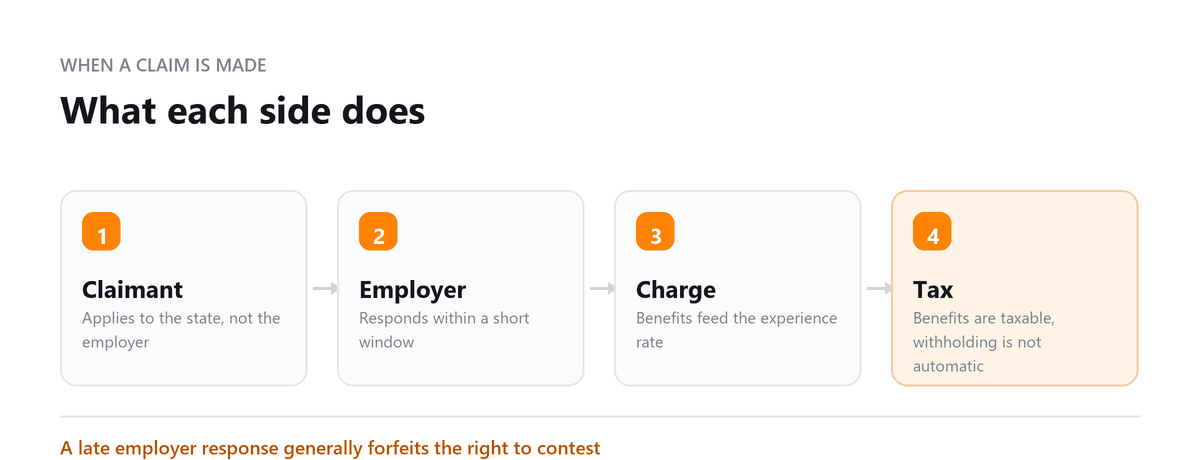
A claim is made by the former employee to the state, and the employer receives a notice asking for information about the separation. How that notice is handled has consequences for the employer's own costs.
- Respond within the window given, since a late response generally forfeits the right to contest
- Answer the actual question: the reason for separation, and the date
- Attach the documentation that exists, rather than describing it
- Keep a record of what was sent and when
Benefits paid on a claim are generally charged to the employer's account and feed into the experience rate applied to future contributions. That makes responding properly a financial matter rather than an administrative one, and it is why documenting the reason for any separation at the time it happens is worth the few minutes it takes.
The Tax on Benefits Catches People Out
Unemployment benefits are generally taxable income, and withholding from them is not automatic. Someone who takes benefits for several months and elects no withholding can face a balance at filing at exactly the point they can least afford it.
Withholding can usually be requested when the claim is made or changed afterwards, and for most people that is the simpler route than setting money aside independently.
State treatment differs from federal treatment in some states, so the position on a state return may not match. Anyone who received benefits during a year should expect a statement of the amounts paid and should check it against their own records, since errors on these statements do occur and are corrected through the state agency.
Returning to Work Part Time
Most state programmes allow some earnings while claiming, with the benefit reduced rather than stopped, and the rules for how much can be earned before the benefit is affected differ considerably between states.
The practical obligation is to report earnings for the week they were earned rather than the week they were paid, which is where honest mistakes happen. Failing to report earnings correctly can result in an overpayment that has to be repaid, and in some cases penalties on top.
For an employer taking someone back on reduced hours, or offering temporary work to a former employee, it is worth being clear that the arrangement may affect their claim. Current earning allowances and reporting requirements are published by each state's unemployment agency.
Book a free consultation and we will review how they are handled.
FAQs
How long do unemployment benefits last?
Unemployment benefit duration varies by state. Many states provide benefits for up to 26 weeks, while some states offer fewer weeks based on their eligibility rules and unemployment rates. Extended Benefits may provide additional weeks when a state meets federally established unemployment thresholds. Pandemic-era federal unemployment programs have expired.
Are unemployment benefits taxable?
Yes. Unemployment benefits are generally taxable as federal income and are reported to recipients on Form 1099-G. Claimants can generally request voluntary federal income tax withholding from their benefits to reduce the possibility of owing taxes when they file their return. State tax treatment varies.
How are unemployment benefits calculated?
Each state determines its own unemployment benefit formula, typically using a claimant's wages during a specified base period. The weekly benefit is subject to state minimums and maximums, so two people with similar earnings may receive different benefits depending on where they live.
Can you receive unemployment benefits if you work part-time?
In many states, yes. You may be eligible for partial unemployment benefits if your earnings and hours remain below the state's limits. Any wages earned while receiving benefits generally must be reported, and the state may reduce your weekly benefit accordingly.
Can unemployment benefits be extended after regular benefits run out?
In certain circumstances, additional benefits may become available through Extended Benefits (EB) programs when a state experiences sufficiently high unemployment. Eligibility and the number of additional weeks depend on federal and state requirements and whether the program is activated in that state.

Written by
Ankit Sarawagi, CPA, CA, MBA
Ankit leads the finance team at Profitjets, where he has worked with 500+ businesses across the US on bookkeeping, tax and CFO-level strategy. He writes about the habits that keep small business books accurate all year. Connect on LinkedIn
Free consultation
Claims Pushing Your Rate Up?
Book a free consultation and we will review how they are handled.