
Understanding how your state calculates unemployment benefits is critical in determining your payroll taxes and your state unemployment (SUTA) experience rating. Weekly benefit caps and formulas vary widely by state and can be as high as $275 in Florida to over $1,100 in Massachusetts, which could greatly impact your labor costs.
During payroll audits, we often see clients with unexpectedly high SUTA rates due to uncontrolled and uncalled unemployment claims. Maintaining proper separation of duties and calling claims in a timely manner when notified by the state can help prevent unnecessary increases in a company’s SUTA experience rating.
The costlier mistake employers make with state unemployment is failing to maintain documented, written warnings for cause separations without that paper trail, state workforce agencies almost automatically award benefits and hike your company's SUTA experience rating.
Ankit Sarawagi, CPA, CA, MBA · LinkedInUnemployment benefit amounts vary significantly by state with the maximum weekly benefit in Massachusetts is over four times that of Mississippi, and benefit durations range from 12 weeks (Florida) to 28 weeks (Montana).
This guide explains how states calculate weekly benefit amounts, the state-by-state differences, and what employers and employees need to know about the system.
How Weekly Benefit Amounts (WBA) Are Calculated
Most states calculate WBA using one of these methods:
| Method | Formula | Example |
|---|---|---|
| Fraction of highest quarter | Divide the highest-earning quarter's wages by a fraction (typically 1/21 to 1/26) | $13,000 highest quarter / 26 = $500/week |
| Average weekly wage x replacement rate | Calculate average weekly wages from base period; apply a replacement rate (typically 50%) | $800 average weekly wage x 50% = $400/week |
| Percentage of annual wages | Divide annual base period wages by a factor | $40,000 / 104 (2 years of weeks) = $385/week (example) |
State Unemployment Benefit Figures (2025, Must Be Verified Annually)
| State | Max Weekly Benefit (2025 approx.) | Max Duration | Calculation Method |
|---|---|---|---|
| Massachusetts | ~$1,033/week | Up to 30 weeks | High-quarter fraction |
| Washington | ~$1,079/week | Up to 26 weeks | High-quarter fraction |
| Colorado | ~$781/week | Up to 26 weeks | High-quarter fraction |
| New York | $504/week | Up to 26 weeks | Fraction of average weekly wage |
| District of Columbia | ~$444/week | Up to 26 weeks | Fraction of average weekly wage |
| North Carolina | ~$350/week | Up to 12 weeks | High-quarter fraction |
| Georgia | ~$365/week | Up to 26 weeks | High-quarter fraction |
| California | $450/week | Up to 26 weeks | High-quarter fraction (cap unchanged since 2005) |
| Texas | ~$648/week | Up to 26 weeks | High-quarter fraction, verify at twc.texas.gov |
| Alabama | ~$275/week | Up to 14 weeks | High-quarter fraction |
| Mississippi | ~$235/week | Up to 26 weeks | High-quarter fraction (one of the lowest max benefits nationally) |
| Florida | $275/week | Up to 12 weeks | High-quarter fraction (shorter duration; benefit unchanged for many years) |
| Montana | Varies | Up to 28 weeks | One of the longest standard durations |
Employer Responsibilities: Funding and Reporting
Unemployment insurance is funded by employer payroll taxes, FUTA (federal) and SUTA (state). Employees generally do not contribute (exceptions: Alaska, New Jersey, Pennsylvania have employee SUI contributions). Key employer obligations:
- File quarterly SUTA reports with the state workforce agency, report wages paid each quarter
- Remit SUTA payments on time, late payment affects the employer's credit (and FUTA credit)
- Respond to UI claim notices, if a former employee files a claim, the employer receives a notice and can contest it if the separation was for cause or the employee quit voluntarily
- Maintain accurate employment and separation records, documentation is critical for contesting invalid claims
Experience Rating: Why Employer SUTA Rates Change
State SUTA rates are not fixed each employer has an 'experience rating' based on their claims history. An employer with few or no successful UI claims against them will have a low SUTA rate (new employers typically start at a standard rate); an employer with many successful claims will see their rate increase at annual review. Every successful UI claim costs the employer not directly, but through higher future SUTA rates.
| State | New Employer Rate (2025 approx.) | Rate Range |
|---|---|---|
| California | 3.4% | 1.5% to 6.2% |
| New York | 3.2% | 0.6% to 7.9% |
| Texas | 2.7% | 0.31% to 6.31% |
| Florida | 2.7% | 0.1% to 5.4% |
| Illinois | 3.175% | 0.525% to 6.925% |
During a recent year-end payroll reconciliation for an IT services client, we uncovered a $42,000 variance between their quarterly Form 941 filings and total W-2 Box 1 figures across 35 employees. The discrepancy stemmed from an uncalibrated payroll tool that failed to properly exclude pre-tax 401(k) contributions from federal taxable wage buckets, causing improper tax reporting.
Our team immediately recalculated the wage bases, filed corrected Form W-2c returns with the Social Security Administration, and re-aligned their payroll software to ensure future W-4 changes auto-flow accurately into annual tax summaries.
Why the Numbers Differ So Much Between States
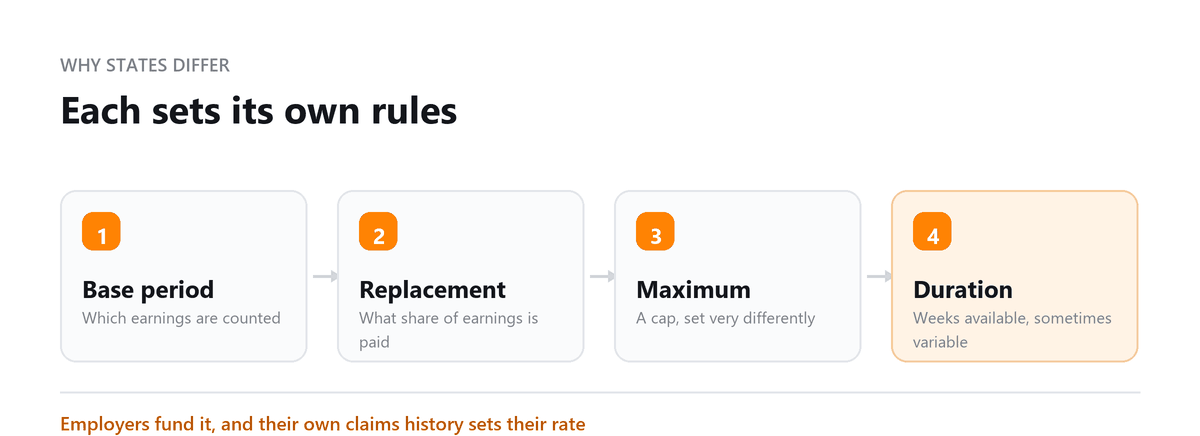
Unemployment insurance is a federal framework administered by each state, and the states have made genuinely different choices within it. That is why the benefit for the same wage history varies substantially depending on where the work was performed.
- The base period used to calculate the benefit differs, as does whether recent work counts
- The proportion of previous earnings replaced differs
- Maximum weekly amounts differ widely, and some states index them while others set them by legislation
- The number of weeks available differs, and in some states varies with economic conditions
- Dependent allowances exist in some states and not in others
All of these are set by state law and revised regularly, so figures should come from the relevant state agency for the current year rather than from any comparison.
Employer Experience Rating
Employers fund the state programme through contributions, and the rate is not the same for everyone. New employers start on a rate set by the state, and thereafter the rate moves with the claims history charged to the employer's account.
That makes claims management a direct cost. Claims not contested where there were grounds, claims charged to the wrong account, and separations poorly documented at the time all raise a rate that then applies to the whole payroll for future periods.
The annual rate notice is worth reading rather than filing. Check the charges listed against your own records of who left and when, and query anything that does not belong. Errors on these accounts happen, and they are far easier to correct when raised promptly.
Appeals and Disputed Claims
Both employees and employers can appeal a determination, and the process has short deadlines that are strictly applied.
For an employer contesting a claim, the case rests on evidence about the separation: what happened, when, what was communicated, and what the documentation shows. Assertions without records rarely succeed, which is another reason to document the reason for any separation at the time rather than reconstructing it later.
For a claimant, an initial denial is not the end of the matter and appeals do succeed. Either way the deadline is the critical part, and it is usually measured in days rather than weeks. Each state publishes its own appeal process and timescales.
Book a free consultation and we will check the charges against it.
FAQs
How much do you get on unemployment?
Unemployment benefit amounts vary by state and are generally based on a percentage of the claimant's previous wages, subject to a state-specific maximum. Benefit amounts and duration can change, so applicants should check their state's current unemployment agency guidelines for the applicable weekly benefit amount and eligibility requirements.
Do employers pay for unemployment benefits?
Yes, employers generally help fund unemployment insurance through state unemployment (SUTA) taxes and federal FUTA taxes. State unemployment tax rates can vary based on factors such as the employer's industry, payroll, state requirements, and claims history. Employers may also need to respond to unemployment claims to ensure their experience rating accurately reflects eligible claims.
Is unemployment tax paid by employees or employers?
Federal FUTA tax is generally an employer-paid tax and is not withheld from employee wages. State unemployment insurance is also generally funded through employer taxes, although the rules and financing structure vary by state.
Does an employee's unemployment claim increase an employer's taxes?
It can. Many states use an experience-rating system, meaning an employer's unemployment tax rate may be affected by its history of unemployment claims. Employers should respond accurately to claims and provide supporting documentation when they believe a claim is incorrect.
How long can someone receive unemployment benefits?
The duration varies by state and depends on factors such as the state's eligibility rules, the claimant's work history, and whether extended benefits are available. There is no single nationwide benefit duration, so claimants should check their state's unemployment agency for current rules.

Written by
Ankit Sarawagi, CPA, CA, MBA
Ankit leads the finance team at Profitjets, where he has worked with 500+ businesses across the US on bookkeeping, tax and CFO-level strategy. He writes about the habits that keep small business books accurate all year. Connect on LinkedIn
Free consultation
Reviewing Your Rate Notice?
Book a free consultation and we will check the charges against it.