
Changing how you account for something is not the same as fixing a mistake, and the difference decides which route you take to put it right.
An error in applying a method you were already using is corrected by amending the affected return. Moving from one permissible method to another is a change of accounting method, and that generally needs consent and brings an adjustment calculated as though the new method had always applied.
This covers why consent is required, which changes are automatic and which are not, how the catch-up adjustment works, and the mistakes that most often send people down the wrong route.
When you want to change the way you account for income or expenses, you generally cannot simply do it on the next return. The IRS requires formal consent through Form 3115 (Application for Change in Accounting Method). This guide explains the two tracks for approval, the Section 481(a) adjustment, and the most common method changes.
Why You Need IRS Consent
Accounting methods are the rules that determine when income is recognized and when expenses are deducted. Once adopted, a method can only be changed with IRS consent. Without consent, changing methods could result in:
- Income being taxed twice (both under old and new methods)
- Income permanently escaping taxation
- Penalties and interest for improperly reporting income
Form 3115 provides the mechanism for obtaining that consent and calculating the catch-up adjustment needed to put you on the new method without either double-counting or gaps.
The first question is whether you are correcting an error or changing a method, because they are put right by completely different routes. Applying a method wrongly is an error and gets amended. Moving from one permissible method to another is a change, and that is what this process exists for. Getting that distinction wrong sends people down the wrong road entirely.
Ankit Sarawagi, CPA, CA, MBA · LinkedInAutomatic vs. Non-Automatic Changes
Automatic Changes (No IRS Approval Required Beyond Filing)
Revenue Procedure 2023-24 (and its predecessors) lists hundreds of accounting method changes that are granted automatically, no prior IRS approval is needed. The taxpayer simply files Form 3115 with the tax return and the IRS processes it administratively.
- Changes in depreciation methods (correcting MACRS errors, changing to ADS)
- Small business taxpayer exceptions (cash method for qualifying businesses)
- Revenue recognition changes under ASC 606 alignment
- Inventory method changes for qualifying small businesses
- Bad debt accounting changes
- Advance payment changes under Rev. Proc. 2004-34
Non-Automatic Changes (Advance Consent Required)
Some method changes require advance consent from the IRS National Office. For these:
- File Form 3115 with the IRS National Office (not with your return) by the last day of the tax year for which the change is requested
- Pay the applicable user fee (currently $11,500 for most filers)
- Await IRS approval, typically takes several months
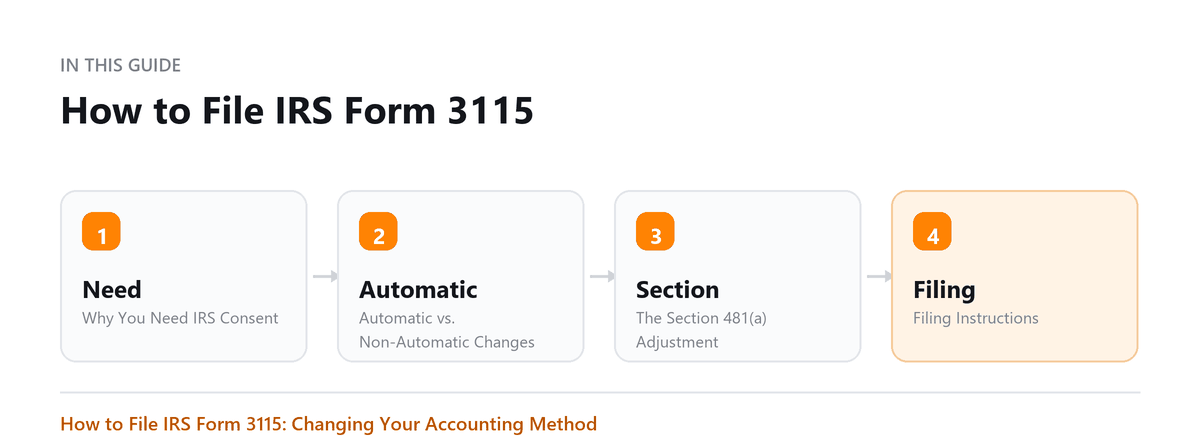
The Section 481(a) Adjustment
When you change accounting methods, there is often a difference between the old and new methods that must be reconciled. This is the Section 481(a) adjustment, it accounts for items that were not taxed (or were over-taxed) under the old method.
- Positive Section 481(a) adjustment: taxable income increases (e.g., switching from cash to accrual recognizes uncollected receivables)
- Negative Section 481(a) adjustment: taxable income decreases (favorable, usually spread over only one year for automatic changes)
For automatic changes, positive Section 481(a) adjustments are generally spread over four years. Negative adjustments are taken entirely in the year of change.
Pro Tip: A negative 481(a) adjustment can be a significant tax benefit, look for method change opportunities as part of year-end tax planning.
Filing Instructions
For Automatic Changes
- File Form 3115 with the taxpayer's timely filed (including extensions) original return for the year of change
- Also send a duplicate copy to the IRS National Office in Ogden, UT (or the current designated address)
- The change is effective for the year of change
When to File
For automatic changes, you can generally file within the first or second year of the window of applicability. Some changes allow retroactive filing under the deficiency procedures. Read the specific change description in the Revenue Procedure carefully.
Common Accounting Method Changes
| Common Change | Why Businesses Make It |
|---|---|
| Cash to accrual | Required when gross receipts exceed threshold or to match large contracts |
| Accrual to cash (small business exception) | Gross receipts under $29M (2024) can use cash method, simplifying accounting |
| LIFO to FIFO inventory | Reduce administrative burden; LIFO often disadvantageous for declining-cost inventory |
| Full absorption to simplified production method | Reduce costs capitalized to inventory |
| Deducting repair vs. capitalizing improvements | Correct prior errors under the Tangible Property Regulations (TPR) |
| Cost segregation reclassification | Accelerate depreciation on real property components |
| Revenue recognition changes | Align tax accounting with ASC 606 financial reporting |
Form 3115 Structure
- Part I: Identification, taxpayer info, type of change, designated change number from Rev. Proc.
- Part II: Information for all requests, description of old and new methods, year of change, Section 481(a) adjustment
- Part III: Specific questions about inventory method changes
- Part IV: Depreciation-specific questions
- Various schedules: Section 481(a) computation, statement of income and expenses under old and new methods
Common Mistakes
- Filing only one copy (automatic changes require a duplicate to the IRS National Office)
- Missing the filing deadline for non-automatic changes
- Incorrectly calculating the Section 481(a) adjustment
- Using Form 3115 for a change in tax classification (that requires Form 8832 or 2553, not Form 3115)
- Changing methods without Form 3115, this is an impermissible change and can result in assessments
Book a free consultation and we will take the return off your desk.
Frequently Asked Questions
Can a partnership or S-corp file Form 3115?
Yes. Partnerships and S-corps file at the entity level. The resulting Section 481(a) adjustment flows through to the partners or shareholders on their K-1s.
Do I need to file Form 3115 to correct a prior-year error?
Not always. A change from an impermissible method (i.e., you were doing it wrong) requires Form 3115. A computational error (math mistake within a permissible method) is corrected by amending the relevant prior-year return, not Form 3115.
Can I change methods in the middle of the year?
No. Method changes are effective as of the first day of the year of change (January 1 for calendar-year taxpayers). You cannot switch methods mid-year.
Is this needed to correct a simple arithmetic mistake?
Generally no, and the distinction matters because the two are corrected differently. A mistake in applying a method you were already using is an error, and errors are corrected by amending the affected return. Changing from one permissible method to another is a change of method, and that is what this process exists for. Misclassifying one as the other is a common way to use the wrong route entirely.
How far back does the adjustment reach?
Conceptually, all the way: the adjustment is calculated as though the new method had always applied, which is what makes the arithmetic bigger than people expect. Whether the resulting amount is taken in one year or spread, and over how long, depends on the direction of the adjustment and on the current procedures. Those procedures change, so take the treatment from the guidance in force for the year of change.

Written by
Ankit Sarawagi, CPA, CA, MBA
Ankit leads the finance team at Profitjets, where he has worked with 500+ businesses across the US on bookkeeping, tax and CFO-level strategy. He writes about the habits that keep small business books accurate all year. Connect on LinkedIn
Free consultation
Want the Filing Handled?
Book a free consultation and we will take the return off your desk.