
This is an information return rather than a tax return. Filing it does not by itself mean anything is owed, and that distinction reassures people more than it should, because the consequences of not filing can be severe even where no tax arises.
It covers dealings with foreign trusts and large gifts or bequests from people and entities outside the country, which are situations families often do not think of as reportable at all.
This covers who has to file, what counts for these purposes, how the return is structured, what does not need reporting, and the evidence worth gathering at the time rather than years later.
Form 3520 is an annual information return, not a tax return per se, that US persons use to report certain transactions with foreign trusts and large gifts from foreign persons. Penalties for non-filing are severe, and the IRS has intensified enforcement in this area.
Who Must File Form 3520
A US person (citizen, resident alien, domestic partnership, corporation, or trust) must file Form 3520 if they:
- Received a gift or bequest from a foreign person that exceeded $100,000 in aggregate during the year
- Received a gift or bequest from a foreign corporation or foreign partnership that exceeded $16,649 (2023)
- Were the grantor (creator) of, or transferor to, a foreign trust
- Received a distribution from a foreign trust
- Owned any portion of a foreign trust during the year
What people underestimate is the evidence, not the filing. You need documentation of what was received, from whom, when and in what form, and where property rather than cash changed hands, a valuation at the date of transfer. Obtaining that afterwards is harder and considerably less persuasive than obtaining it at the time.
Ankit Sarawagi, CPA, CA, MBA · LinkedInWhat Is a 'Gift' Under Form 3520 Rules
The definition of gift for Form 3520 purposes is broad:
- Cash transferred from a foreign person
- Property transferred without adequate consideration
- Forgiven debt from a foreign person
- Bequest from a foreign estate
The gift does not have to be income-producing or subject to income tax, the filing requirement is information-only for gifts. However, the IRS uses Form 3520 data to identify potential tax avoidance schemes involving foreign entities.
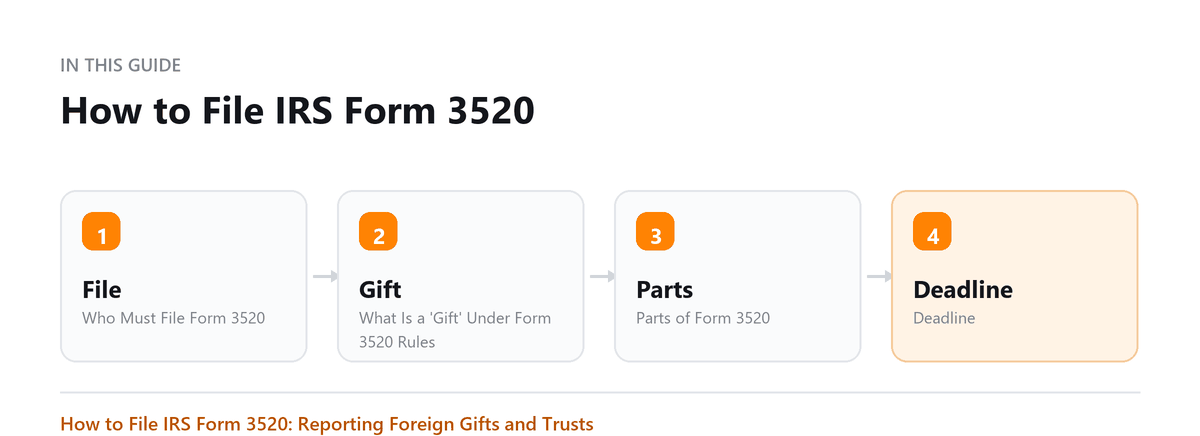
Parts of Form 3520
| Part | What It Covers |
|---|---|
| Part I | US persons who transferred assets to foreign trusts (including creating a foreign trust) |
| Part II | US owners of foreign trusts under grantor trust rules |
| Part III | US persons who received distributions from foreign trusts or who are beneficiaries |
| Part IV | US persons who received large foreign gifts or bequests |
Many filers will only need to complete Part IV (foreign gifts). Only complete the parts that apply to your situation.
Deadline
| Filer Type | Deadline |
|---|---|
| US person (individual) | Same as Form 1040, April 15, or October 15 with extension |
| US estate or trust | Same as Form 1041, April 15 (or fiscal year equivalent), or September 30 with extension |
| Foreign trust (Form 3520-A) | March 15, or September 15 with extension |
Pro Tip: The deadline for Form 3520 follows your individual tax return deadline, including extensions. If you file Form 4868, your Form 3520 deadline extends automatically.
Penalties for Non-Filing
Form 3520 penalties are among the harshest in the US tax code:
| Violation | Penalty |
|---|---|
| Failure to report a transfer to a foreign trust | 35% of the gross value of the property transferred |
| Failure to report a distribution from a foreign trust | 35% of the gross value of the distribution |
| Failure to report a foreign gift (over threshold) | 5% of the gift amount per month, up to 25% |
| Failure to furnish correct information | Additional penalties may apply |
What Does NOT Need to Be Reported
- Gifts from foreign individuals under the $100,000 threshold for the year
- Amounts received as compensation for services (reported as income, not a gift)
- Loans from foreign persons (but watch for below-market loans that may be reclassified as gifts)
- Inheritances from foreign persons that constitute excluded property, but check carefully
Form 3520-A: Annual Information Return of Foreign Trust
If you are the grantor of a foreign trust, the trust itself must file Form 3520-A (annual information return of foreign trust with a US owner) by March 15. If the foreign trust fails to file, the US grantor must file a substitute Form 3520-A as an attachment to their Form 3520.
How to Submit Form 3520
Form 3520 is filed separately from your income tax return. Send it to:
Internal Revenue Service Center, P.O. Box 409101, Ogden, UT 84409
Do NOT attach Form 3520 to Form 1040. It is a standalone filing.
Common Mistakes
- Attaching Form 3520 to Form 1040 (it must be filed separately at a different address)
- Not filing because the gift was not taxable income, it is a separate reporting requirement
- Missing the threshold calculation, aggregate gifts from all foreign persons must be combined if from the same source
- Failing to file a substitute Form 3520-A when the foreign trust does not file
- Not extending Form 3520 when you extend Form 1040 (the extension should cover both)
Book a free consultation and we will take the return off your desk.
Frequently Asked Questions
Do I owe income tax on a foreign gift?
Gifts are generally not income. You report the gift on Form 3520 for information purposes, but you do not pay income tax on the receipt of a gift. However, income earned from gifted assets is taxable.
What if the foreign gift was from a family member who is a foreign person?
Family members who are foreign individuals are treated the same as any other foreign person. If the aggregate gifts from them exceed $100,000, you must file Form 3520.
What are the penalties for late filing vs. non-filing?
The IRS treats late filing and non-filing similarly, both are subject to the 5% per month penalty (for gifts). However, the IRS has some discretion to abate penalties for reasonable cause. Filing late (even very late) is generally better than not filing at all.
Is a loan from a foreign relative treated as a gift?
Not automatically. A legitimate loan with documented terms, interest at or above the applicable federal rate, and actual repayment is not a gift. A purported loan with no documentation, no interest, and no repayment schedule may be reclassified as a gift.
What should be gathered before preparing one?
Documentation of what was received, from whom, when, and in what form. That means bank records showing the transfer, correspondence or a deed evidencing the gift, and enough information about the person or entity that gave it to establish their status. Where property rather than cash is involved, a valuation at the date of transfer is needed as well, and obtaining one afterwards is harder and less persuasive.

Written by
Ankit Sarawagi, CPA, CA, MBA
Ankit leads the finance team at Profitjets, where he has worked with 500+ businesses across the US on bookkeeping, tax and CFO-level strategy. He writes about the habits that keep small business books accurate all year. Connect on LinkedIn
Free consultation
Want the Filing Handled?
Book a free consultation and we will take the return off your desk.