
What is Finance?
Finance is the discipline concerned with managing capital, securing funding, making investments, managing risk, and creating the financial strategies that determine how a business allocates its resources over time. Finance professionals answer questions like: How should we fund growth? Where should we invest surplus cash? How do we manage the risk of currency fluctuations or rising interest rates? What is the business worth, and how do we maximise that value?
Finance spans a wide range of specialisations: investment banking (advising on mergers, acquisitions, and capital raises), corporate finance (managing a company's internal financial strategy), commercial banking (lending and treasury services), and the CFO function (overall financial leadership of an organisation). Finance is forward-looking and strategic, it deals as much in projections, models, and decisions as in historical records.
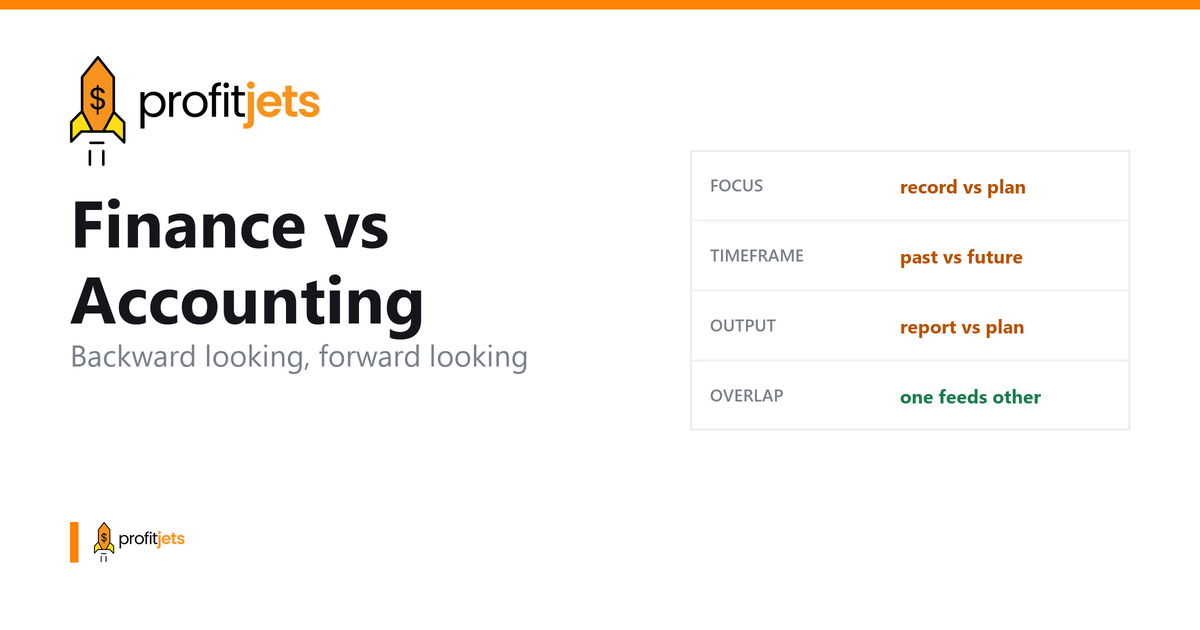
Finance and accounting are like strategy and operations. Finance asks 'where should we invest?' Accounting asks 'what exactly did we do with the money?' You need both questions answered to run a healthy business, and you need them to talk to each other.
Ankit Sarawagi, CPA, CA, MBA · LinkedInWhat is Accounting?
Accounting is the discipline focused on documenting, reporting, and analysing what has already happened financially. Accountants record every transaction, prepare financial statements, ensure regulatory compliance, and produce the reliable historical data that finance teams use for planning. Where finance asks 'what should we do?', accounting asks 'what did we do, and did we record it correctly?'
Accounting encompasses several specialisations: public accounting (serving external clients including audits and tax), bookkeeping (transaction recording and reconciliation), corporate accounting (internal reporting for one company), government accounting (public sector financial management), and tax accounting (compliance with tax regulations). Accounting is governed by strict standards, GAAP in the United States, IFRS internationally.
Types of Finance
Investment finance covers the management of portfolios, securities, and capital markets, the world of asset managers, investment banks, and hedge funds. Corporate finance focuses on the financial decisions of operating companies: capital structure, budgeting, and value creation. Real estate finance deals with property acquisition, development financing, and mortgage structures. International finance extends these disciplines across borders, managing the additional complexity of currency risk, cross-border regulation, and multinational capital structures.
Types of Accounting
Financial accounting produces the external-facing financial statements, income statement, balance sheet, cash flow statement, that investors, lenders, and regulators rely on. Management accounting generates internal reports, budgets, variance analyses, cost analyses, that help management make operational decisions. Auditing involves independent examination of financial statements for accuracy and compliance. Tax accounting focuses on preparing and filing tax returns and optimising tax positions within the bounds of applicable law.
Key Differences Between Finance and Accounting
| Factor | Finance | Accounting |
|---|---|---|
| Time orientation | Future-focused planning | Past records and present analysis |
| Primary output | Investment decisions, capital strategy | Financial statements, compliance reports |
| Key skill | Financial modelling, risk analysis | Accuracy, GAAP/IFRS knowledge |
| Typical roles | CFO, analyst, investment banker | CPA, bookkeeper, controller |
| Regulation | Less regulated (FCA, SEC oversight) | Heavily regulated (GAAP, IFRS, IRS) |
Why Choose Profitjets for Finance and Accounting Needs
Profitjets provides outsourced bookkeeping and accounting services that ensure your financial records are accurate, current, and compliant, giving your finance team the clean data they need to plan effectively. Beyond bookkeeping, Profitjets offers CFO advisory services that bridge the gap between accounting records and strategic financial decision-making, as well as tax preparation and planning services that reduce your tax burden and keep you compliant. Whether you need day-to-day accounting support or higher-level financial strategy, Profitjets covers both disciplines under one roof.
Conclusion
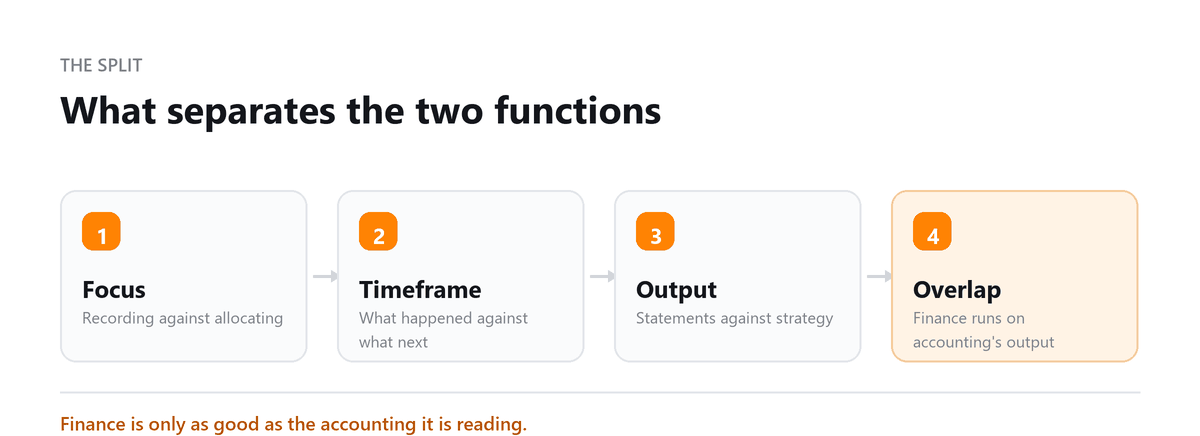
Finance and accounting are complementary disciplines that serve different but equally vital functions within any business. Accounting creates the record; finance uses that record to shape the future. Both are essential, and understanding the distinction helps you hire the right professionals, ask the right questions, and build a financial infrastructure that supports long-term growth.
Book a free consultation and we will get the accounting solid.
Frequently Asked Questions
Should my business hire a CFO or an accountant first?
For most small businesses, an accountant (or outsourced bookkeeper) comes first, you need accurate records before you can do meaningful financial strategy. Once you're generating enough revenue to need capital allocation decisions, cash flow forecasting, or fundraising support, add a CFO or virtual CFO.
What does a financial analyst do vs an accountant?
An accountant maintains and reports historical financial records. A financial analyst uses those records plus market data to evaluate business performance, model scenarios, and recommend capital allocation decisions. Analysts look forward; accountants look backward.
Is a degree in finance or accounting better for business?
Both are valuable but serve different purposes. Accounting is more directly applicable to starting and managing a business's financial records. Finance is more applicable to investment decisions, corporate strategy, and capital markets. Many business school programs combine both.
Can accounting software handle finance functions too?
Accounting software handles bookkeeping and reporting. Finance tools (financial models, DCF spreadsheets, forecasting platforms like Fathom or LivePlan) handle planning and analysis. Some platforms bridge both, but sophisticated finance work still requires separate tools and human judgment.
What does 'working capital' mean and is it accounting or finance?
Working capital (current assets minus current liabilities) lives in both worlds. Accounting measures it from balance sheet data; finance uses it to manage liquidity and plan operations. It's one of the most important metrics connecting accounting records to financial decision-making.

Written by
Ankit Sarawagi, CPA, CA, MBA
Ankit leads the finance team at Profitjets, where he has worked with 500+ businesses across the US on bookkeeping, tax and CFO-level strategy. He writes about the habits that keep small business books accurate all year. Connect on LinkedIn
Free consultation
Want the Foundation Right First?
Book a free consultation and we will get the accounting solid.