
<!doctype html>
Financial forecasting predicts your company’s future financial performance based on historical data, current trends, and informed assumptions. Think of it as your business’s headlights — it lets you see what’s ahead and navigate with confidence.
Key Takeaways
- Financial forecasting uses historical data and informed assumptions to predict future revenue, expenses, and cash flow.
- Short-term forecasts cover less than one year. Long-term forecasts project 3 to 5 years ahead for strategic planning.
- Two main method categories: quantitative (data-driven) and qualitative (expert judgment).
- Forecasting is an ongoing process — forecasts must be regularly reviewed and updated as conditions change.
What Is Financial Forecasting?
Imagine driving at night. With headlights, it is easier to see where you are going. Financial forecasting acts as your headlights in the business world. It predicts a company’s future financial performance based on historical data, current trends, and informed assumptions.
Financial forecasting allows businesses to:
- Make informed decisions: By anticipating future cash flow, revenue, and expenses, companies can strategically choose investments, staffing, and resource allocation.
- Manage risk: Forecasting helps identify potential financial challenges and allows businesses to develop contingency plans.
- Attract investors: Well-prepared forecasts demonstrate a company’s understanding of its financial future and can attract potential investors or lenders.
- Track progress: Comparing forecasts with actual results helps measure progress and identify areas for improvement.
Importance of Financial Forecasting
Financial forecasting is like having a roadmap for your business journey. It offers several key benefits:
- Improved Decision-Making: By understanding potential financial scenarios, businesses can make more informed choices about their future.
- Proactive Risk Management: Identifying potential financial pitfalls allows for proactive measures to mitigate risks.
- Enhanced Communication: Financial forecasts facilitate clear communication with stakeholders about future expectations.
- Performance Monitoring: Comparing forecasts to actual results helps track progress and identify areas for improvement.
- Increased Confidence: Well-developed forecasts provide security and direction for businesses and stakeholders.
Investors and lenders routinely request financial forecasts during due diligence. A forecast based on clean historical data and realistic assumptions is one of the strongest signals of management competence.
Steps Involved in Financial Forecasting
Financial forecasting is a structured process with several key steps:
- Define Your Goals: Determine the purpose of the forecast — is it to predict sales, expenses, or overall profitability?
- Gather Data: Collect relevant historical data (sales figures, expenses, etc.) to use as a foundation for the forecast.
- Choose a Forecasting Method: Select an appropriate method based on your goals and data availability.
- Make Assumptions: Develop informed assumptions about future trends, economic factors, and market conditions.
- Build Your Forecast: Apply the chosen method to your data and assumptions to generate a financial prediction.
- Analyze and Adapt: Review the forecast, identify potential weaknesses, and refine assumptions if necessary.
- Monitor and Update: Monitor actual results and update the forecast as needed to reflect changing circumstances.
Types of Financial Forecasting
There are two main categories of financial forecasting:
1. Short-Term Forecasting
This technique predicts financial performance for less than one year (e.g., monthly or quarterly). It is often used for budgeting and cash flow management.
2. Long-Term Forecasting
This method projects financial performance over a longer period (e.g., 3-5 years). It is used for strategic planning, capital investment decisions, and business valuation.
Financial Forecasting Methods: Choosing the Right Approach
There are two primary categories of financial forecasting methods: quantitative and qualitative.
Quantitative Forecasting Methods
These methods rely on historical data and statistical analysis to predict future trends.
- Time Series Analysis: Analyzes past data patterns to identify trends, seasonality, and cyclical variations. Includes moving averages, exponential smoothing, and trend extrapolation.
- Regression Analysis: Identifies relationships between variables and uses them to predict future values. Can be simple (one variable) or multiple regression.
- Econometric Modeling: Builds mathematical models based on economic theory to forecast economic indicators and their impact on the business.
Qualitative Forecasting Methods
These methods use expert judgment, opinions, and experience to make predictions.
- Delphi Method: Gathering expert opinions through multiple questionnaires to reach a consensus forecast.
- Scenario Planning: Developing multiple possible future scenarios based on different assumptions to assess potential outcomes.
- Market Research: Collecting data on customer preferences, market trends, and competitor activities to inform forecasts.
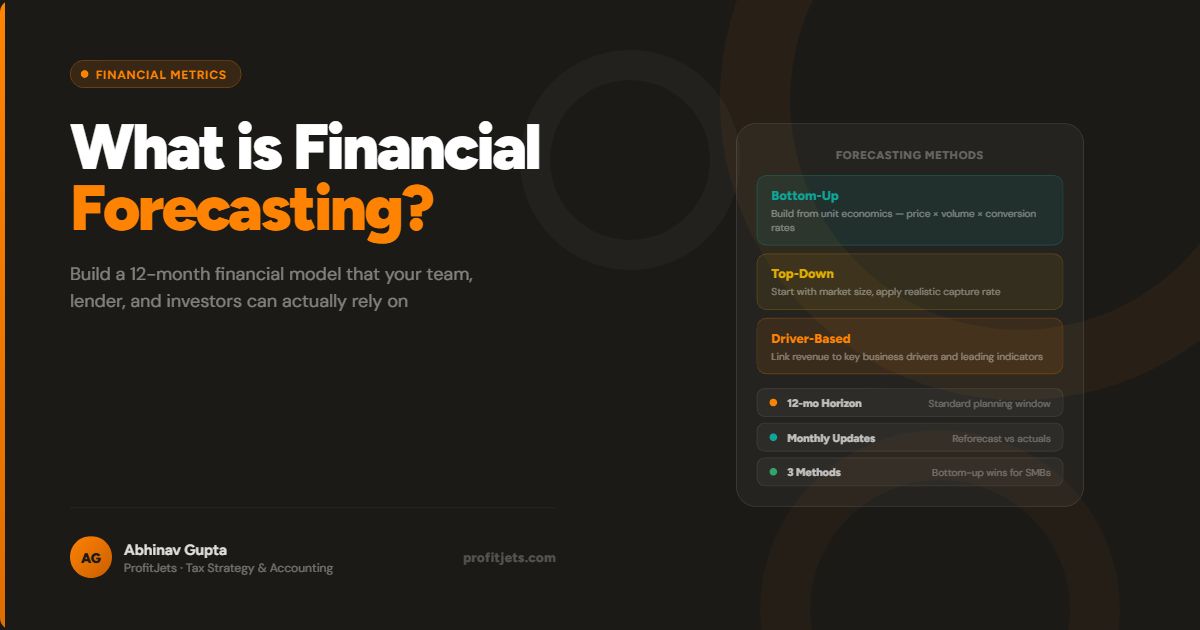
The best forecasting method depends on the nature of your business, data availability, desired accuracy level, and the forecast’s time horizon. Many businesses combine quantitative and qualitative approaches for more robust results.
| Forecasting Method | Description |
|---|---|
| Historical Analogy | Uses historical trends to predict future performance. Good for stable markets and short-term forecasting. |
| Moving Average | Calculates the average of past data points to predict future values. Works well for stable, short-term trends. |
| Trend Analysis | Analyzes historical data to identify patterns and projects them into the future. Useful for identifying long-term growth trends. |
| Regression Analysis | Uses statistical techniques to identify relationships between variables. More complex, but powerful for multi-factor predictions. |
| Scenario Planning | Develops multiple forecasts based on different assumptions. Helps businesses prepare for various possibilities and manage risk. |
Not sure which forecasting method fits your business?
Talk to a Profitjets CFOExamples of Financial Forecasting
Here are some practical examples of financial forecasting in action:
- Sales Forecasting: Predicting future sales revenue based on historical data, market trends, and economic indicators.
- Cash Flow Forecasting: Projecting cash inflows and outflows to manage liquidity and avoid cash shortages.
- Expense Forecasting: Estimating future expenses based on historical data and anticipated changes in costs or headcount.
- Profit and Loss Forecasting: Predicting future profitability by combining sales and expense forecasts.
- Balance Sheet Forecasting: Projecting the future financial position of the company, including assets, liabilities, and equity.
Financial Forecasting Tools
Several software tools and applications can assist in the financial forecasting process:
- Spreadsheet Software (Excel): While basic, Excel is widely used for building financial models and performing calculations.
- Financial Forecasting Software: Specialized software offers advanced forecasting features, data analysis, and visualization capabilities.
- Enterprise Resource Planning (ERP) Systems: Integrated software solutions often include financial forecasting modules.
- Business Intelligence (BI) Tools: Provide data analysis and visualization tools to support financial forecasting.
Financial forecasting is an ongoing process. It is essential to regularly review and update forecasts to reflect changing business conditions and market dynamics. A forecast built once and never revisited quickly loses its value.
Conclusion
Financial forecasting is a critical tool for businesses of all sizes. By accurately predicting future financial performance, companies can make informed decisions, manage risks effectively, and achieve their strategic goals.
By embracing financial forecasting, businesses can confidently navigate the future and achieve long-term success.
Need expert financial forecasting tailored to your business goals?
Talk to ProfitjetsProfitjets Editorial Team
At Profitjets, we provide expert financial forecasting services to help businesses make informed decisions and plan for the future — from cash flow projections to long-term growth modeling.