
What is a Comptroller?
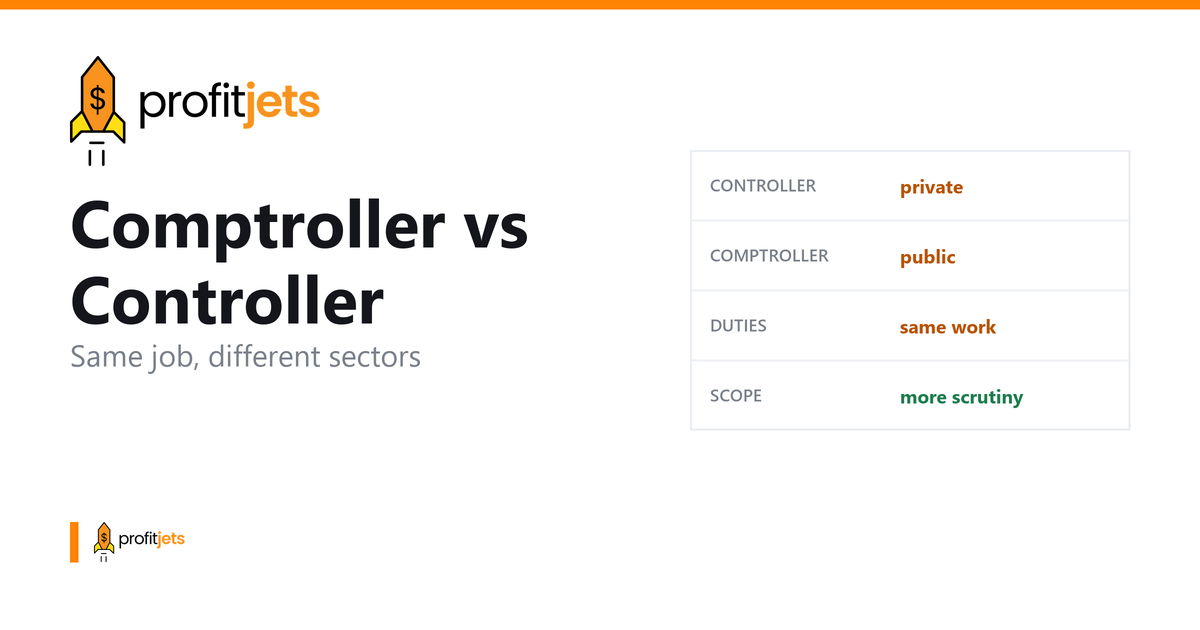
A Comptroller is a senior accounting executive whose title is primarily used in government, public sector, and non-profit organisations.
The Comptroller performs the same core function as a Controller in the private sector managing financial statement preparation, internal controls, and accounting accuracy but does so within a context of public accountability. In many jurisdictions, the Comptroller is a statutory officer with legal reporting obligations to a legislature, governing board, or the public.
The title reflects the historical usage of 'comptroller' in governmental accounting and public fund management, where independent oversight of public money is a specific legal and constitutional requirement.
The Controller role is often underestimated. The CFO is the face of finance to investors; the Controller is the backbone of financial integrity inside the company. If the Controller isn't getting the close right, the numbers the CFO presents to the board aren't reliable. That's a failure nobody sees coming until it's too late.
Anu Gupta, CA, EA, B.Tech · LinkedInWhat is a Controller in Finance?
A Controller (also sometimes spelled Comptroller in some private sector contexts) is the senior accounting executive in a private company who manages the accounting department, financial close process, financial statement preparation, and internal controls framework. The
Controller ensures that the company's books are accurate, the monthly close happens on schedule, and the financial statements produced are reliable and compliant with applicable accounting standards (GAAP or IFRS).
The Controller typically reports to the CFO and manages the accounting team below them. In larger organisations, there may be an Assistant Controller and multiple accounting managers beneath the Controller.
Comptroller vs Controller: What Do They Do?
| Dimension | Comptroller | Controller |
|---|---|---|
| Primary sector | Government, public, non-profit | Private sector, corporate |
| Authority | Often statutory (government oversight role) | Corporate accounting leadership |
| Accountability | Taxpayers, legislature, or governing board | CFO, board of directors |
| Scope | Public fund accountability, compliance | Financial statements, internal controls, close process |
| Title usage | Government agencies, non-profits, municipalities | Private companies, corporations |
Comptroller vs Controller: Similarities
Despite the sectoral distinction, the two roles share a common core. Both the Comptroller and the Controller lead the accounting function and are ultimately responsible for the accuracy of financial statements.
Both oversee internal controls frameworks ensuring that financial processes are designed to prevent error and fraud. Both are typically CPAs (or equivalent), manage accounting teams, and report to a financial executive above them: a CFO in the private sector, or a senior government financial officer in the public sector.
The technical accounting skills required are substantially the same; the regulatory environment and accountability framework differ.
Comptroller vs Controller: Key Role Differences
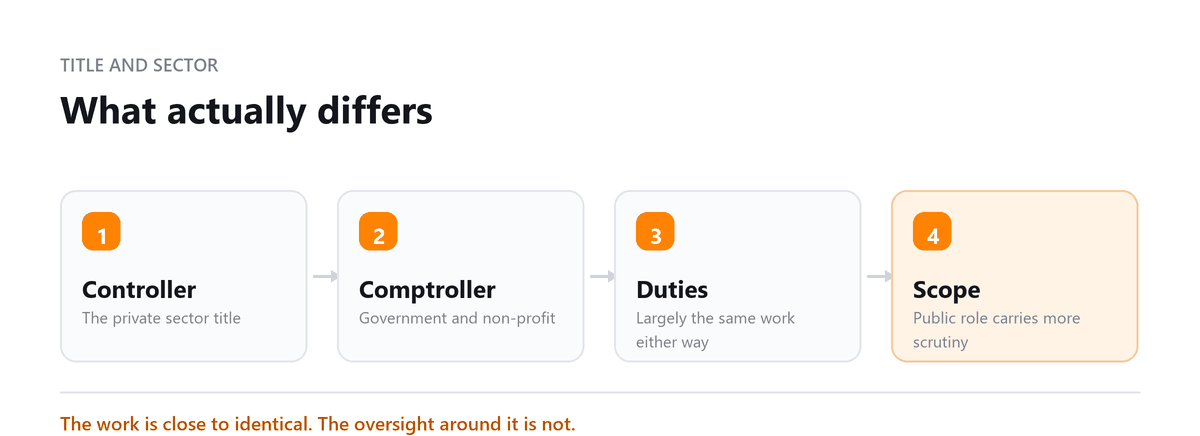
The most important distinction between Comptroller and Controller is the sector in which the role operates. 'Comptroller' is the preferred title in government agencies, municipalities, non-profit organisations, and quasi-governmental entities. 'Controller' is the standard title in private sector companies.
In practice, the two titles are sometimes used interchangeably even within organisations some private companies use 'Comptroller' simply as a stylistic preference or historical convention, particularly in regulated industries like banking or utilities where the term has a longer history.
The substantive difference is accountability context: Comptrollers are accountable to public constituencies; Controllers are accountable to their company's leadership and shareholders.
How to Become a Comptroller or Controller
Education and Certifications
Both roles typically require a bachelor's degree in accounting or finance as a foundation. The CPA (Certified Public Accountant) licence is the standard credential for senior accounting roles and is effectively required for Controller or Comptroller positions at any organisation of meaningful scale. An MBA is common among senior Controllers and Comptrollers but is not universally required: the CPA carries more weight in accounting-specific career tracks than an MBA does.
Gaining Experience
The typical career path to Controller or Comptroller runs through public accounting (Big 4 or regional firm), providing broad GAAP technical exposure across industries, followed by a move into industry.
From there, the progression is: staff accountant, senior accountant, accounting manager, assistant controller, and then Controller.
Each step builds technical depth, team management experience, and process ownership. The timeline from entry-level to Controller typically ranges from 10 to 15 years, depending on the size and complexity of organisations worked for.
Specific Path for Comptroller
The path to a government Comptroller role typically involves government accounting experience and familiarity with GASB (Governmental Accounting Standards Board) standards rather than GAAP.
Fund accounting tracking resources and expenditures against specific appropriations rather than producing profit-oriented financial statements is a core technical competency.
Additional government-specific certifications add significant credibility: the CGFM (Certified Government Financial Manager) for federal roles and the CGFO (Certified Government Finance Officer) for local government positions.
Specific Path for Controller
The private sector Controller path most commonly runs through public accounting at a Big 4 or strong regional firm, providing exposure to financial statement audits across multiple industries and building the GAAP technical foundation the Controller role requires.
For Controllers at public companies, experience with SEC reporting with 10-K and 10-Q filings, management's discussion and analysis, and internal control over financial reporting (ICFR/SOX), is often a prerequisite. Controllers at private equity-backed companies similarly need experience with investor-grade reporting and management reporting packages.
Why Choose Profitjets for Comptroller and Controller Services?
Profitjets provides outsourced Controller and Comptroller services that give growing businesses access to senior accounting leadership without the cost and complexity of a full-time hire.
Whether your business needs a clean monthly close, GAAP-compliant financial statements, or the accounting infrastructure to support a fundraising round or audit, the Profitjets team delivers controller-level rigour scaled to your stage.
In my experience, good accounting leadership is about more than keeping the books accurate. A strong Controller makes sure the numbers are reconciled, reviewed, and ready for management to use, while also identifying issues before they affect reporting or cash flow. I look closely at the month-end close, balance-sheet reconciliations, unusual transactions, and reporting consistency because those details give leadership confidence in the numbers they are using to make decisions.
Conclusion
The Comptroller and Controller titles describe the same fundamental role- senior accounting leadership responsible for financial statement accuracy and internal controls but in different organisational contexts.
Comptroller is the public sector and government term; Controller is the private sector standard. Both require deep accounting expertise, a CPA credential, and strong team management skills. For businesses evaluating their accounting leadership needs, the key question is not Comptroller vs Controller; it's whether the accounting function has the leadership it needs to be accurate, timely, and scalable.
Profitjets provides controller-level accounting oversight to businesses that need stronger financial controls, reconciliations, and month-end reporting. In these engagements, the team reviews account reconciliations, accounting classifications, and close procedures to help ensure financial statements are accurate and ready for management use.
Book a free consultation and we will bring it to your books.
Frequently Asked Questions
Is a comptroller the same as a controller?
Functionally, yes. Both are the senior accounting executive responsible for financial statements, internal controls, and the accounting function overall. The real distinction is sector: Comptroller in government, public sector, and non-profits; Controller in the private sector. Some organizations use the terms interchangeably regardless of sector.
What qualifications does a controller actually need?
A bachelor's degree in accounting or finance, plus a CPA license, the CPA is the credential that's genuinely non-negotiable in most organizations. Big 4 audit experience is common and valued. Public company Controllers usually need SEC reporting experience (10-K, 10-Q) specifically. An MBA shows up often but isn't required the way the CPA is.
How is a controller different from a CFO?
A Controller runs the accounting function: accurate books, financial statements, internal controls. A CFO sits above that setting financial strategy, managing investor and board relationships, owning capital structure, and leading M&A. The Controller typically reports directly to the CFO, and the two roles are complementary rather than overlapping.
What does a government comptroller actually do day to day?
Manages public funds: confirming spending matches legislative appropriations, producing official government financial statements, overseeing internal audit, and maintaining compliance with GASB standards. In many jurisdictions the Comptroller is elected or appointed with statutory authority that's independent of the executive branch, which is a level of independence a private-sector Controller simply doesn't have.
Is Controller a realistic step toward becoming a CFO?
Yes. it's one of the most common launching points for a CFO promotion. The jump requires building skills beyond accounting itself: investor relations, strategic planning, treasury, executive communication. Plenty of sitting CFOs came up through a Controller role or public accounting rather than a more "strategic" title earlier in their career.

Written by
Anu Gupta, CA, EA, B.Tech
Anu works with US businesses on tax and entity questions at Profitjets, from choosing a structure to the filings that follow it. She writes about the decisions owners make once and then live with for years. Connect on LinkedIn
Free consultation
Need Controller-Level Oversight?
Book a free consultation and we will bring it to your books.