
Retained earnings is perhaps one of the most misinterpreted items on the balance sheet. Owners see a large sum of money and think that they can just walk away with it.
Lenders see the same line item and believe that it reflects the company’s history of operations. Finally, buyers see the trend in the retained earnings and evaluate the company’s ability to report honest profits and the management’s policy on distributions versus reinvestment in the business.
The concept is simple, as the company either generates profits or suffers losses, from which a portion is distributed to the owners.
The remaining amount is then added to the retained earnings, which represent the company’s cumulative profits/net losses, less the amount distributed to its owners. It is essential to analyze this line item’s trends, as significant increases or decreases can represent a change in the business’s profitability or management’s policies.
This guide explains what retained earnings are, how to calculate them, where they appear in the financial statements, and why they matter to lenders, investors, and buyers.
What Are Retained Earnings?
Retained earnings are the portion of net profit that remains in the business after distributions to owners (dividends for corporations; draws for sole proprietors and LLC members). They accumulate over the life of the business and appear as a line item in the equity section of the balance sheet. Unlike cash, retained earnings are not a liquid asset, they have been reinvested into the business's assets (inventory, equipment, receivables) or used to reduce liabilities.
When I look at a company's retained earnings with a buyer or investor, I'm not just looking at the number. I'm looking at the pattern. Steady growth tells me the business has been profitable for years and the owners have reinvested instead of draining it. A business with strong profits but flat or falling retained earnings raises a different question: where did the money go, and will it keep going there after the deal closes?
Abhinav Gupta, CPA, CA, MBA · LinkedInHow to Calculate Retained Earnings
Retained Earnings = Beginning Retained Earnings + Net Income (or - Net Loss) - Dividends / Distributions
Example from live page: $50,000 beginning retained earnings + $20,000 net income - $5,000 distributions = $65,000 ending retained earnings.
This calculation is performed at each period-end (monthly, quarterly, or annually) to update the retained earnings balance on the balance sheet.
Statement of Retained Earnings
The statement of retained earnings is a standalone financial statement (sometimes presented as part of the equity section of the balance sheet) that shows how retained earnings changed during the period:
| Line | Amount |
|---|---|
| Beginning retained earnings (Jan 1) | $50,000 |
| + Net income for the period | $20,000 |
| - Dividends / distributions paid | ($5,000) |
| = Ending retained earnings (Dec 31) | $65,000 |
Retained Earnings on the Balance Sheet
Retained earnings appear in the equity section of the balance sheet. For a corporation:
| Equity Section | Balance |
|---|---|
| Common stock | $10,000 |
| Additional paid-in capital | $40,000 |
| Retained earnings | $65,000 |
| Total shareholders' equity | $115,000 |
For a sole proprietorship or single-member LLC, the equity section is simpler: Capital contributions + Retained earnings (cumulative profit/loss net of draws) = Owner's equity.
Importance of Retained Earnings
- Signals long-term profitability: growing retained earnings over multiple periods indicates sustained profitability, not just a single good year
- Funds growth: retained earnings are internal financing, the lowest-cost source of capital because there is no interest cost and no dilution of ownership
- Lender and investor confidence: banks use retained earnings (and the equity it represents) to assess creditworthiness; investors use it to assess management's capital discipline
- Dividend capacity: for corporations, accumulated retained earnings determine the maximum amount available for dividend payments
- Acquisition value: acquirers examine retained earnings as an indicator of historical profit quality and the business's ability to fund its own growth
During initial balance-sheet reviews, Profitjets identified retained earnings discrepancies in approximately 25% of new clients, most commonly caused by prior-period adjustments, incorrect closing entries, or historical bookkeeping errors. After cleanup and reconciliation, clients have a more accurate view of retained earnings and total equity, giving management a reliable starting point for ongoing financial reporting.
What Negative Retained Earnings Mean
When a business's cumulative losses and distributions exceed its cumulative profits, retained earnings turn negative. This is often called an accumulated deficit.
It isn't automatically a sign of trouble. Early-stage startups commonly have negative retained earnings for years while they invest in growth. In an established business, though, a negative or shrinking balance deserves attention, because it can mean ongoing losses or owners taking out more than the business earns.
Conclusion
Retained earnings are a simple running total with a lot to say. They show how much a business has earned and kept over its lifetime, how much it has reinvested, and how disciplined its owners have been about distributions. They aren't cash in the bank, but lenders, investors, and buyers all read them as a signal of financial health and management quality. Keeping them accurate, and understanding what the trend is telling you, is part of knowing where your business really stands.
What the Balance Is Not
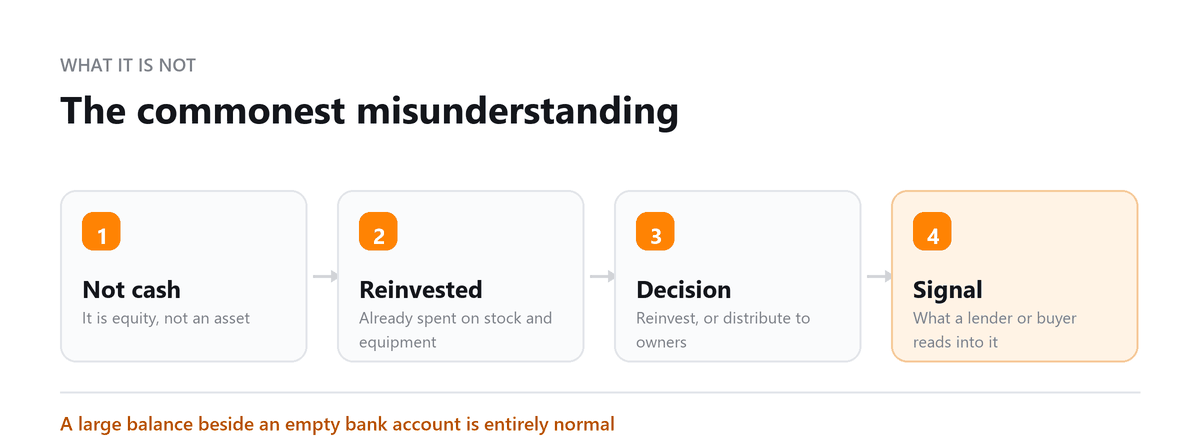
The most common misunderstanding in this area is treating the figure as money available to spend. It is not cash, and there is no reason for it to correspond to the bank balance.
The profits it represents were reinvested as they were earned: into equipment, into stock, into receivables, into paying down borrowing. A business with a substantial retained earnings balance and an empty bank account is entirely normal, and so is the reverse.
- It is an equity balance, not an asset
- It cannot be spent, because it is not a pot of anything
- What can be distributed depends on available cash and on the rules applying to your structure
- Two businesses with identical balances can be in completely different cash positions
Reinvest or Distribute
The decision the balance represents is the one that actually matters: whether profit stays in the business or goes to the owners.
Reinvesting funds growth without giving away ownership or taking on debt, and it concentrates the owners' wealth in a single illiquid asset. Distributing gives owners access to what they have earned and diversification, and it slows what the business can fund from its own resources.
There is a tax dimension that differs by structure, and it should not be the only input. The more useful question is what the business could actually do with the money, at what return, compared with what the owners would do with it. Where the business has no use for it, retaining it is a decision to hold an investment rather than a neutral default.
What Outside Readers Take From It
For anyone assessing the business, this single figure carries a great deal of information, and owners are often unaware how much.
A steadily growing balance suggests consistent profitability and a conservative distribution policy. A large balance beside heavy borrowing raises the question of where the profits went. A negative balance prompts a look at the history. Sharp movements invite questions about what happened in that year.
None of that is a judgement on its own, and all of it shapes the questions you will be asked. Knowing what your own figure says, and being able to explain its movements over several years, is worth doing before a lender or a buyer does it for you.
Book a free consultation and we will model both.
Frequently Asked Questions
Are retained earnings the same as cash?
No. Retained earnings are an accounting measure of profit kept in the business over time. That profit is usually already tied up in assets like inventory, equipment, or receivables, or used to pay down debt. A business can report large retained earnings and still have limited cash available.
What's the difference between retained earnings and reserves?
Retained earnings are the total accumulated profit kept in the business. Reserves, sometimes called appropriated retained earnings, are portions of that balance that the business has earmarked for a specific purpose, such as future expansion or legal requirements. They're part of retained earnings, not a separate pool of money.
Can a corporation only pay dividends from retained earnings?
Not necessarily. The rules depend on the state of incorporation, and many US states measure dividend capacity using broader tests that can include other forms of surplus, along with a requirement that the company remain able to pay its debts. Because the rules vary and the consequences of an improper distribution can be serious, larger dividends should be reviewed with a CPA or corporate attorney.
Can retained earnings be negative?
Yes. When accumulated losses and distributions are greater than accumulated profits, retained earnings become negative, which is also called an accumulated deficit. It's common for young, growth-stage companies, but in a mature business it can be a sign of ongoing losses or excessive distributions.
How do owner draws affect retained earnings?
Draws and distributions reduce the equity that profits add to the business. In corporations, dividends are subtracted directly from retained earnings. In sole proprietorships and many LLCs, draws reduce the owner's capital or equity account, which serves the same purpose as retained earnings in those simpler structures.

Written by
Abhinav Gupta, CPA, CA, MBA
Abhinav works with business owners across the US on industry-specific bookkeeping, from dental practices and restaurants to construction and e-commerce. He writes about what each trade's books actually need. Connect on LinkedIn
Free consultation
Deciding Whether to Distribute?
Book a free consultation and we will model both.