
Selling something the business used is reported differently from selling an investment, and this is where those sales go.
The treatment depends on what the asset was, how long it was held, and how much depreciation has been claimed on it, which means the answer comes from the fixed asset register rather than from the sale documents.
This covers which property belongs here, what each part of the form deals with, how the figures are built, how depreciation already claimed changes the character of the gain, and how it all reaches the rest of the return.
When a business sells property it used in operations, equipment, vehicles, buildings, or land, the gain or loss is not simply a capital gain or loss. Depreciation recapture rules and Section 1231 may turn what looks like a capital gain into ordinary income. Form 4797, Sales of Business Property, is where all of this is calculated and reported.
What Types of Property Go on Form 4797?
- Depreciable business property sold at a gain (machinery, equipment, vehicles, computers)
- Real property used in a trade or business
- Capital assets held in connection with a trade or business
- Involuntary conversions from theft, casualty, or condemnation
- Livestock held for draft, breeding, dairy, or sporting purposes
Everything on this return depends on the fixed asset register: what was paid, when it went into service, and what depreciation has been taken over the whole period of ownership. Where that register is incomplete, reconstructing the history is the real work and the sale is already done.
Ankit Sarawagi, CPA, CA, MBA · LinkedInThe Three Parts of Form 4797
Part I, Property Held More Than 1 Year (Section 1231 Transactions)
Section 1231 assets are business assets held for more than one year. The netting rule: if total Section 1231 gains exceed Section 1231 losses for the year, the net gain is treated as long-term capital gain, taxed at preferential rates. If Section 1231 losses exceed gains, the net loss is treated as an ordinary loss, fully deductible without limitation.
Pro Tip: The Section 1231 lookback rule: if you had net Section 1231 losses in any of the previous 5 years, your current year Section 1231 gains are recharacterized as ordinary income to the extent of those unrecaptured losses.
Part II, Ordinary Gains and Losses (Recapture, Sections 1245 and 1250)
Depreciation recapture converts what would otherwise be capital gain into ordinary income, to the extent of prior depreciation deductions. Two main recapture rules:
Section 1245 Recapture, Personal Property
Applies to depreciable personal property (equipment, vehicles, machinery, computers, and even certain intangibles). ALL depreciation previously taken is recaptured as ordinary income on sale, up to the amount of gain. If the sale price exceeds the original cost, the excess is Section 1231 gain.
Example: Machine purchased for $100,000, accumulated depreciation $70,000, sold for $80,000. Adjusted basis = $30,000. Gain = $50,000. Section 1245 recapture = $50,000 (all gain is ordinary income up to depreciation of $70,000).
Section 1250 Recapture, Real Property
Applies to depreciable real property (buildings). Under current law (post-1986), straight-line depreciation is required for real property, so there is typically no Section 1250 recapture in the traditional sense. However, a special rule, unrecaptured Section 1250 gain, taxes the straight-line depreciation portion at 25% (rather than the 20% long-term capital gains rate) when the property is sold.
Part III, Gain from Disposition of Property Under Sections 1245, 1250, 1252, 1254, and 1255
Part III is a detailed computation section where you calculate the recapture amounts that feed into Part II. It identifies the amount of gain attributable to depreciation for each property sold.
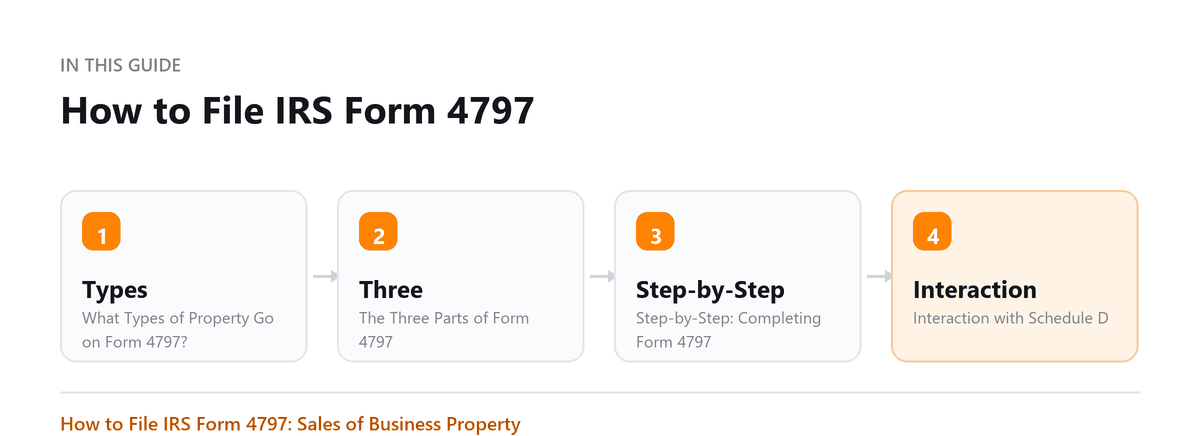
Step-by-Step: Completing Form 4797
- List each property in the appropriate Part based on the type and holding period.
- For each property: enter description, date acquired, date sold, gross sales price, depreciation allowed since acquisition, cost/basis, and gain or loss.
- Compute Section 1245 recapture in Part III and carry the recapture amount to Part II.
- Net all Section 1231 transactions in Part I.
- Transfer ordinary gains from Part II to Form 1040 (or 1120) as ordinary income.
- Transfer any net Section 1231 gain from Part I to Schedule D as long-term capital gain.
Interaction with Schedule D
Net Section 1231 gains flow to Schedule D, Line 11. Net Section 1231 losses do not go to Schedule D, they are ordinary losses deducted directly. Unrecaptured Section 1250 gain is tracked on a separate worksheet and ultimately taxed at 25% on Schedule D.
Book a free consultation and we will take the return off your desk.
Frequently Asked Questions
My business sold a truck that was fully depreciated. How much of the gain is ordinary income?
All of it, up to the gain. Under Section 1245, all previous depreciation is recaptured as ordinary income. If you fully depreciated the truck (adjusted basis of zero) and sold it for $10,000, the entire $10,000 is ordinary income.
We sold a building at a loss. Where does the loss go?
A loss on a Section 1231 asset held more than 1 year goes to Part I of Form 4797. If Section 1231 losses exceed Section 1231 gains for the year, the net is an ordinary loss, deductible in full against ordinary income.
Is an involuntary conversion on Form 4797?
Yes. Gain from involuntary conversions of business property (casualty, theft, condemnation) is reportable on Form 4797. However, if you elect deferral under Section 1033 (replacing the property within the replacement period), the gain may be deferred.
What has to be established before the form can be completed?
The adjusted basis of what was sold and the depreciation taken on it over the whole period of ownership. That is the figure the treatment turns on, and it comes from the fixed asset register rather than from the sale documents. Where the register is incomplete, reconstructing the depreciation history is the real work, and it is the reason asset records should be kept for as long as the asset is owned.
What if several assets were sold in one transaction?
They are dealt with individually, because the treatment can differ between them. A single price covering a group of assets has to be allocated across them, and the allocation drives the result. Where the sale is of a business rather than of equipment, that allocation is usually agreed with the buyer and reported by both sides, so it should be settled in the agreement rather than decided afterwards.

Written by
Ankit Sarawagi, CPA, CA, MBA
Ankit leads the finance team at Profitjets, where he has worked with 500+ businesses across the US on bookkeeping, tax and CFO-level strategy. He writes about the habits that keep small business books accurate all year. Connect on LinkedIn
Free consultation
Want the Filing Handled?
Book a free consultation and we will take the return off your desk.