
The decision to renounce US citizenship or surrender a long-held green card is usually motivated by personal circumstances: the place of residence, work, and retirement.
The issue of taxation comes up later, when an appointment to the embassy is scheduled. People who renounce their citizenship seldom realize that they will continue to be subject to US taxation in many cases and that they must pay a special one-time exit tax when expatriating if they are covered expatriates.
Form 8854: Initial and Annual Expatriation Statement is designed for the IRS to collect information about relinquishing citizenship or residency. This form is filled out by taxpayers who lose their citizenship or long-term residency. They certify that they have filed all tax returns and statements, report their net worth and income tax liabilities, and determine whether they are covered expatriates.
taxpayers should understand that completing the form and attaching it to the tax return when expatriating is not enough. The five-year compliance period preceding expatriation is examined as well.
Thus, delinquent tax returns and FBARs should be filed first. In addition, retirement and deferred compensation plans, as well as any interest in trusts, require special attention. Covered expatriate status may have adverse effects on families because gifts or inheritances from expatriates may be subject to gift and estate taxes.
Expert Perspective
The most important planning step in the year before expatriation is making sure you can honestly certify five years of full US tax compliance. People focus on the net worth test and the exit tax calculation, but a single missed return or FBAR can make someone a covered expatriate even when their assets and income are well below the thresholds. Catching up on filings before the expatriation date is almost always cheaper and simpler than living with covered expatriate status afterward.
Ankit Sarawagi, CPA, CA, MBA · LinkedInThis guide explains who must file Form 8854, how covered expatriate status is determined, how the exit tax works, how retirement accounts and deferred compensation are treated, and the planning steps to consider before expatriating.
Who Must File Form 8854?
- U.S. citizens who relinquish citizenship (by renouncing at a U.S. embassy or consulate or other qualifying act)
- Long-term permanent residents (LTRs) who held a green card in at least 8 of the last 15 years and terminate that residency
- Form 8854 is filed for the year of expatriation AND for each subsequent year if Form 8854-T (annual certifications) are required
Covered Expatriate Thresholds, TY2025
| Test | Covered Expatriate If... |
|---|---|
| Net worth test | Net worth of $2,000,000 or more on expatriation date (NOT inflation-adjusted) |
| Average annual net income tax test | Average net income tax for the 5 years before expatriation exceeds the threshold (approx. $193,000 to $196,000 for 2025) |
| Certification test | Fails to certify 5 years of U.S. tax compliance on Form 8854, Part I |
The Exit Tax for Covered Expatriates
A covered expatriate is deemed to have sold all worldwide assets at fair market value on the day before expatriation date. This triggers:
- Capital gains and ordinary income on the 'deemed sale', net gain above the exclusion amount is taxable in the year of expatriation
- Exclusion amount for 2024: $866,000 (inflation-indexed annually)
- Special rules apply to deferred compensation items, specified tax-deferred accounts (IRAs, 401(k)s), and interests in non-grantor trusts
Completing Form 8854
- Part I: Tax compliance certification, certify 5 years of U.S. tax filing and payment compliance
- Part II: Covered expatriate determination, answer the net worth and income tax tests
- Part III: Mark-to-market gain calculation, list all assets, their FMV on day before expatriation, and adjusted basis; calculate deemed gain/loss
- Part IV: Deferred compensation items, IRAs, pension plans, deferred comp
- Part V: Interests in non-grantor trusts
- File with Form 1040NR or Form 1040 for the year of expatriation
Key Tax Planning Before Expatriation
- Consider Roth conversions before expatriating, distributions from Roth IRAs post-expatriation may be subject to 30% withholding tax on covered expatriates
- Establish basis in appreciated assets before expatriation to reduce deemed gain
- Review state domicile, some states impose their own exit taxes (California is most aggressive)
- File all outstanding U.S. tax returns and FBAR before expatriating
Profitjets has handled more than 25 expatriation tax engagements, helping high-net-worth clients review worldwide assets, retirement accounts, deferred compensation, and potential exit-tax exposure before relinquishing US citizenship or ending long-term residency.
Across these engagements, the firm has identified and planned around more than $8 million in potential exit-tax exposure.
I was preparing to relinquish my US citizenship and wanted to understand the potential exit tax before making the decision. Profitjets reviewed my worldwide assets, investment accounts, and deferred compensation, helped me plan the timing of the expatriation, and prepared Form 8854 with the required supporting information; the planning reduced my projected exit-tax liability by approximately $180,000 compared with our initial estimate.
When should I file Form 8854?You generally file Form 8854 with your federal tax return for the year you expatriate. The form is used to report your expatriation information, certify your prior-year tax compliance, and determine whether the covered-expatriate rules apply.
Do I need Form 8854 if I am not a covered expatriate?Yes. Filing Form 8854 is not limited to covered expatriates. US citizens who relinquish citizenship and certain long-term residents who end their US residency generally have a filing requirement even if they do not owe an exit tax.
Can I avoid the exit tax if I have not sold my assets?Not necessarily. For a covered expatriate, the exit-tax rules generally use a deemed sale of worldwide property at fair market value on the day before expatriation. You do not have to actually sell the assets for the rules to apply.
Does expatriation eliminate my US tax obligations immediately?Not in every situation. Your filing requirements can continue after expatriation for certain types of income, deferred compensation, trusts, or other interests. The tax treatment depends on your assets, income, and circumstances after expatriation.
What information do I need before completing Form 8854?You may need detailed information about your worldwide assets, liabilities, income, tax history, retirement accounts, deferred compensation, and prior federal tax compliance. Gathering this information before preparing the form can help identify potential covered-expatriate issues and avoid incomplete or inconsistent reporting.
The Certification Is the Whole Point
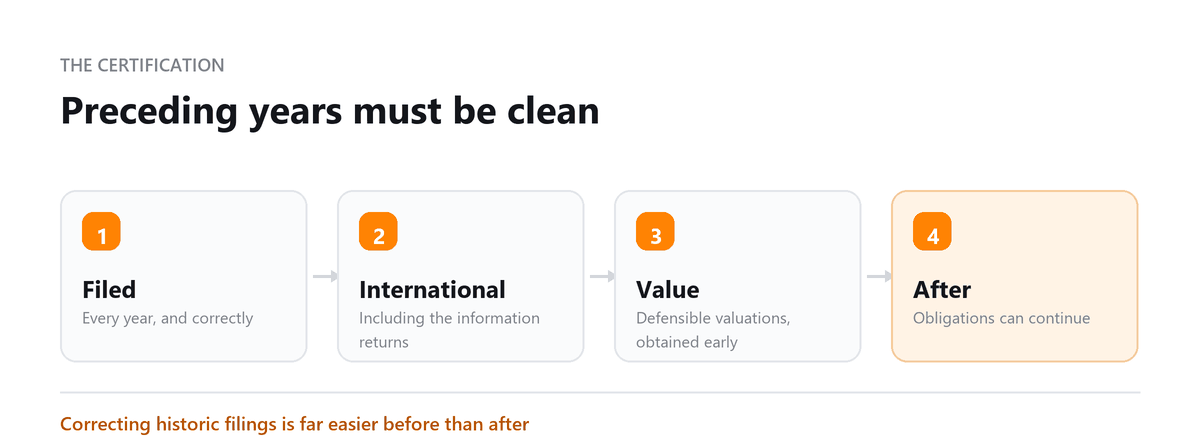
This is not primarily a calculation. It is a certification that all filing obligations for a defined period of preceding years have been met, and a person who cannot make that certification is treated unfavourably regardless of their financial position.
- The preceding years have to be filed and correct, not merely filed
- That includes any international information reporting for those years, which is where gaps most often exist
- Correcting historic filings is generally far easier before the expatriation than afterwards
- The certification is made under penalty of perjury, so it is not a formality
Anyone contemplating expatriation should establish their compliance position first and work backwards from there. Discovering an unfiled international form for an earlier year after the event is a materially worse situation than finding it beforehand.
Planning Happens Before, Not After
Almost every decision that affects the outcome is taken before the expatriation date, and after it very little remains available.
That covers the timing of the act itself relative to income and gains, how assets are held and valued, whether particular holdings are dealt with beforehand, and the treatment of deferred compensation and retirement arrangements, which follow their own rules.
Valuation is a significant part of the work and is frequently underestimated, particularly where a private business interest, real property or an illiquid holding is involved. Obtaining defensible valuations takes time, and the figures used have to be supportable rather than estimated.
Obligations Can Continue Afterwards
Expatriation is not always the end of the relationship. Depending on circumstances, filing obligations can continue, particularly where deferred arrangements exist or where an election has been made in connection with the expatriation.
There are also consequences for people who receive gifts or bequests from someone who expatriated, which is a consideration for family rather than for the individual alone and is rarely discussed at the time.
Because the rules are detailed, the certification carries real exposure, and the planning window closes on a specific date, this is one of the clearest cases in the whole area for advice well in advance. Current definitions, thresholds and procedures are published by the IRS and have been amended.
Long-Term Residents Are Caught Too
The rules are usually discussed in terms of citizenship, and they apply to certain long-term permanent residents as well. That is the group most likely to be caught unaware.
Someone who held a green card for a sufficient number of years and then gives it up, or allows it to lapse, can fall within the same regime as a citizen renouncing. People frequently assume that letting a card expire is a passive act with no tax consequence, and for a long-term holder it may not be.
The timing of when residency ends, and how it is formally ended, matters to the outcome. So does the length of time the card was held, since the test counts years rather than looking at current status alone. Anyone in this position should establish where they stand before allowing a card to lapse, because after the event the planning options have gone.
Book a free consultation well before you act.
FAQs
Who has to file Form 8854?
Form 8854 is filed by US citizens who relinquish citizenship and by long-term permanent residents who give up green card status. It is how you certify that you have met your US tax obligations for the five years before expatriating and report the information the IRS uses to decide whether you are a covered expatriate.
What makes someone a covered expatriate?
There are three tests and meeting any one of them is enough: a net worth at or above $2 million on the expatriation date, an average annual net income tax above an inflation-adjusted threshold for the five years before expatriating, or a failure to certify five years of full US tax compliance on Form 8854.
Can a missed tax return make me a covered expatriate?
Yes. The certification test is independent of your assets and income, so a single unfiled return or FBAR in the five-year lookback can make you a covered expatriate even when your net worth and tax liability are well below the other thresholds. Catching up on those filings before the expatriation date is usually far simpler than dealing with covered expatriate status afterwards.
How does the exit tax work?
A covered expatriate is generally treated as having sold their worldwide assets at fair market value on the day before expatriating, with the resulting net gain taxed after an exclusion amount that is adjusted each year. Certain deferred compensation, specified tax deferred accounts and interests in non-grantor trusts are handled under separate rules rather than this mark-to-market calculation.
When and where is Form 8854 filed?
The form is attached to your final US tax return for the year you expatriate, filed by that return's normal due date including extensions, and a separate copy is sent to the IRS address given in the form's instructions. Filing the return without the form, or sending only one of the two copies, leaves the certification incomplete.

Written by
Ankit Sarawagi, CPA, CA, MBA
Ankit leads the finance team at Profitjets, where he has worked with 500+ businesses across the US on bookkeeping, tax and CFO-level strategy. He writes about the habits that keep small business books accurate all year. Connect on LinkedIn
Free consultation
Considering Expatriation?
Book a free consultation well before you act.