
Every January, families with a student in college receive a Form 1098-T and hand it to whoever prepares their taxes, expecting the software to take care of the rest. Sometimes it does. Often it doesn't. The credit ends up claimed on the student's return when it should be on the parents', a scholarship quietly wipes out the expenses the credit is based on, or a family claims the smaller credit when they qualify for the larger one.
Form 8863 is where two federal education credits are claimed: the American Opportunity Tax Credit and the Lifetime Learning Credit. Both reduce tax dollar for dollar, which makes them more valuable than a deduction of the same amount.
The American Opportunity Tax Credit is worth up to $2,500 per student and is partly refundable. The Lifetime Learning Credit is worth up to $2,000 per return and covers a much wider range of education, including graduate school and courses taken to build job skills.
The rules that decide which credit you get, and how much, sit in the details. Who claims the student as a dependent, what counts as a qualified expense, how scholarships and 529 plan withdrawals are handled, and whether the student is subject to the kiddie tax can all change the result.
A little planning before filing, and sometimes before paying tuition, can make a noticeable difference.
This guide explains how the American Opportunity Tax Credit and Lifetime Learning Credit compare, who can claim them, the income limits, what counts as a qualified expense, how Form 1098-T, scholarships, and 529 plans affect the credit, and how to complete and file Form 8863.
What is Form 8863?
Form 8863, Education Credits (American Opportunity and Lifetime Learning Credits), is used to figure and claim education credits for qualified education expenses paid for eligible students at eligible educational institutions.
An eligible educational institution is generally any college, university, vocational school, or other postsecondary institution eligible to participate in federal student aid programs. Most accredited public, nonprofit, and for-profit postsecondary schools qualify, and some qualifying institutions are located outside the United States.
Who Claims the Credit When the Student is a Dependent
If you claim a student as your dependent, only you can claim the education credit for that student's expenses, even if the student paid the tuition. Expenses paid by the student, or by a third party such as a grandparent paying the school directly, are treated as paid by the student and therefore by the person claiming the student as a dependent.
If no one claims the student as a dependent, the student can claim the credit on their own return, including for expenses paid by someone else.
American Opportunity Credit vs Lifetime Learning Credit
| Factor | American Opportunity Credit (AOC) | Lifetime Learning Credit (LLC) |
|---|---|---|
| Maximum credit | $2,500 per student per year | $2,000 per tax return per year |
| Eligible years | First 4 years of higher education only | Any year of post-secondary education |
| Enrollment requirement | At least half-time for at least 1 academic period | Any enrollment |
| Prior credit disallowance | Cannot have completed 4 years of post-secondary education | No restriction |
| Felony drug conviction | Student must not have a felony drug conviction | No restriction |
| Refundable? | 40% refundable, up to $1,000 even with no tax liability | NOT refundable |
| Eligible expenses | Tuition, fees, AND required course materials (books, supplies) | Tuition and fees only (not books) |
A student in their first four years who's enrolled at least half time should almost always get the American Opportunity Tax Credit rather than the Lifetime Learning Credit. And when a student has a scholarship, it can sometimes make sense to treat part of it as taxable income so tuition paid with family money supports the larger credit. That choice can be worth more than the extra tax on the student's return, but only if someone runs the numbers before filing.
Ankit Sarawagi, CPA, CA, MBA · LinkedInIncome Phase-Out Thresholds
| Credit | Single / HoH Phase-Out | Married Filing Jointly Phase-Out |
|---|---|---|
| American Opportunity Credit | $80,000 to $90,000 MAGI | $160,000 to $180,000 MAGI |
| Lifetime Learning Credit | $80,000 to $90,000 MAGI | $160,000 to $180,000 MAGI |
Note: These thresholds are NOT inflation-adjusted and have remained at the same levels for many years. Married Filing Separately filers cannot claim either credit.
How to Complete Form 8863
Form 8863 is generally organized into three parts. Complete Part III first.
Part III: Student and Educational Institution Information
Complete a separate Part III for each student. Enter the student's name and identifying number, information about each educational institution, and answers to the eligibility questions for the American Opportunity Tax Credit, such as whether the credit has already been claimed for four years, whether the student was enrolled at least half time, and whether the student has a felony drug conviction. Then figure the qualified expenses for either credit.
Part I: Refundable American Opportunity Credit
Total the American Opportunity Tax Credit for all students, apply the income phase-out, and figure the refundable portion. The refundable amount is reported with other refundable credits on Form 1040.
Part II: Nonrefundable Education Credits
Figure the Lifetime Learning Credit, apply the income phase-out, and combine it with the nonrefundable portion of the American Opportunity Tax Credit. The total is reported with other nonrefundable credits on Schedule 3.
Work from the current revision of Form 8863 and its instructions, since line numbers and eligibility questions are updated periodically.
When to File Form 8863
Form 8863 doesn't have its own deadline. It's attached to your Form 1040, 1040-SR, or 1040-NR for the year you paid the qualified expenses, and it's due when that return is due, generally April 15, or October 15 with an extension.
If you qualified for an education credit but didn't claim it, you can generally file an amended return with Form 8863 within three years from the date you filed the original return, or two years from the date you paid the tax, whichever is later.
Required Source Document: Form 1098-T
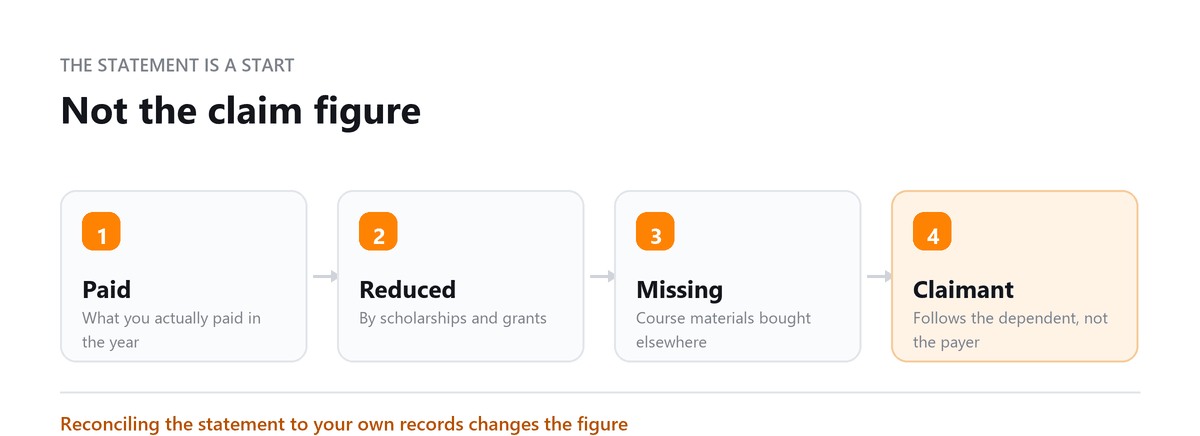
Educational institutions send Form 1098-T (Tuition Statement) to students by January 31. Box 1 shows the amounts billed or payments received (varies by institution reporting method). Use Form 1098-T as the primary source for qualifying education expenses. Note: the amount on Form 1098-T may differ from what is deductible, scholarship or grant amounts reduce eligible credit expenses.
If Your Credit Was Previously Disallowed
If the IRS reduced or disallowed your American Opportunity Tax Credit for a prior year for any reason other than a math or clerical error, you generally must attach Form 8862 the next time you claim it. If the IRS found that a prior claim involved reckless or intentional disregard of the rules, you can't claim the credit for two years, and a fraud finding bars the credit for ten years.
Filing Deadline
Form 8863 is filed with the annual tax return. For TY2025: April 15, 2026 (or October 15, 2026 with extension).
Profitjets has processed more than 75 education tax credit claims, helping families review eligibility for the American Opportunity Credit (AOC) and Lifetime Learning Credit and maximize available education-related tax benefits.
“Our daughter was in college, and Profitjets reviewed her tuition and other qualified education expenses to determine whether we could claim the American Opportunity Credit. They also checked our income against the AOC phase-out limits and confirmed that we qualified for the refundable portion, resulting in approximately $2,500 in total AOC benefits for the year.”
Book a free consultation and we will check which credit fits.
Frequently Asked Questions
Which is better, the American Opportunity Tax Credit or the Lifetime Learning Credit?
For a student in their first four years of college who's pursuing a degree and enrolled at least half time, the American Opportunity Tax Credit is usually better. It's worth up to $2,500 per student, up to $1,000 of it can be refunded, and it covers required course materials. The Lifetime Learning Credit is useful for graduate students, part-time students, and people taking courses to improve job skills.
What are the income limits for education credits?
Both credits phase out between $80,000 and $90,000 of modified adjusted gross income for single, head of household, and qualifying surviving spouse filers, and between $160,000 and $180,000 for married couples filing jointly. No credit is available above those ranges, and married couples filing separately can't claim either credit.
Can a student claim the credit if their parents claim them as a dependent?
No. If a parent claims the student as a dependent, only the parent can claim the education credit, even if the student paid the tuition. If no one claims the student as a dependent, the student can claim it on their own return.
Can I use a 529 plan and still claim an education credit?
Yes, but not for the same expenses. Expenses used to figure the education credit must be subtracted from the expenses used to make the 529 distribution tax-free. Coordinating how expenses are allocated between the two lets you claim the credit without making part of the distribution taxable.
Do I need Form 1098-T to claim an education credit?
To claim the American Opportunity Tax Credit, you generally must have received Form 1098-T from the educational institution, with limited exceptions. For both credits, the form is a starting point, and you should keep receipts and statements showing the qualified expenses you actually paid.

Written by
Ankit Sarawagi, CPA, CA, MBA
Ankit leads the finance team at Profitjets, where he has worked with 500+ businesses across the US on bookkeeping, tax and CFO-level strategy. He writes about the habits that keep small business books accurate all year. Connect on LinkedIn
Free consultation
Paying College Fees?
Book a free consultation and we will check which credit fits.