
Form 8995 is used to calculate the Qualified Business Income (QBI) deduction under IRC Section 199A is a deduction of up to 20% of qualified business income for eligible pass-through business owners (sole proprietors, partnerships, S corporations, and certain trusts). This is one of the most valuable deductions available to small business owners, and one of the most complex.
A freelance designer, a family-owned HVAC company, a rental property owner, and a partner in a small consulting firm all have something in common. Their business income flows through to their personal tax returns, and many of them can deduct up to 20 percent of that income without spending another dollar. It's one of the most valuable tax breaks available to small business owners, and it's also one of the most often miscalculated.
That break is the qualified business income deduction under Section 199A. It's claimed on the owner's individual return, not on the business's return, and it reduces taxable income without requiring you to itemize.
For owners whose taxable income stays below an annual threshold, the calculation is straightforward and goes on Form 8995. Above the threshold, limits based on W-2 wages, business property, and the type of business kick in, and the calculation moves to Form 8995-A.
What still trips people up is how the deduction interacts with S corporation salaries, how service businesses are treated, and what counts as qualified business income in the first place.
This guide explains what the qualified business income deduction is, who qualifies, what counts as qualified business income, the income thresholds, how specified service businesses are treated, when to use Form 8995 or Form 8995-A, what changed permanently in 2025, and how to complete the form.
TCJA Sunset Warning: Act Before December 31, 2025
Once taxable income moves into the phase-in range, the deduction for a specified service business starts shrinking, and above that range it disappears. So planning often happens on the personal return: retirement contributions, the timing of income, and how an S corporation owner's salary is set can decide whether a service business owner keeps the deduction or loses it.
Ankit Sarawagi, CPA, CA, MBA · LinkedInWhat Is the QBI Deduction?
Eligible business owners can deduct up to 20% of their qualified business income (QBI), the net profit from their pass-through business. The deduction is claimed on the individual return (not at the business entity level) and reduces taxable income, not AGI.
- Maximum deduction: 20% of QBI (with limitations based on income and business type)
- Available to: sole proprietors (Schedule C), partners in partnerships, shareholders in S corporations, and certain trust and estate beneficiaries
- NOT available to: C corporations (they have their own flat 21% rate)
TY2025 Income Thresholds
| Filing Status | TY2024 Threshold (Live Page) | TY2025 Threshold (Updated) |
|---|---|---|
| Single / HoH / MFS | $191,950 (2024) | $197,300 (2025) |
| Married Filing Jointly | $383,900 (2024) | $394,600 (2025) |
Below these thresholds: the full 20% deduction applies to all QBI from any trade or business. Above these thresholds: additional limitations apply based on W-2 wages paid and qualified property, and specified service trades or businesses (SSTBs) begin to phase out.
Specified Service Trades or Businesses (SSTBs)
SSTBs are businesses where the principal asset is the skill or reputation of employees or owners. They include: law, accounting, health, consulting, athletics, financial services, performing arts, and brokerage services. Engineering and architecture are NOT SSTBs.
- Below the threshold ($197,300 single / $394,600 MFJ for TY2025): SSTBs get the full 20% deduction, no restriction
- Phase-out range (above threshold by $50,000 single / $100,000 MFJ): SSTB deduction phases out
- Above phase-out range: SSTB owners receive NO QBI deduction
Form 8995 vs Form 8995-A
| Form | Who Uses It |
|---|---|
| Form 8995 (simplified) | Taxpayers with income below the threshold ($197,300/$394,600 for TY2025), straightforward calculation |
| Form 8995-A | Taxpayers above the threshold, complex W-2 wage limitation, property basis calculation, and SSTB phase-out apply |
Step-by-Step: Form 8995
- Line 1: List each qualified trade or business and its QBI amount
- Line 4: Net QBI (sum of all businesses; losses from one offset gains from another)
- Line 5: 20% of Line 4, the tentative QBI deduction
- Line 10: 20% of ordinary qualified REIT dividends and PTP income (adds to the deduction)
- Line 15: QBI component deduction (subject to overall taxable income limit)
- Line 16: Overall limitation, QBI deduction cannot exceed 20% of (taxable income minus net capital gains)
Profitjets has calculated Qualified Business Income (QBI) deductions for more than 60 pass-through business clients, identifying eligible deductions and coordinating income, wage, and business-structure planning to support tax-efficient outcomes.
“My business income had grown enough that Profitjets recommended reviewing both my S-corporation structure and QBI deduction before year-end. They helped time some income, optimize my W-2 wages, and plan the business expenses, resulting in an estimated $32,000 QBI deduction on my return.”
What Counts as Qualified Business Income
The deduction applies to income from a qualifying trade or business, and several things that feel like business income are excluded.
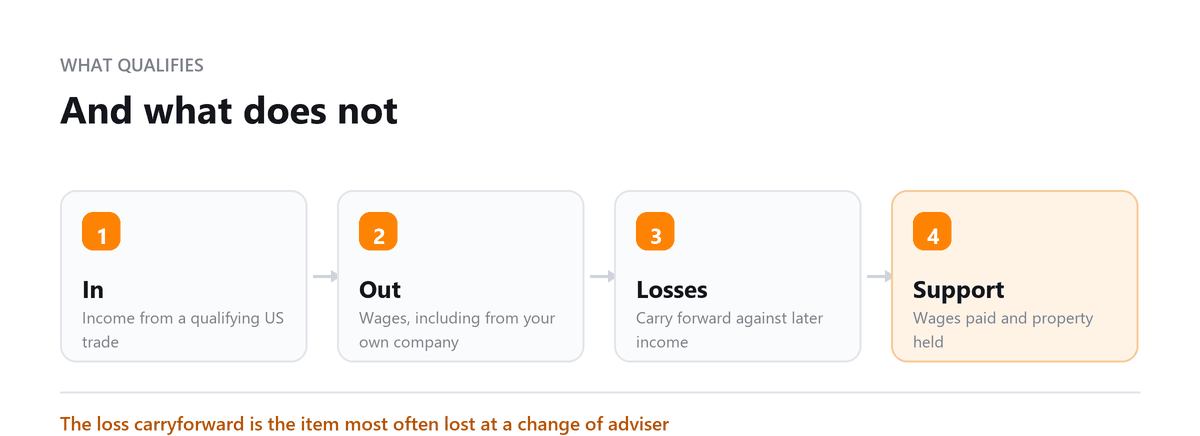
- Income from a qualifying trade or business conducted in the US is generally within it
- Wages received as an employee are outside it, including wages from your own corporation
- Certain investment-type income is excluded even where it arises inside a business
- Income from outside the US is generally excluded
- Losses carry forward and reduce the qualifying income of later years, which is frequently overlooked
The loss carryforward is the item most often missed, because it requires tracking a figure across years that produces no benefit in the year it arises. Keeping that schedule with your own records rather than only in a preparer's file is what stops it being lost at a change of adviser.
Aggregation and Entity Structure
Where a taxpayer has more than one business, there are rules allowing them to be treated together in defined circumstances, and the choice affects the result.
Aggregation can help where one business has the characteristics that support a larger deduction and another does not, but the conditions are specific and the election is not freely reversible year to year. It also has to be disclosed.
Entity structure matters alongside it, because the calculation interacts with wages paid and with property held, both of which depend on how the business is organised. That is why this is one of the areas where the structure decision and the tax outcome are genuinely connected, and worth modelling together rather than separately.
Records That Support the Claim
Above certain income levels the calculation depends on figures that have to be evidenced rather than estimated.
That generally means wages paid by the business as reported on payroll filings, and the unadjusted basis of qualifying property with its acquisition dates, since the property element depends on how long assets have been held.
It also means being able to demonstrate the nature of the business where the service-business restrictions could apply, which is a facts question about what the business actually does rather than about how it describes itself. Thresholds, definitions and the treatment of service businesses are set out in the current IRS guidance and have been subject to change.
Service Businesses and the Restriction
The rules restrict the deduction for certain service businesses once income passes defined levels, and the definition of which businesses are caught is narrower and stranger than most people expect.
It covers named fields, and the boundary cases are genuinely difficult: a business that combines services with products, one that could be described in more than one way, or one whose principal asset is arguably the reputation or skill of its owners.
Because the restriction only applies above certain income levels, many businesses in these fields are unaffected entirely. Where income is close to the threshold, the planning that matters is about the income measure rather than about the business description, and it happens before the year ends. Current definitions and thresholds are published by the IRS and have been the subject of detailed guidance.
Book a free consultation and we will check the structure first.
Frequently Asked Questions
What is the QBI deduction for 2025 and 2026?
Eligible owners can deduct up to 20 percent of qualified business income from pass-through businesses, plus 20 percent of qualified REIT dividends and PTP income. For 2025, taxpayers with taxable income before the deduction at or below $197,300, or $394,600 for joint filers, generally receive the full deduction. For 2026, the thresholds are $201,775 and $403,550.
Is the QBI deduction still available after 2025?
Yes. It was originally scheduled to expire after 2025, but legislation passed in 2025 made it permanent. Starting in 2026, the phase-in range for higher earners is wider, and a minimum deduction applies for active business owners with at least $1,000 of qualified business income.
When do I use Form 8995-A instead of Form 8995?
Use Form 8995-A if your taxable income before the QBI deduction is above the annual threshold, or if you're a patron in a specified agricultural or horticultural cooperative. Form 8995-A applies the W-2 wage and property limit, the specified service business phase-in, and aggregation rules.
Do doctors, lawyers, and consultants qualify for the QBI deduction?
Yes, if their taxable income is at or below the threshold. These businesses are specified service trades or businesses, so the deduction phases out as taxable income moves through the phase-in range and isn't available once income is above that range.
Does the QBI deduction reduce self-employment tax?
No. The deduction reduces taxable income for federal income tax purposes only. It doesn't reduce adjusted gross income, self-employment tax, or the net investment income tax.

Written by
Ankit Sarawagi, CPA, CA, MBA
Ankit leads the finance team at Profitjets, where he has worked with 500+ businesses across the US on bookkeeping, tax and CFO-level strategy. He writes about the habits that keep small business books accurate all year. Connect on LinkedIn
Free consultation
Claiming the QBI Deduction?
Book a free consultation and we will check the structure first.