
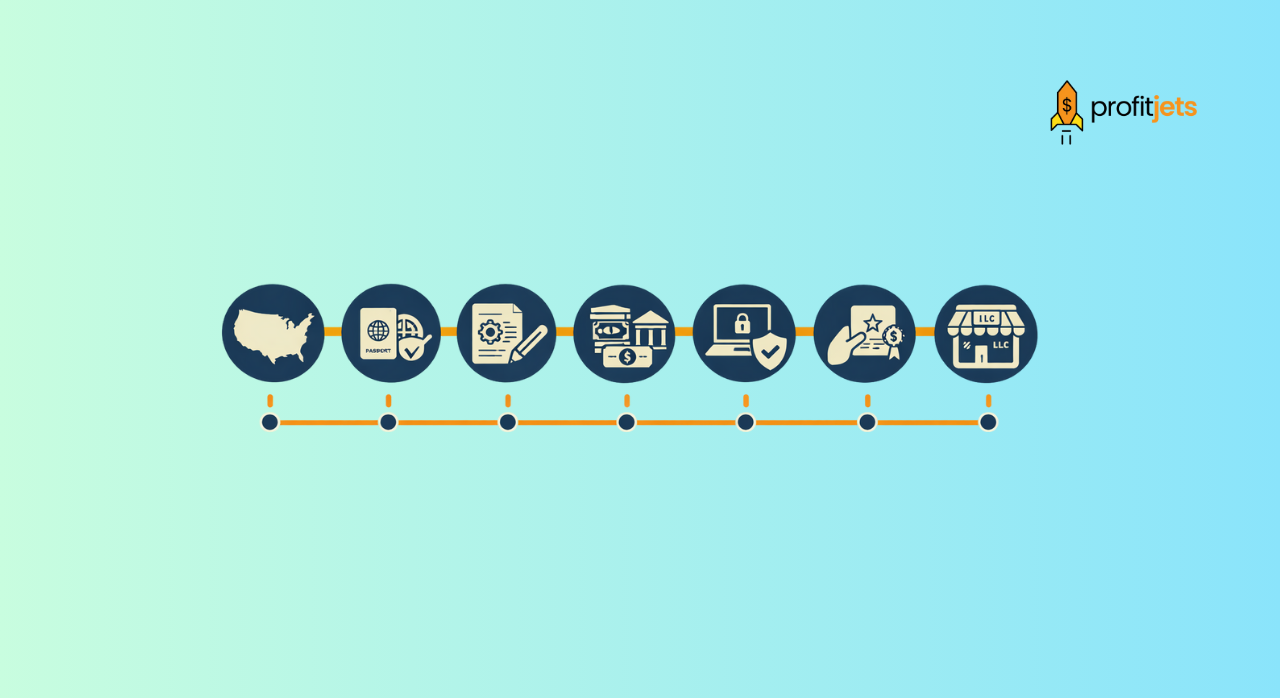
Expanding your startup into the United States can unlock a world of opportunities. Fortunately, how to start an LLC in the US for foreigners is simpler than it sounds – you don’t need U.S. citizenship or even to set foot on American soil to get started. In fact, LLC for non-US residents has become a popular strategy for international founders seeking credibility, access to the U.S. market, and legal protections for their business. In this guide, we’ll break down US LLC formation for non-residents into 8 clear steps. Each step includes practical guidance (and even examples) to make the process strategic yet straightforward. We’ll also highlight how Profitjets can be your full-service partner at every step, simplifying the journey of forming and growing your U.S. company.
Table of Contents
Introduction: Why Form a U.S. LLC as a Non-Resident?
Forming a U.S. LLC (Limited Liability Company) can be incredibly beneficial for foreign entrepreneurs. An LLC provides personal liability protection – separating your personal assets from business debts – and is relatively easy to maintain. It’s a flexible business structure with pass-through taxation, meaning profits are taxed on your personal return (no double taxation at the company level). This can often result in simplified or lower taxes. For example, if your U.S. LLC is 100% foreign-owned and earns no U.S.-sourced income, you may owe no U.S. federal tax on those earnings (always confirmed with a tax advisor). Beyond legal perks, having a U.S. company boosts your credibility with American clients and partners. It also enables you to open a U.S. business bank account, accept USD payments (via services like Stripe or PayPal), and tap into the world’s largest consumer market. In short, a U.S. LLC can be your gateway to scaling globally.
Good news: Any non-U.S. resident can form an LLC in the United States. You do not need to be a U.S. citizen, hold a green card, or have a Social Security Number to open an LLC. The process can be done remotely from your home country. That said, there are a few important steps and requirements to get it right. Let’s dive into the 8 simple steps to open an LLC as a non-resident, and see how Profitjets can help streamline each one.
Step 1: Choose the Right State for Your U.S. LLC
The first decision is deciding which U.S. state to form your LLC in. Every state has its own incorporation laws, fees, and benefits. As a non-resident, you generally have the freedom to choose any state, since you won’t have a “home state” in the U.S. Many international founders gravitate toward business-friendly states like Delaware or Wyoming.
- Delaware is famous for its well-established legal system and investor-friendly laws. It’s often the top choice if you plan to raise venture capital; many U.S. investors prefer Delaware entities.
- Wyoming is popular for its low fees and strong privacy (members are not publicly listed). It has no state income tax and low annual costs, making it ideal for a simple, cost-effective setup.
- Other options include Nevada (no state income tax, similar to Wyoming) or forming in a specific state where you expect to have a physical presence or customers. For instance, if you know you’ll operate in California, you might form your LLC there to simplify compliance, even though fees may be higher.
Example: If you’re a SaaS startup founder in Europe with an online-only business, you might choose Wyoming for minimal fees and hassle. On the other hand, if you’re aiming to join a U.S. tech accelerator or seek Silicon Valley investors, Delaware could be advantageous for the prestige and familiarity.
Profitjets tip:* Not sure which state suits your business best? Profitjets* offers strategic consultations to help non-U.S. founders pick the optimal state for their LLC. Our experts weigh factors like tax implications, fees, privacy, and your long-term goals. Reach out for a free consultation, and let Profitjets guide you to the right choice from day one.
Step 2: Pick a Unique Business Name and Check Availability
Every LLC needs an official name. In Step 2, you’ll choose a unique name for your company and ensure it meets state requirements. Here’s how to proceed:
- Brainstorm a Name: Pick a name that reflects your brand and is easy to remember. It must include a designator like “LLC” or “Limited Liability Company” at the end (for example, ABC Innovations LLC).
- Follow Naming Rules: Each state has rules – typically, the name can’t be misleading or too similar to an existing business. It also cannot include restricted words (like “Bank” or “Insurance”) unless your business is licensed accordingly.
- Check Availability: Search the business name database on the website of the Secretary of State (or equivalent state registry) for your chosen state. This lets you verify that no other company is already registered under your desired name. Most states offer a free online name search tool.
- Reserve (Optional): Some states allow you to reserve the name for a small fee if you’re not ready to file your LLC immediately. This can secure the name for you for a set period.
Example: Suppose you want to name your LLC “Global Tech Solutions LLC.” You’d search the Delaware Secretary of State’s online records to ensure “Global Tech Solutions” isn’t taken or too close to an existing name. If it’s available, you’re good to go. If not, you might try variations until you find a unique one.
Profitjets tip:* Coming up with a compliant name can be tricky across languages and legal rules. Profitjets* can assist you with the name search and ensure your chosen name meets all state guidelines. We help verify availability and can even handle name reservations. Save time by letting Profitjets double-check the details so your LLC name approval goes through smoothly.
Step 3: Appoint a Registered Agent in the U.S.
All U.S. LLCs are required to have a Registered Agent (RA) in their state of formation. A registered agent is a person or company with a physical address in the state who is designated to receive official mail and legal documents (like service of process if your company is ever sued, or state correspondence).
As a non-U.S. resident (and likely living overseas), you cannot serve as your own registered agent unless you have a physical address and are present in the state. Therefore, you will need to hire a registered agent service or use a representative in that state.
What to look for in a Registered Agent service:
- Reliable Service: They should promptly notify you and forward any mail or legal notices received. Time-sensitive documents like lawsuit notices require quick action.
- Compliance Support: A good agent will remind you of state filing deadlines (like annual report due dates) since they often receive those notices.
- Coverage: If you plan to register in multiple states (not common for a new LLC, but future growth might require it), some services offer nationwide coverage.
Most states charge $100–$200 per year for professional registered agent services (some are less). It’s a necessary investment for non-resident LLC owners to maintain good standing.
Example: If you form your LLC in Wyoming but live in Asia, you can contract a Wyoming registered agent service. They provide you with a Wyoming address (for official purposes) and will email you scans of any documents they receive for your company.
Profitjets tip:* Profitjets can arrange registered agent services* on your behalf in all 50 states. We partner with reputable registered agents to ensure you never miss an important document. By using Profitjets as your liaison, you get peace of mind that your LLC’s legal correspondence is handled professionally. We’ll help you fulfill this requirement easily so you can form an LLC in the US without a physical presence.
Step 4: File the LLC Formation Documents (Articles of Organization)
Now comes the core step: officially registering your LLC with the state. To do this, you must file the LLC formation documents (often called “Articles of Organization” or “Certificate of Formation”, depending on the state). This can usually be done online via the Secretary of State’s website, or you can file by mail. Here’s what’s generally involved:
- Prepare Required Information: You’ll need your chosen LLC name, the principal business address (you can often use your registered agent’s address if you don’t have a U.S. office), the name and address of your registered agent, and the names of the LLC’s owners or managers (some states don’t require listing members in public filings).
- Fill Out the Form: Each state provides a form or online portal to input these details. Double-check spellings and accuracy.
- Pay the State Fee: Filing fees range from around $50 up to a few hundred dollars depending on the state. (For example, Wyoming’s LLC filing fee is $100, Delaware’s is around $90, while states like California charge $70 plus additional franchise tax fees in the first year.)
- Submission: Submit the form and fee. If online, approval can be quick (a few days to a couple of weeks). By mail, it might take a few weeks to process. Some states offer expedited service for an additional fee if you need the LLC formed urgently.
- Receive Confirmation: Once approved, the state will issue a formal certificate or acknowledgment of your LLC. Congratulations – your LLC is now officially formed!
Example: Let’s say you chose Delaware. You would file the Certificate of Formation with the Delaware Division of Corporations (which can even be done online). You might list “XYZ Ventures LLC” with Profitjets’s Delaware registered agent address and pay the state fee. In a few days, Delaware emails you a stamped Certificate of Formation – your company’s birth certificate.
Profitjets tip:* Paperwork and legal forms can be daunting across borders. Profitjets simplifies this step by handling the LLC filing for you*. Our team will prepare and file your Articles of Organization in the state of your choice, ensuring everything is filled out correctly. We deal with the state bureaucracy and fees on your behalf, so you don’t have to navigate confusing state websites or international mail. With Profitjets managing your LLC formation, you can form a U.S. company hassle-free.
Step 5: Obtain an EIN (Employer Identification Number)
After your LLC is formed at the state level, the next crucial step is getting an EIN (Employer Identification Number) from the U.S. Internal Revenue Service (IRS). An EIN is basically a tax ID number for your business – think of it like a social security number for your company. You’ll need an EIN to pay taxes, open a U.S. bank account, hire employees, or even to apply for certain licenses.
How to get an EIN as a non-U.S. resident:
- The IRS issues EINs for free. U.S. residents can apply online and get it immediately, but foreign applicants (without an SSN) cannot use the online system.
- Apply by Fax or Mail: The common method is to fill out IRS Form SS-4 and fax it to the IRS. Faxing from abroad is doable (and typically processed in about 1-2 weeks). If you mail the form, it can take several weeks.
- Apply by Phone: In some cases, you can call the IRS’s international EIN department and obtain an EIN over the phone if the paperwork is in order. This is a faster option, but navigating the call can be challenging due to time zones and hold times.
- Information needed: The SS-4 form will ask for your LLC name, formation state, business address (you can use your foreign address for mailing, or your registered agent’s address for principal place if allowed), and the “responsible party” (an individual associated with the business – this can be you as the owner). If you don’t have a U.S. Social Security Number, that’s okay – you simply write “Foreign” in the SSN field.
Example: Maria, an entrepreneur from Spain, formed her LLC in Texas. To get her EIN, she fills out Form SS-4 with her details and faxes it to the IRS. In two weeks, she receives her EIN via fax reply. Now Maria’s LLC can legally hire U.S. contractors and open a bank account. (Alternative scenario: If Maria found faxing tricky, she could use a service provider to handle the EIN process, saving her the trouble.)
Profitjets tip:* Obtaining an EIN can be one of the more confusing steps for foreign owners – but Profitjets has you covered. We assist non-U.S. clients in EIN application* from start to finish. Our team will prepare Form SS-4 for you, handle the communication with the IRS (fax or phone), and secure your EIN as quickly as possible. No need to navigate IRS bureaucracy or international fax numbers alone. With Profitjets’ help, your LLC’s tax ID will be in hand so you can move forward to the next steps seamlessly.
Step 6: Open a U.S. Business Bank Account
With your formation documents and EIN ready, you can now open a U.S. business bank account for your LLC. Having a U.S. bank account is invaluable – it lets you easily transact in U.S. dollars, pay American vendors or employees, and accept customer payments without costly foreign exchange fees. It also helps establish your company’s financial presence in the U.S. banking system.
Key considerations for non-residents opening a bank account:
- Documentation: Most banks will require your LLC formation certificate, EIN confirmation letter, and identification (passport) for the company owners. They may also ask for your LLC Operating Agreement (more on that in the next step) and proof of business address.
- In-Person vs. Online: Traditionally, many U.S. banks require an in-person visit to open an account, which can be difficult if you’re overseas. However, some banks and financial tech companies cater to non-residents. For example, Mercury and Relay are online banking platforms that allow non-U.S. founders to open business accounts remotely once your LLC and EIN are set. These can provide FDIC-insured business checking accounts with a fully online process.
- Choose the Right Bank: If you plan to be in the U.S., major banks like Chase or Bank of America might open an account for you in branch (call ahead to confirm requirements for foreign owners). If not, online solutions or international banks with U.S. operations (like HSBC) might be more flexible for remote opening.
- Address Requirements: Banks often want a U.S. mailing address on file. You can typically use your registered agent’s address or a virtual office address if needed.
Example: Ali, a founder from the Middle East, has just formed a Delaware LLC. Instead of flying to the U.S. to visit a bank, he uses an online service (Mercury) to set up his business banking. He provides digital copies of his Delaware Certificate of Formation, EIN letter, and passport. Within a few days, his U.S. business checking account is approved – allowing him to start sending invoices in USD and managing funds from abroad.
Profitjets tip:* Navigating U.S. banking as a foreigner can be one of the trickiest parts of expanding globally. Profitjets offers guidance on choosing the right banking solution*. We’ll prepare you with all necessary documents and introduce you to trusted banking partners who welcome international entrepreneurs. Whether it’s setting up a fintech online account or finding a bank that accommodates non-resident owners, Profitjets will help you get your U.S. business banking up and running, so you can operate your LLC smoothly.
Step 7: Draft an Operating Agreement and Obtain Any Required Licenses
With the major formation steps done, it’s important not to overlook a couple of additional items before you start doing business:
A. Create an Operating Agreement: An Operating Agreement is an internal document that outlines how your LLC will be run. It covers ownership percentages, profit sharing, management structure, and procedures for adding or removing members. Even if you are a single-owner LLC, writing an operating agreement is highly recommended – it adds legitimacy and clarity. In some states (like California and New York), LLCs are legally required to have one (though you don’t file it with the state). Moreover, banks or investors may ask for your operating agreement to understand your company’s governance. You can find templates to draft one yourself, or consult an attorney for a customized agreement if you have multiple partners or specific terms.
B. Check Business License and Permit Requirements: Forming an LLC gives you a legal business entity, but it’s not a license to operate specific activities. Depending on your business type and where you conduct business, you may need additional licenses or permits, such as: – Local business licenses: Many cities/counties require a basic business operating license for any business activity in their jurisdiction. – Industry-specific permits: e.g., selling goods might require a state sales tax permit; running a restaurant or food business requires health permits; professional services (law, medicine, real estate, financial advising, etc.) often require professional licenses. – Import/Export permits: if you plan to import goods into the U.S. or export from the U.S., ensure you have the proper federal permits or registrations.
Do some research for the state/city of your principal place of business (if you have one) or the industry you’re in. As a foreign founder operating remotely, keep in mind you must comply with U.S. laws for any business conducted on U.S. soil or with U.S. customers.
Example: You started an e-commerce LLC selling products to U.S. customers. After forming the LLC, you obtain a sales tax permit in the states where you have sales (often just your formation state initially) so you can collect and remit sales tax. You also draft an operating agreement naming you as 100% owner and outlining how you’ll manage the business. With these in place, you’re legally ready to launch operations.
Profitjets tip:* Dotting the i’s and crossing the t’s is easier with expert help. Profitjets can assist you in drafting a solid Operating Agreement and ensure you meet any licensing requirements*. Our team will point out which permits or registrations your business might need, and connect you with the right resources (or professionals) to secure them. We make sure that after setting up the LLC, you have all the pieces in place to operate legally and efficiently.
Step 8: Maintain Compliance and Leverage Ongoing Support
Congratulations – your U.S. LLC is officially established! The final step is ongoing: keeping your LLC in good standing and well-managed. Here’s what to keep in mind as you start operating:
- Annual Reports & Fees: Most states require LLCs to file an annual report or statement and pay a small fee each year. For example, Delaware LLCs pay an annual franchise tax (around $300) and file a report; Wyoming LLCs file a minimal annual report with a $60 fee. Mark your calendar for these deadlines to avoid penalties.
- Taxes: Even as a non-resident, you may have U.S. tax filing obligations. Single-member foreign-owned LLCs need to file Form 5472 and a pro-forma tax return each year (even if no income, per IRS regulations). If your LLC earns U.S. effectively-connected income, you’ll need to file a U.S. tax return and possibly pay federal and state taxes. Consider hiring a U.S. accountant to navigate these rules, especially to take advantage of any tax treaties your country has with the U.S.
- Bookkeeping and Accounting: Keep your business finances separate and organized. Use accounting software or services to track income and expenses. Good records are vital for tax time and overall business health.
- Compliance Changes: Stay updated on new laws. (For instance, starting 2024, the U.S. Corporate Transparency Act requires most LLCs to file a Beneficial Ownership Information report with the Treasury’s FinCEN, disclosing the company’s owners. This applies to foreign-owned LLCs too – an important new compliance step to note.)
- Registered Agent Renewal: Maintain your registered agent service each year. If your agent or address changes, update the state records promptly to avoid losing good standing.
- Growth Considerations: If your U.S. business grows, you might later need to register to do business in additional states (called “foreign qualification”), especially if you hire employees or open offices elsewhere in the U.S. Keep an eye on where your operations expand.
Running a U.S. company from abroad does add complexity, but you don’t have to do it alone. This is where having a partner becomes invaluable.
Profitjets final tip:* Profitjets is not just about forming your LLC – we’re here for the long haul. We provide comprehensive bookkeeping, tax compliance, and CFO services* to support your U.S. business year-round. Our team will remind you of filing deadlines, handle your accounting, and ensure you meet all legal requirements so you can focus on growing your business. With Profitjets as your full-service partner, you’ll stay compliant effortlessly and gain strategic financial insights to drive success.

Conclusion: Launch Your U.S. LLC with Confidence
Forming a U.S. LLC as a non-resident might seem daunting at first, but as we’ve shown, it boils down to 8 manageable steps. By choosing the right state, completing a few essential filings, and setting up proper banking and compliance measures, you can successfully establish your business in the United States. The process is very achievable – especially with experts guiding you.
Clarity and simplicity are key. Each step you take brings you closer to a fully operational U.S. company that can impress clients, protect your assets, and open new doors for growth. Remember, the benefits of a U.S. LLC – from liability protection to easier access to the U.S. market – far outweigh the initial effort of setting up. And you don’t have to navigate it solo.
Strong Call to Action: If you’re ready to take your startup global, let Profitjets be your trusted partner in U.S. business formation and beyond. We’ve helped countless international founders expand to the U.S. with ease. Profitjets offers full-service support – from forming your LLC, obtaining an EIN, and acting as your registered agent, to providing ongoing accounting and compliance care.
Get Started Today: Visit Profitjets.com or contact our team for a free consultation. We’ll walk you through how we can tailor our services to your needs and set up your U.S. LLC without hassle. Don’t let borders stand in the way of your business ambitions – with Profitjets by your side, opening an LLC in the USA is simple, strategic, and rewarding.
Equip your business for international success and reach out to Profitjets now to jumpstart your U.S. expansion! Your American LLC and a world of opportunity await.

FAQs
Can a non-U.S. resident open an LLC in the USA?
Yes. You can form a U.S. LLC even if you are not a U.S. citizen, don’t live in the U.S., and don’t have an SSN. Most founders complete the entire process remotely with the right support, including state filing, registered agent setup, and EIN application.
Do I need to visit the USA to start an LLC?
No. In most cases, you can form your LLC 100% online without traveling. The only part that may sometimes require extra planning is opening a U.S. bank account, but many modern platforms allow non-residents to open an account remotely with proper documents.
Which state is best for a foreigner to register an LLC?
It depends on your business goals.
– Wyoming is popular for low cost and privacy
– Delaware is preferred for investor-friendly credibility
– If you plan to operate in a specific state (customers, office, team), registering there may make compliance easier
A good choice depends on taxes, fees, long-term plans, and how you’ll run the business.
Can I get an EIN without a Social Security Number (SSN)?
Yes. Foreign owners can still obtain an EIN from the IRS without an SSN. You typically apply using Form SS-4 via fax, mail, or sometimes through the IRS phone process. Many founders choose to get help here because the EIN step can feel confusing the first time.
What ongoing compliance does a foreign-owned U.S. LLC need every year?
Foreign-owned LLCs often have annual responsibilities such as:
– State renewals / annual reports
– Registered agent renewal
– Form 5472 filing (with a pro-forma return) for many foreign-owned single-member LLCs
– BOI filing (FinCEN) under Corporate Transparency Act rules (in many cases)
Staying compliant matters because late filings can lead to penalties or loss of good standing.