
Introduction
Every sale you make and every dollar you spend is a financial event, and each one needs to be recorded. Businesses that track their sales and expenses daily enter tax season with clean, complete books and a clear picture of their financial position. Businesses that don't end up scrambling through months of bank statements at year-end, reconstructing records from receipts and memory, and often missing deductible expenses in the process.
Sound daily recording isn't about bureaucratic paperwork, it's about having accurate data to make decisions. When your books are current, you know your real margins, your actual cash position, and where your money is going. This guide covers the most effective methods, tools, and habits for recording daily sales and expenses in a way that scales with your business.
The businesses that struggle most at tax time are the ones that treated bookkeeping as an annual event. Daily recording doesn't mean hours of work, it means a 10-minute discipline that prevents a 10-hour problem at year end.
Ankit Sarawagi, CPA, CA, MBA · LinkedInMost Effective Ways to Record Daily Sales and Expenses
1. Understand Whether to Use Cash Basis or Accrual
Before you can record transactions correctly, you need to know which accounting method applies to your business. Cash basis accounting records revenue when cash is received and expenses when cash is paid, it's simpler and better suited to very small businesses with no significant inventory or credit sales. Accrual accounting records revenue when earned and expenses when incurred, regardless of cash timing, it produces a more accurate picture of financial performance and is required for businesses above certain revenue thresholds.
For most very small service businesses, cash basis is sufficient and simpler to manage. For product businesses with inventory, or businesses with significant receivables and payables, accrual accounting provides a more reliable picture. Your CPA can confirm which method is appropriate for your situation and revenue level.
2. Maintain Regular Balance Sheets
Your balance sheet should not be an annual surprise, it should be a living document that reflects your current financial position. High-transaction businesses benefit from daily or weekly balance sheet updates that confirm assets, liabilities, and equity are reconciling correctly. All businesses should review their balance sheet at least monthly. Regular balance sheet maintenance catches mispostings, missing entries, and growing liability imbalances before they become costly problems to unwind.
3. Keep All Bookkeeping Documents Organised
Every transaction should have a source document: an invoice, a receipt, a bank statement entry, or a payroll record. Organised documentation is your defence in an audit and your recovery path if records need to be reconstructed. File documents by date or category, digitally scanning receipts as they occur is far more reliable than collecting paper in a shoebox. Accounting software like QuickBooks or Xero allows you to attach source documents directly to transaction entries, creating a clean audit trail from the first day.
4. Use the Right Expense Tracking Software
Modern accounting software has transformed daily recording from a manual, error-prone process into a largely automated one. Bank feeds connect directly to your financial accounts and pull transactions automatically. Rules-based categorisation assigns expenses to the right accounts based on merchant name or transaction description. Real-time reports give you an up-to-date income statement without waiting for a month-end close. Choosing software that integrates with your bank, your payroll provider, and your invoicing tool eliminates the biggest sources of manual error.
5. Separate Business and Personal Finances
This is non-negotiable for clean bookkeeping. Using personal accounts for business transactions, even occasionally, creates ongoing reconciliation complexity and blurs the financial picture that your accountant needs to produce accurate statements. Open a dedicated business checking account and business credit card from day one. Every business transaction flows through those accounts, and personal transactions never appear in your business books. This single habit saves more bookkeeping time than almost any other.
6. Set a Daily or Weekly Recording Routine
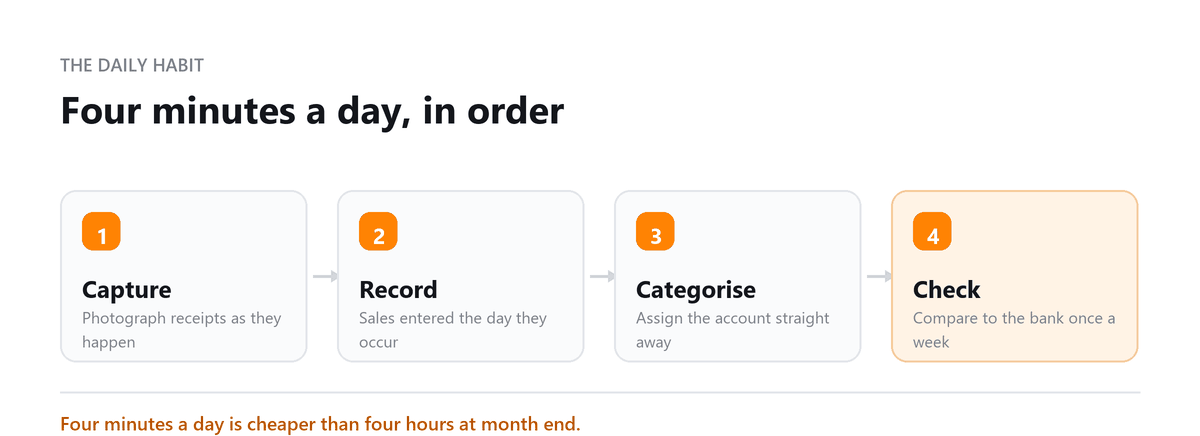
Daily recording doesn't require hours, it requires consistency. Spending 10 to 15 minutes each business day reviewing auto-captured bank feed transactions, categorising any uncategorised items, and filing receipts for cash expenses keeps your books current without creating a burden. If daily isn't realistic, a dedicated one-hour session each week accomplishes the same outcome. The goal is to never let more than a week's worth of transactions accumulate unreviewed, because catching errors quickly is far less time-consuming than catching them at month-end.
Choosing the Right Software
| Software | Best For | Key Feature |
|---|---|---|
| QuickBooks Online | Small to mid-size businesses | Automatic bank feeds, expense categorisation |
| Xero | Growing businesses | Multi-user access, receipt scanning |
| Wave | Solopreneurs / freelancers | Free tier, simple invoicing |
| FreshBooks | Service businesses | Time tracking + project billing |
| Zoho Books | Budget-conscious SMBs | Full accounting suite |
Conclusion
Recording daily sales and expenses is the most basic function of business bookkeeping, and the one most often neglected until it becomes a problem. The methods, tools, and habits covered in this guide aren't complex; they're consistent. Choosing the right accounting method, using software that automates the heavy lifting, separating business and personal finances, and building a short daily or weekly recording routine transforms your books from a year-end chore into a real-time management tool.
Book a free consultation and we will take the routine off your hands.
Frequently Asked Questions
Do I need to record every single transaction every day?
For accuracy, yes, every sale and expense should be recorded. Modern accounting software does most of this automatically through bank feeds and receipt scanning. The key is reviewing and categorising these auto-captured transactions regularly rather than letting them pile up.
What's the best way to track cash sales?
Use a point-of-sale system that integrates with your accounting software, or record cash sales in a daily sales log. Deposit cash receipts intact (don't use them for petty cash) and reconcile your cash drawer to your sales log at day end.
How do I record a business expense I paid with personal funds?
Record the expense under the appropriate expense category in your books, then create a 'Due to Owner' or 'Owner Reimbursement' liability entry. Reimburse yourself via a documented business payment. Keep the receipt regardless of how you paid.
How should I categorise expenses for tax purposes?
Follow IRS Schedule C categories: advertising, car and truck expenses, commissions, contract labour, depreciation, insurance, interest, legal/professional fees, meals (50% deductible), office expenses, rent, repairs, supplies, travel, utilities, wages. Set up your chart of accounts to mirror these categories from day one.
What happens if I miss recording expenses throughout the year?
You'll likely overpay taxes (by understating deductible expenses) and your financial statements will be inaccurate. Catch-up bookkeeping, reconstructing missing records from bank and credit card statements, can recover most of it, but it's time-consuming and sometimes incomplete. Prevention is far cheaper than cure.

Written by
Ankit Sarawagi, CPA, CA, MBA
Ankit leads the finance team at Profitjets, where he has worked with 500+ businesses across the US on bookkeeping, tax and CFO-level strategy. He writes about the habits that keep small business books accurate all year. Connect on LinkedIn
Free consultation
Want the Daily Work Handled?
Book a free consultation and we will take the routine off your hands.