
Ask any small business owner if his or her venture is profitable, and the person would most likely calculate his or her profit and loss. Subtracting the expenses from the revenue, he or she will proudly show a positive number at the end of the column. However, the profit that business owners calculate rarely reflects the true profitability of their business.
The implicit costs which are not duly accounted for in the income statements of businesses include the opportunity of the owner's efforts, the potential income on the money invested in the venture, and the rent the business would have had to pay otherwise if it did not occupy the premises.
Implicit costs should be considered when analyzing the profitability of a venture because the omission of these costs may lead to wrong conclusions regarding the performance of a venture. Businesses usually consider explicit costs which represent actual expenditures and do not require any calculation.
The opportunity cost of the owner's time and effort is not accounted for in the explicit costs. Businesses also overlook the potential income they could have generated by investing in the stock market. Lastly, the implicit costs to be considered when calculating the profitability of a venture include the rent the business would have paid otherwise to put up in a building it owns.
Expert Perspective
The owners who miss implicit costs most often are the ones running a business that pays everyone except themselves. They'll tell me they're saving money by not taking a salary. They're not saving anything. They're just moving the cost somewhere the P&L can't see it. Once you put a market salary and a fair return on their capital next to the profit figure, the conversation about pricing and growth changes very quickly.
Abhinav Gupta, CPA, CA, MBA · LinkedInThis guide explains what explicit and implicit costs are, walks through how to calculate each using one worked example, and shows how the two together reveal the gap between accounting profit and economic profit.
What is an Explicit Cost?
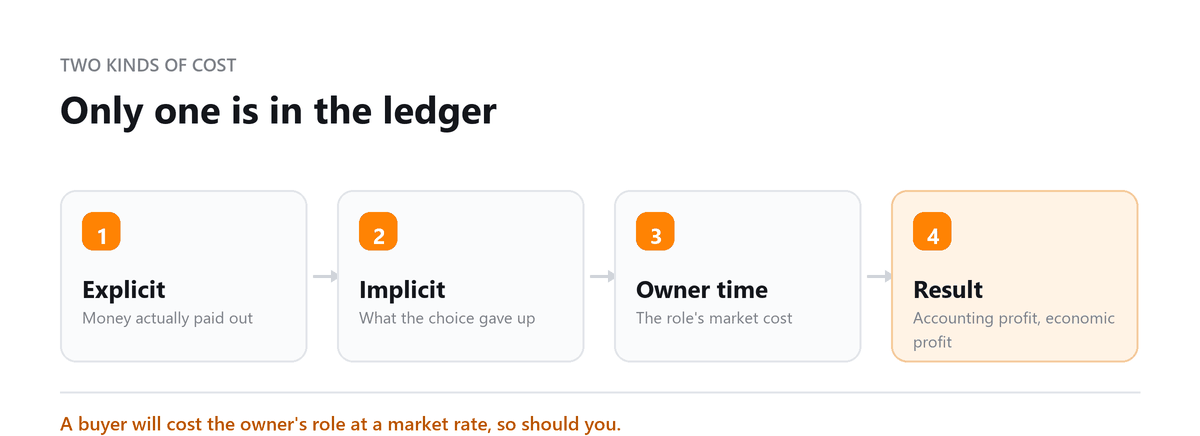
Explicit costs are out-of-pocket expenditures, real cash payments to outside parties. They appear on financial statements and are used to calculate accounting profit.
Examples of Explicit Costs
- Rent paid to a landlord: $3,000/month
- Employee salaries: $12,000/month
- Raw materials purchased: $8,000/month
- Software subscriptions, utility bills, insurance premiums
- Interest paid on business loans
What is an Implicit Cost?
Implicit costs are the opportunity costs of resources the business owner has deployed into the business, the value of what those resources could have generated in their next-best alternative use. They do not appear on any financial statement.
Examples of Implicit Costs
- Owner's time: if the owner works 60 hours/week managing the business, the implicit cost is the salary they could have earned as an employee in an equivalent role
- Owner-occupied premises: if the owner uses their own building for the business, the implicit cost is the rental income foregone by not leasing it to a third party
- Owner's capital: the business owner invested $200,000 in the business; the implicit cost is the investment return they could have earned elsewhere (e.g., 8% in an index fund = $16,000/year)
How to Calculate Implicit Cost, Worked Example
Scenario: A business owner runs a bakery. She invested $150,000 of her own savings, works 50 hours/week, and uses a space she owns that could be rented for $2,500/month.
| Implicit Cost Item | Calculation | Annual Implicit Cost |
|---|---|---|
| Owner's foregone salary | $75,000/year market salary for equivalent manager role | $75,000 |
| Foregone investment return on capital | $150,000 × 8% (conservative market return) | $12,000 |
| Foregone rent on owned premises | $2,500/month × 12 | $30,000 |
| Total Implicit Costs | $117,000/year |
How to Calculate Explicit Cost, Worked Example
Continuing the bakery example, annual explicit costs:
| Explicit Cost Item | Annual Amount |
|---|---|
| Ingredients and packaging | $60,000 |
| Staff wages | $45,000 |
| Utilities and supplies | $12,000 |
| Loan interest | $8,000 |
| Marketing and misc | $5,000 |
| Total Explicit Costs | $130,000 |
Accounting Profit vs Economic Profit: The Full Picture
The bakery earns $260,000 in annual revenue.
| Accounting Profit | Economic Profit | |
|---|---|---|
| Revenue | $260,000 | $260,000 |
| Explicit Costs | ($130,000) | ($130,000) |
| Implicit Costs | Not deducted | ($117,000) |
| PROFIT | $130,000 | $13,000 |
The accounting profit of $130,000 looks healthy. But after accounting for the owner's foregone salary, foregone investment return, and foregone rent, the economic profit is only $13,000. The owner is generating only marginally more value than she would by taking a salaried job, investing her $150,000, and renting out her space.
Why Are Implicit and Explicit Costs Important?
- Pricing decisions: If pricing only covers explicit costs, the business may be sustainable on paper but not economically rewarding for the owner
- Business viability: A negative economic profit signals the owner would be better off deploying their resources elsewhere
- Owner compensation: Many small business owners undercount their own time, treating zero explicit salary as 'saving money' while carrying a large implicit cost
- Investment decisions: Before starting a new product line or expanding, implicit costs (management time, capital commitment) should be weighed against the expected return
We were looking at the business as profitable because the financial statements showed a healthy return, but once Profitjets mapped the value of our time, invested capital, and other implicit costs, the economic return was much less attractive. We changed the structure of the business by delegating operations, reducing the owner's involvement, and reallocating capital, so the business could generate a return that better reflected what we were actually putting into it.
Book a free consultation and we will cost it honestly with you.
FAQs
Do implicit costs appear on financial statements?
No. Implicit costs aren't recorded in the books because no cash is paid out. They're opportunity costs, so they show up in economic analysis and decision-making but not in standard accounting profit or on your P&L.
Can a business have positive accounting profit and negative economic profit?
Yes, and it's common in owner-run businesses. If the owner doesn't pay themselves a market salary, accounting profit looks strong because their labor isn't recorded as a cost. Once that foregone salary and the return on their invested capital are counted, economic profit can easily fall below zero.
Is depreciation an explicit or implicit cost?
In accounting, depreciation is treated as an explicit cost because it's recorded on the income statement, even though no cash leaves the business in that period. It reflects the earlier cash purchase of an asset spread over its useful life. Implicit costs, by contrast, never involve a cash payment at any point.
How do I estimate the implicit cost of my own time?
Look at what you could realistically earn doing comparable work as an employee. If you run a business with a dozen staff, the benchmark is a general manager or operations manager salary in your industry and area, not a vague best-case number. Using a grounded figure keeps the analysis honest.
Should I use implicit costs when setting prices?
They should inform your pricing, even if they never appear on an invoice. Your prices need to cover explicit costs to keep the business running, but they also need to leave enough margin to reward your time and capital fairly. If they don't, the business may survive while you'd be better off financially doing something else.

Written by
Abhinav Gupta, CPA, CA, MBA
Abhinav works with business owners across the US on industry-specific bookkeeping, from dental practices and restaurants to construction and e-commerce. He writes about what each trade's books actually need. Connect on LinkedIn
Free consultation
Is the Business Actually Worth Your Time?
Book a free consultation and we will cost it honestly with you.