
Pricing mistakes are made by small businesses not due to wrong strategy but incorrect arithmetic. A business owner sets a target margin at 30%, adds 30% to the costs and believes they have set the price right. In reality, the job will yield only 23% which may be satisfactory on an individual basis but summed up over dozens of such jobs will produce significant losses.
The calculation of the profit margin itself is not difficult, given the correct formulas and a set of financial data. The complexity lies in the accurate determination of revenue, COGS, and the difference between markup and margin. With these fundamentals, the profit margin calculation becomes a routine exercise.
This page covers the definition of formulas for different types of margins and provides an example of the calculation. The article also explains the relationship between markup and margin and shows how to calculate the desired price based on the desired margin.
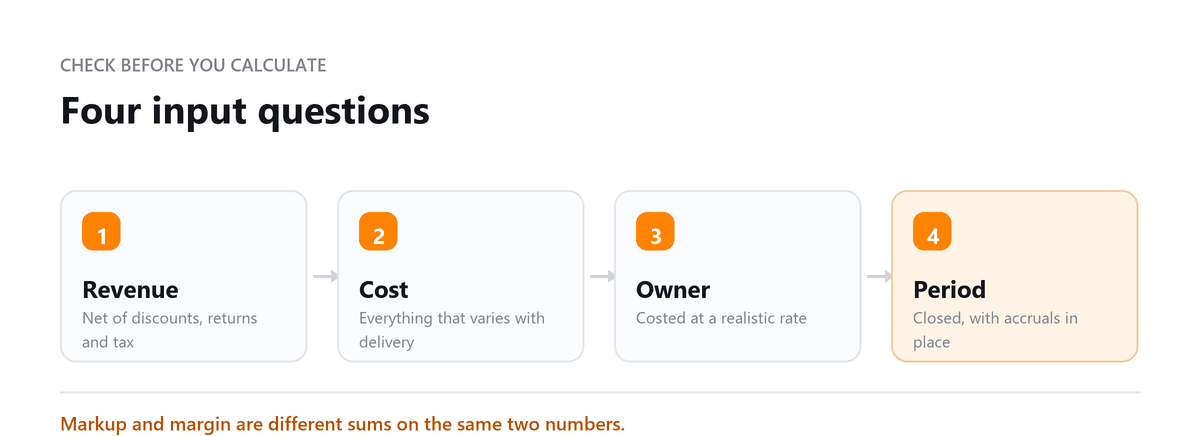
The calculation mistake I see most is owners using markup when they mean margin. A contractor wants to make 30% on a job, adds 30% to the cost, and ends up nearer 23%. Do that on every quote for a year and it's a serious amount of profit that never shows up.
The P&L line most often misclassified alongside it is the cost of goods sold. Shipping, subcontractors, and payment fees get buried in overhead, so gross margin looks better than it really is and prices get set too low. Fix the COGS accounts first, then price from margin, not markup.
Abhinav Gupta, CPA, CA, MBA · LinkedInThe Three Profit Margin Formulas
| Margin Type | Formula | Result |
|---|---|---|
| Gross Profit Margin | (Revenue − COGS) / Revenue × 100 | % of revenue left after direct costs |
| Operating Profit Margin | (Revenue − COGS − Operating Expenses) / Revenue × 100 | % left after all operating costs |
| Net Profit Margin | Net Income / Revenue × 100 | % kept after everything, interest, tax, all costs |
Step-by-Step Calculation Guide
Step 1: Find Your Revenue
Use the top line of your income statement, total sales or net revenue for the period. For a calculator context: Revenue = Total invoices raised (accrual) or cash received (cash basis).
Step 2: Calculate Gross Profit Margin
Identify your COGS, the direct costs of producing your goods or delivering your service (materials, direct labour, direct production overhead). Gross Margin = (Revenue − COGS) / Revenue × 100
Step 3: Calculate Operating Profit Margin
Add all operating expenses below gross profit: staff salaries (non-direct), rent, utilities, marketing, software, depreciation. Operating Margin = (Gross Profit − Operating Expenses) / Revenue × 100
Step 4: Calculate Net Profit Margin
Subtract interest expense (loan costs) and income tax expense. Net Margin = Net Income / Revenue × 100
Worked Example, Step by Step
A retail e-commerce business, monthly figures:
| Step | Item | Amount | Margin |
|---|---|---|---|
| 1 | Revenue (net sales) | $80,000 | , |
| 2 | COGS (product cost + shipping to customer) | $44,000 | , |
| 2 | Gross Profit | $36,000 | 45.0% |
| 3 | Operating Expenses (staff, ads, software, rent) | $22,000 | , |
| 3 | Operating Profit | $14,000 | 17.5% |
| 4 | Interest + Tax | $4,000 | , |
| 4 | Net Profit | $10,000 | 12.5% |
How to Use These Numbers
- Compare gross margin month-over-month: a falling gross margin signals rising input costs or pricing pressure, catch it early
- Compare operating margin to your gross margin: the gap represents your overhead load. If operating margin is much lower than gross margin, overheads are high relative to revenue
- Track net margin as your headline health metric: trending down over 3+ months requires investigation
- Compare to industry benchmarks: see the small-business-profit-margin post for industry-specific ranges
Markup vs Margin: A Common Confusion
Markup and margin are calculated differently and give different percentages for the same product:
| Formula | Example (Cost $60, Price $100) | |
|---|---|---|
| Gross Margin | (Price − Cost) / Price × 100 | ($100 − $60) / $100 = 40% margin |
| Markup | (Price − Cost) / Cost × 100 | ($100 − $60) / $60 = 66.7% markup |
A 40% gross margin = a 66.7% markup on cost. These are not interchangeable. Always confirm which a supplier or partner means when they quote a 'margin' or 'markup' figure.
Reading Your Results
- Watch gross margin month to month. A falling gross margin points to rising direct costs, discounting, or prices that haven't kept up.
- Look at the gap between gross and operating margin. That gap is your overhead. If it's widening, overhead is growing faster than sales.
- Track net margin as the overall trend. Several months of decline deserves a closer look.
- Compare with your industry. The guide to small business profit margins covers typical ranges and how to improve yours.
We thought we were pricing our services at a 30% margin, but we were actually applying a 30% markup to our costs, and some COGS had also been classified incorrectly. Profitjets recalculated our pricing using the correct margin and cost structure, which showed that several jobs were underpriced. We adjusted our rates, and our gross profit improved without needing a major increase in sales volume.
Book a free consultation and we will price from your real costs.
FAQs
What's the difference between gross margin and net margin?
Gross margin subtracts only the direct costs of what you sold. Net margin subtracts everything, including overhead, interest, and taxes. A strong gross margin paired with a weak net margin usually means overhead is taking up most of the profit.
How do I convert markup to margin?
Divide the markup by one plus the markup. A 50% markup gives 0.50 ÷ 1.50 = 33.3% margin. To go the other way, divide the margin by one minus the margin. A 40% margin needs a 0.40 ÷ 0.60 = 66.7% markup.
What price do I need to charge to make a certain margin?
Divide your cost by one minus the target margin. For a product costing $45 with a target margin of 40%, the price is $45 ÷ 0.60 = $75.
Can profit margin be negative?
Yes. A negative margin means costs exceeded revenue for that level of the P&L. A negative gross margin means you're selling below direct cost. A negative net margin with a positive gross margin means overhead, interest, or taxes are more than the business earns on its sales.
How do I improve my profit margin quickly?
Pricing is usually fastest. A price increase with no extra cost goes straight to margin. Reducing direct costs through supplier terms, less waste, or better delivery improves gross margin, and cutting overhead improves operating and net margin. The guide to small business profit margins covers each approach in more detail.

Written by
Abhinav Gupta, CPA, CA, MBA
Abhinav works with business owners across the US on industry-specific bookkeeping, from dental practices and restaurants to construction and e-commerce. He writes about what each trade's books actually need. Connect on LinkedIn
Free consultation
Pricing by Guesswork?
Book a free consultation and we will price from your real costs.