
Year-over-year growth is a method of evaluating two or more measurable events on an annualized basis — comparing identical periods in consecutive years to cut through seasonal noise and reveal whether your business is actually moving forward.
Key Takeaways
- YoY growth eliminates seasonal variations, making it more reliable than month-over-month comparisons for trend analysis.
- The formula: (Current Period Value – Prior Period Value) / Prior Period Value x 100.
- A company reporting Q1 revenue of $150,000 vs $120,000 the prior year shows a 25% YoY increase.
- Negative YoY signals decline requiring investigation; zero growth signals stagnation prompting strategic innovation.
Year-over-year (YoY) growth is one of the most widely used performance metrics in business finance. By comparing identical periods across consecutive years — Q1 to Q1, full year to full year — it filters out the seasonal swings that make month-over-month comparisons misleading. The result is a clean signal about whether your underlying business is growing, declining, or standing still.
What Is Year-Over-Year (YoY) Growth?
Year-over-year growth is a method of evaluating two or more measurable events on an annualized basis. Rather than comparing sequential months — which can produce wildly different results depending on seasonal patterns — YoY locks the comparison to the same calendar window in the prior year.
The key benefits of using YoY as your primary growth measure are:
- Eliminates seasonal variations that distort month-over-month comparisons
- Simplifies trend analysis by providing a consistent, apples-to-apples view
- Facilitates benchmarking against industry peers and competitors who report on the same basis
The YoY Growth Formula
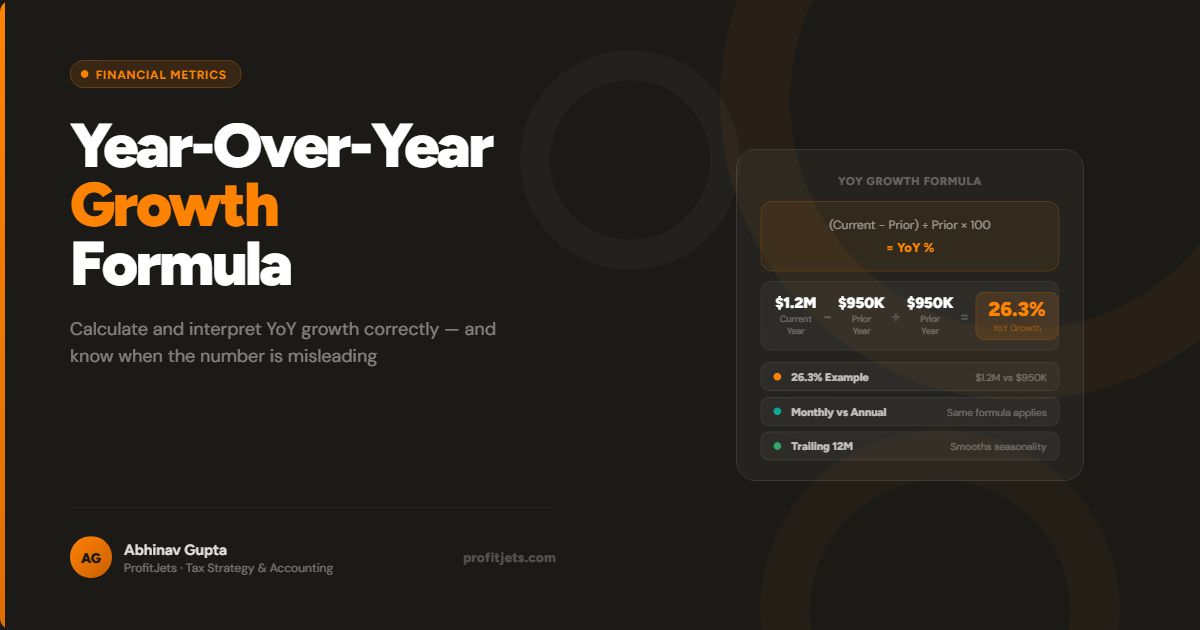
The formula is straightforward. Subtract the prior period value from the current period value, divide by the prior period value, and multiply by 100 to express the result as a percentage:
Steps to Calculate YoY Growth
- Identify the metric you want to measure (revenue, expenses, customers, units sold).
- Select the matching periods — the same quarter, month, or full year across two consecutive years.
- Apply the formula — subtract prior from current, divide by prior, multiply by 100.
- Interpret the result in context — consider industry conditions, macro environment, and internal changes.
Always confirm you are comparing the same time window. Comparing a 13-week quarter to a 12-week quarter will distort the result. If your fiscal calendar shifted, adjust before calculating.
Worked Example
Consider a company reporting the following Q1 revenue figures:
| Period | Revenue | YoY Change |
|---|---|---|
| Q1 2024 | $120,000 | Baseline |
| Q1 2025 | $150,000 | +25% |
($150,000 – $120,000) / $120,000 x 100 = 25% YoY growth. The company grew revenue by a quarter compared to the same quarter last year.
Interpreting YoY Growth Results
The number alone is not the insight. Context is what turns a growth rate into a business decision:
| Result | Signal | What to ask |
|---|---|---|
| Positive growth | Growing | Is growth driven by volume, price, or both? Is it sustainable? |
| Negative growth | Declining | Is this market-wide or company-specific? What changed? |
| Zero growth | Stagnating | Are we losing share while the market grows? Where to innovate? |
A high YoY growth rate in year one often reflects a low base, not a structural improvement. If you launched in Q1 of the prior year with minimal revenue, even modest absolute gains will show outsized percentages. Always check the absolute numbers alongside the rate.
Utilizing YoY Growth in Business Strategy
YoY analysis is not just a reporting metric. Applied consistently, it drives three core strategic decisions:
Sales analysis
Compare revenue by product line, region, or channel year-over-year to identify which segments are gaining momentum and which are stalling. This directs investment toward what is working and prompts investigation where growth has stopped.
Expense management
Tracking expenses YoY reveals whether cost categories are growing faster or slower than revenue. If operating expenses are up 30% YoY while revenue grew 15%, the business is losing margin efficiency — a signal that needs attention before it compounds.
Customer retention evaluation
Measuring customer count or revenue per customer YoY shows whether your base is growing, churning, or expanding. A business adding customers but showing flat revenue YoY may have a pricing or mix problem worth investigating.
The Role of Professional Services in YoY Analysis
Accurate YoY analysis depends on clean, consistently categorized financials. A month of miscategorized expenses or a delayed revenue recognition entry can distort the comparison and lead to wrong decisions. That is where professional bookkeeping, tax, and CFO services add direct value.
- Bookkeeping services ensure your books are consistent period-to-period, so YoY comparisons are apples-to-apples.
- Tax services identify whether YoY changes have tax implications — for example, crossing a revenue threshold that changes your filing obligations.
- CFO services translate YoY data into strategic recommendations: where to invest, where to cut, and where growth is masking problems.
Want clean, consistently categorized financials that make YoY analysis reliable?
Talk to a ProfitJets AdvisorFrequently Asked Questions
What is the year-over-year growth formula?
Why is YoY better than month-over-month?
What counts as good YoY growth?
Can I use YoY for metrics other than revenue?
What should I do if YoY growth is negative?
Need help turning your YoY data into clear financial strategy?
Schedule a Free ConsultationProfitJets Editorial Team
The ProfitJets team writes practical finance guides for small and mid-sized business owners navigating growth, reporting, and strategic decisions.