
The Best Accounting for Startups Solution: In-House vs. Outsourced Services
The real cost and capability comparison for a startup finance function, including the parts that never appear on a salary line
A bank wants clean books before extending credit. A due diligence team finds that revenue was booked the wrong way for eighteen months. By then, the accounting setup chosen in the first year has already shaped how much work it will take to fix.
The first real decision is whether to hire accounting help in-house or outsource it. In-house brings finance closer to the leadership team and builds knowledge inside the company. Outsourcing brings specialist expertise, lower cost, and the flexibility to scale up or down as the business changes. Neither is right for every startup, and the answer usually changes as the company grows.
Choose badly and the problems compound. Hire a full-time bookkeeper too early and you're paying a fixed salary for work that doesn't yet need one, often from someone who has never dealt with cap tables or investor reporting. Stay outsourced too long and a complex, fast-moving finance function can end up without the day-to-day ownership it needs.
This guide covers why accounting matters so much for startups, what each stage needs, the case for outsourcing and for in-house, the tools most startups use, and where a fractional CFO fits in.
Why Accounting for Startups Is Crucial
Startups fail to manage accounting at their peril. Investors require accurate financials before funding. Banks require clean books for credit. Accurate revenue and expense recognition determines whether the business appears profitable, on track for targets, or in trouble. Payroll tax compliance, equity accounting (option pool, cap table, 409A valuation), and multi-state nexus compliance are all startup-specific accounting complexities that require specialist knowledge from the start.
| Startup Stage | Key Accounting Needs |
|---|---|
| Pre-revenue / seed | Entity setup, chart of accounts, bank setup, basic bookkeeping, payroll, state registration |
| Early revenue ($0-$1M) | Revenue recognition, COGS tracking, investor-ready reporting, cap table maintenance, 409A awareness |
| Growth ($1M-$5M) | Month-end close discipline, budget vs actual, burn rate management, multi-state nexus, R&D credit |
| Scale ($5M-$20M) | Controller-level oversight, audit preparation, equity compensation accounting (ASC 718), full FP&A |
For most startups, outsourcing is the right starting point. You get people who've seen dozens of companies at your stage, for a fraction of a full-time salary. The signal to bring finance in-house isn't a revenue number on its own. It's when finance questions come up every day in operating decisions and you need someone sitting in those conversations, not someone you email. For most companies that happens somewhere after $5 to $10 million in ARR.
Ankit Sarawagi, CPA, CA, MBA · LinkedInWhy Outsource Accounting?
- Cost: outsourced bookkeeping starts from $300-$800/month for a seed-stage startup, far less than a $50,000-$80,000 in-house bookkeeper
- Expertise from day one: outsourced startup accounting specialists know the specific requirements of VC-backed companies, cap table accounting, 409A valuation awareness, investor reporting, R&D credits
- No single point of failure: an outsourced team provides continuity; an in-house bookkeeper who resigns takes institutional knowledge with them
- Flexibility: scale up during fundraising or audit preparation; scale down in slower periods, without a hiring/firing cycle
- Technology: outsourced firms bring established tech stacks (QuickBooks, Xero, Brex, Ramp, Gusto) that are time-consuming to evaluate and implement independently
Why Go With In-House Accounting?
- Deep business context: an in-house accountant attends team meetings, understands business model nuances, and can answer finance questions in real time
- Control: finance data stays internal; no need to share sensitive information with an external provider
- Integration with operations: in-house finance staff can manage vendor relationships, approve invoices, and interact with department heads directly
- Preferred by some investors: some institutional investors prefer companies with an in-house finance function, particularly at later stages
In-house accounting is typically warranted when: the startup has crossed $5-10M ARR, the finance function is strategic and requires deep daily integration with operations, or the business has complexity (multi-entity, multi-currency, complex revenue recognition) that requires a dedicated full-time controller or CFO.
In-House vs Outsourced Accounting: Which Is Right?
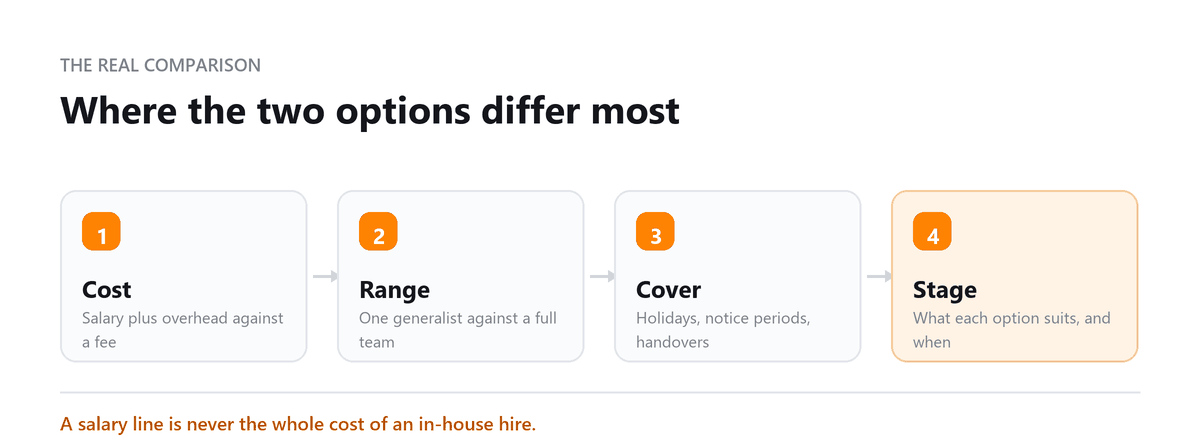
| Factor | In-House | Outsourced |
|---|---|---|
| Monthly cost (early stage) | $5,000-$8,000+ (salary + overhead) | $300-$2,500 |
| Expertise | Depends on individual hire | Startup specialists from day one |
| Scalability | Fixed cost until next hire | Scales with startup growth |
| Best for stage | $10M+ ARR with complex operations | Pre-seed through Series A-B |
| Continuity risk | High, departure is disruptive | Low, team continuity guaranteed |
| Investor-readiness | Depends on hire quality | Specialists produce investor-grade output |
Best Accounting Software for Startups
| Software | Best For | Stage |
|---|---|---|
| QuickBooks Online | Most widely used; strong accountant ecosystem | Seed through Series B |
| Xero | Multi-currency; clean UI; good Stripe/PayPal integration | Seed through Series B |
| NetSuite | Multi-entity; complex revenue recognition; audit-ready | Series B+ / $10M+ ARR |
| Brex / Ramp | Corporate cards with spend management; integrates with QBO/Xero | Any stage |
| Gusto / Rippling | Payroll; integrates with QBO/Xero | Any stage with employees |
Why Do Startups Need CFO Services?
Startup founders frequently face financial decisions that exceed bookkeeping: fundraising financial models, burn rate management, unit economics analysis, investor reporting, and board-level financial communication. A fractional CFO fills this gap without the cost of a full-time hire. For VC-backed startups, a fractional CFO also ensures the financial reporting meets investor expectations, monthly reporting packages, board deck financial slides, and audit preparation.
Profitjets supports startup businesses at different stages of growth, providing accounting and financial support around cash-flow management, monthly reporting, budgeting, forecasting, and fundraising preparation with the number of clients that raised subsequent funding within 12 months.
Whether you're pre-seed, seed, or Series A, Profitjets provide outsourced accounting support matched to your stage. Pre-seed startups can get their books and financial systems set up correctly; seed-stage companies can add monthly reporting, cash-flow forecasting, and budget management; and Series A companies can get stronger financial controls, forecasting, investor reporting, and CFO-level support.
Start with a consultation to review your current finance setup, identify gaps, and determine what level of ongoing accounting support makes sense as you scale.
Frequently Asked Questions
Book a free consultation and we will cost both against your actual volume.
Frequently Asked Questions
What is the difference between bookkeeping and accounting?
Bookkeeping is recording financial transactions such as invoices, receipts, payments, and payroll. Accounting takes those records and turns them into financial statements, tax returns, compliance work, and analysis. At a startup, a bookkeeper handles the ongoing transactions, a CPA handles tax returns and complex accounting judgments, and a fractional CFO handles financial strategy on top of both.
When should a startup hire an in-house bookkeeper?
Most startups don't need one until they're past $5 to $10 million in ARR and processing enough complex transactions to keep a full-time person busy. Before that point, outsourced accounting at roughly $500 to $2,500 a month usually offers better expertise, better continuity, and lower cost.
Does a pre-revenue startup need an accountant?
Yes, even before revenue. Entity setup, a proper chart of accounts, payroll, state registrations, and early equity paperwork all benefit from getting it right the first time. Cleaning up a messy first year later is usually more expensive than setting things up correctly from the start.
Can we switch from outsourced to in-house accounting later?
Yes, and many startups do. A good outsourced team will keep clean, well-documented books that make the handover straightforward. Some companies also keep an outsourced partner after hiring in-house, for specialized work like tax, audit preparation, or fractional CFO support.
What do investors expect to see from a startup's accounting?
At a minimum, accurate monthly financial statements, a clear view of burn rate and runway, and revenue recognized correctly. As you move into later rounds, investors also expect a clean cap table, a timely month-end close, budget vs actual reporting, and books that can hold up to due diligence or an audit.

Written by
Ankit Sarawagi, CPA, CA, MBA
Ankit leads the finance team at Profitjets, where he has worked with 500+ businesses across the US on bookkeeping, tax and CFO-level strategy. He writes about the habits that keep small business books accurate all year. Connect on LinkedIn
Free consultation
Deciding Between the Two?
Book a free consultation and we will cost both against your actual volume.