

Being named executor of your parent's estate means you have a long list of worries: the funeral, the bank accounts, the house, the probate court. Taxes are not likely to be at the top of your list.
Meanwhile, the IRS is sending notices to your parent's last address, where they are likely to languish, unless someone happens to be checking that mailbox, or, if forwarded, received by a relative who is unaware that a deadline has passed.
Form 56 closes that gap. It tells the IRS that a taxpayer has been named as a fiduciary for another taxpayer. That can include an executor, administrator, or guardian, or a receiver or assignee for someone else's assets for the purpose of paying debts.
Once the IRS has received Form 56, the fiduciary can be notified of tax matters on behalf of the taxpayer whose address they are using.
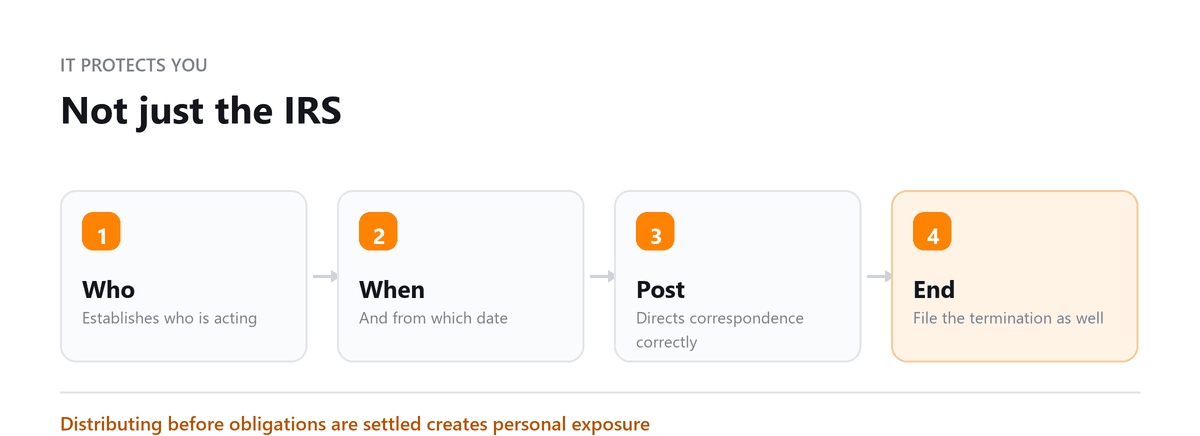
There are two important timing aspects to filing Form 56. Filing it early means that the IRS can send tax notices to a person who can deal with them before any deadlines. Filing it again when the fiduciary role ends announces to the IRS that the former fiduciary is no longer responsible for tax matters.
This guide explains who needs to file Form 56, when to file it, how it differs from a power of attorney, what can go wrong if it isn't filed, and how to notify the IRS when the fiduciary relationship ends.
Failure to file either form could result in the fiduciary having to respond to late notices and, in some cases, personal liability for the taxes of the estate, trust, or other taxpayer entity.
What Is a Fiduciary Relationship?
A fiduciary is a person or institution entrusted to manage the financial affairs of another. Common fiduciaries who must file Form 56:
| Fiduciary Type | Common Situation |
|---|---|
| Executor / Administrator | Managing the estate of a deceased person during probate |
| Trustee | Managing a trust on behalf of beneficiaries |
| Guardian / Conservator | Managing the affairs of a minor or incapacitated person |
| Receiver in bankruptcy | Managing assets in a bankruptcy proceeding |
| Assignee for creditors | Managing assets assigned by a debtor for the benefit of creditors |
When an executor doesn't file Form 56, the IRS keeps writing to the person who died. A notice proposing additional tax on the final return goes to an empty house, the response window closes, and the tax is assessed before anyone in the family knows there was a question.
By the time it surfaces, the estate may already have distributed its assets, and the executor is now trying to fix a debt with no money left in the estate to pay it. Filing Form 56 as soon as you're appointed is a small step that prevents that sequence.
Ankit Sarawagi, CPA, CA, MBA · LinkedInWhen to File Form 56
Form 56 notifies the IRS that a fiduciary relationship exists establishing or terminating a fiduciary's authority to act on behalf of a taxpayer. A fiduciary (executor, trustee, guardian, receiver, or assignee) files this form so the IRS sends tax notices to the correct party and recognises the fiduciary's authority to sign returns and respond to IRS correspondence.
- File upon assuming fiduciary duties, as soon as the fiduciary relationship is established (appointment, court order, trust becoming effective)
- File again when the fiduciary relationship terminates (estate closed, trust terminated, conservatorship ended, discharge in bankruptcy)
- File before the first tax return due date for the fiduciary, so IRS correspondence goes to the right place for that first filing
Where to File Form 56
File Form 56 with the IRS service center where the person or entity you're acting for files their tax returns. For an executor, that's generally where the decedent filed their individual returns or where the estate files. For a trustee, it's where the trust files Form 1041.
The correct address depends on the type of return and the taxpayer's location, and the IRS updates service center addresses from time to time. Check the "Where to File" section of the current Form 56 instructions before mailing, rather than relying on an address from an older form or article.
Receivers and assignees for the benefit of creditors follow a different rule. They generally file with the IRS Advisory Group Manager for the area office that covers the taxpayer, within 10 days of their appointment.
Mail Form 56 separately from any tax return, use a trackable delivery method, and keep a copy with the date it was sent. It can take the IRS several weeks to update its records, so keep an eye on mail at the taxpayer's old address in the meantime.
What Happens If Form 56 Is Not Filed?
- The IRS will continue sending notices to the taxpayer (or decedent) at their last known address, notices may be missed or ignored
- Deadlines for responding to IRS correspondence may be missed without the fiduciary being aware
- The fiduciary's authority to sign tax returns may not be clearly established, creating signature issues on estate or trust returns
- Potential personal liability for the fiduciary if taxes go unpaid because notices were never received
Step-by-Step: Completing Form 56
- Part I: Taxpayer information, the person for whom the fiduciary is acting (decedent, minor, trust, etc.)
- Part II: Fiduciary information, the fiduciary's name, address, and authority
- Part III: Authority, check the box describing the basis for the fiduciary relationship
- Part IV: Tax notices, specify which tax years and forms the fiduciary will handle; request notices be sent to the fiduciary's address
- Part V: Revocation or termination, complete when ending the relationship; check appropriate termination basis
- Sign and mail to the appropriate IRS service center
Profitjets has supported more than 30 estate and trust administration engagements, including coordinating Form 56 filings for executors and trustees and assisting with related federal tax compliance.
I was appointed executor of my parent’s estate and wasn't sure how to handle the IRS correspondence or tax filings that followed. Profitjets filed Form 56 after my appointment, redirected the IRS correspondence to the estate’s authorized fiduciary, and later managed the estate tax return and related compliance.
Book a free consultation and we will map the filings.
FAQs
Who needs to file Form 56?
A fiduciary who acts on behalf of another person or entity for tax purposes should file Form 56. Common examples include executors and administrators of estates, trustees, guardians and conservators, receivers, and assignees for the benefit of creditors. The form notifies the IRS of the relationship so the fiduciary can handle the taxpayer's federal tax matters and receive notices. A separate Form 56 is generally filed for each person or entity the fiduciary acts for.
When should Form 56 be filed?
File it as soon as the fiduciary relationship begins, such as when a court appoints an executor or a trustee begins serving, and ideally before the first return under your authority is due. Receivers and assignees for the benefit of creditors have a stricter timeline and generally must notify the IRS within 10 days of their appointment. You should also file when the relationship ends.
What's the difference between Form 56 and Form 2848?
Form 56 is for fiduciaries, who legally step into the taxpayer's position, such as an executor acting for an estate. Form 2848, Power of Attorney and Declaration of Representative, is for authorizing a representative like a CPA, enrolled agent, or attorney to deal with the IRS on a taxpayer's behalf.
What happens if Form 56 isn't filed?
The IRS can continue sending notices to the taxpayer's last known address, and notices sent there are generally treated as valid even if the fiduciary never sees them. That can lead to missed response deadlines and assessments made without a reply. Separately, a fiduciary who pays other debts or distributes assets before paying federal taxes the estate or trust owes can be held personally liable for the unpaid tax.
How do I tell the IRS the fiduciary relationship has ended?
File Form 56 again, completing the section for termination of the relationship, and include evidence that it has ended, such as a court order closing the estate or discharging a guardian or receiver. If a new fiduciary is taking over, they should file their own Form 56. Until termination is filed, the IRS may continue treating you as the responsible party.

Written by
Ankit Sarawagi, CPA, CA, MBA
Ankit leads the finance team at Profitjets, where he has worked with 500+ businesses across the US on bookkeeping, tax and CFO-level strategy. He writes about the habits that keep small business books accurate all year. Connect on LinkedIn
Free consultation
Acting as an Executor or Trustee?
Book a free consultation and we will map the filings.