
Form 8959 calculates the 0.9% Additional Medicare Tax (AMT) on wages, RRTA compensation, and self-employment income above certain thresholds. This surtax applies to high earners and is separate from the regular 1.45% employee Medicare tax. The result from Form 8959 transfers to Schedule 2 (Form 1040), Line 11.
Many high-earning married couples face the Additional Medicare Tax for the first time on their tax return. Each spouse earns high income, both employers withhold exactly what they should do according to the law, and nothing in their paychecks suggests that something might go wrong. Despite this, when their joint tax return is filed, a balance due appears because, altogether, they crossed a threshold which each would have crossed by themselves.
The Additional Medicare Tax is a 0.9 percent tax on wages paid or compensation for services under the Railroad Retirement Tax Act and self-employment income in excess of a threshold for your filing status.
It is in addition to the regular Medicare tax and only employees and self-employed people are obliged to pay it. Employers do not pay a matching Additional Medicare Tax. The form 8959 calculates the tax, sum of self-employment income and wages, and reconciles withholding of Additional Medicare Tax against what you actually owe.
Expert Perspective
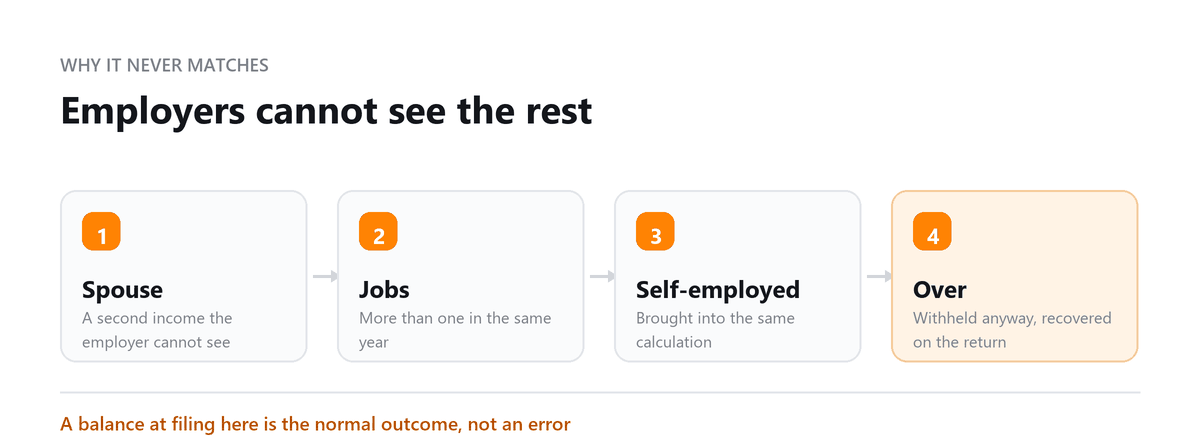
Dual-income couples should look at Additional Medicare Tax when they update their Forms W-4, not when they file. If each spouse earns $150,000, neither employer will withhold the 0.9 percent, but the couple still owes it on $50,000 of combined wages. Employers can't withhold Additional Medicare Tax below $200,000 because they don't know what your spouse earns.
The fix is to add extra withholding in Step 4(c) on one spouse's W-4, or include it in estimated payments, so the tax is covered during the year instead of showing up as a balance due in April.
Ankit Sarawagi, CPA, CA, MBA · LinkedInThis guide explains who owes the Additional Medicare Tax, the income thresholds, how employer withholding works, how self-employment income is included, and how Form 8959 reconciles withholding with the tax you owe.
The law seems simple, the problems stem precisely in relation to the fact that the employers only withhold taxes from the wages they give you or compensate you for services. Employers do not take into account your filing status, your other income or self-employment income, and therefore your tax liability might be lower or higher than what has been withheld. Depending on your situation you could be either owed a penalty or a refund is due.
Who Owes Additional Medicare Tax?
The 0.9% surtax applies to the amount of wages, RRTA compensation, or self-employment income that exceeds the threshold for your filing status:
| Filing Status | Income Threshold (Not Inflation-Adjusted) |
|---|---|
| Single / Head of Household | $200,000 |
| Married Filing Jointly | $250,000 |
| Married Filing Separately | $125,000 |
| Estates and Trusts | $14,450 (TY2024) |
These thresholds are NOT adjusted for inflation and have not changed since the Additional Medicare Tax was introduced in 2013. The tax rate is 0.9% of income above the threshold, separate from and in addition to the regular 2.9% Medicare tax (1.45% employee + 1.45% employer).
Employer Withholding Obligation
Employers must withhold the Additional Medicare Tax from employee wages that exceed $200,000 in a calendar year, regardless of the employee's filing status. This creates a key planning issue:
- Single earner with $210,000 wages: employer withholds 0.9% on the $10,000 above $200,000, correctly handled
- Dual-income couple filing jointly with $150,000 each ($300,000 combined): neither employer sees a single employee exceeding $200,000, so NO withholding is triggered, but $50,000 is subject to the 0.9% surtax at filing
- Solution: the couple should use Form W-4 to request additional withholding or make quarterly estimated tax payments to cover the expected $450 ($50,000 x 0.9%)
Self-Employment Income
Self-employed individuals owe 0.9% on self-employment income above their threshold. Unlike the 1.45% self-employment Medicare tax (which you can deduct 50% of on Form 1040), the 0.9% Additional Medicare Tax is NOT deductible. It is calculated on Schedule SE first, then flows to Form 8959.
Step-by-Step: Completing Form 8959
Part I: Total Medicare Wages and Other Income
- Line 1: Medicare wages from all W-2s (Box 5 total from all employers)
- Line 2: Unreported tips from Form 4137
- Line 3: Wages from household employees
- Line 4: RRTA compensation
- Line 5: Total of Lines 1-4
Part II: Total Self-Employment Income
- Line 6: Net self-employment income from Schedule SE (if positive)
Part III: Total Additional Medicare Tax
- Line 18: Total of wages + self-employment income above the threshold
- Line 19: 0.9% of Line 18 = Additional Medicare Tax owed
- Transfers to Schedule 2 (Form 1040), Line 11
Filing Deadline
Form 8959 is filed with Form 1040 by April 15, 2026 for TY2025 (October 15, 2026 with extension). Self-employed individuals should include Additional Medicare Tax in their quarterly estimated tax payments.
Profitjets performs Additional Medicare Tax reviews for more than 150 high-income W-2 and self-employed clients each year, identifying situations where combined wages and self-employment income may create an additional 0.9% Medicare Tax liability and helping clients adjust withholding or estimated payments accordingly.
My spouse and I both earned W-2 income, but neither employer withheld enough for the Additional Medicare Tax that applied to our combined wages, leaving us with an unexpected tax bill at filing. Profitjets adjusted our W-4 withholding and set up quarterly estimated payments for the remaining liability, so our federal tax payments were spread throughout the year instead of leaving us with another large balance at filing
If you file an extension, the form is still due with the return, but any tax owed must be paid by the original due date.
Book a free consultation and we will adjust the payments.
FAQs
Who has to pay the Additional Medicare Tax?
Individuals with wages, RRTA compensation, or self-employment income above the threshold for their filing status: $200,000 for single, head of household, and qualifying surviving spouse filers, $250,000 for married couples filing jointly, and $125,000 for married filing separately. The 0.9 percent applies only to the amount above the threshold. These thresholds aren't adjusted for inflation. Employers don't pay a matching share, and the tax doesn't apply to estates or trusts.
Why didn't my employer withhold Additional Medicare Tax when I owe it?
Employers must begin withholding the 0.9 percent once they pay you more than $200,000 in wages during a calendar year, regardless of filing status. They don't consider your spouse's wages, wages from other jobs, or self-employment income. So a married couple with $300,000 of combined wages, split evenly, can owe the tax on $50,000 even though neither employer withheld any. You can cover it by requesting extra income tax withholding on Form W-4 or by making estimated tax payments.
How does self-employment income affect the Additional Medicare Tax?
Self-employment income is combined with wages on Form 8959. The threshold for self-employment income is reduced by your wages, but not below zero, so someone with $180,000 of wages and $50,000 of self-employment income, filing single, owes the tax on $30,000. Unlike regular self-employment tax, no part of the Additional Medicare Tax is deductible when calculating adjusted gross income.
Can I get a refund if my employer withheld Additional Medicare Tax I don't owe?
Yes. If your employer withheld the 0.9 percent because your wages from that employer exceeded $200,000, but your household income is below your filing status threshold, such as a couple filing jointly with combined income under $250,000, Form 8959 calculates the excess withholding. That excess is included with your federal income tax withheld on Form 1040 and increases your refund or reduces your balance due.
How is Form 8959 filed?
Form 8959 is attached to your Form 1040, 1040-SR, or 1040-NR and is due with your return. The tax calculated on the form is reported on Schedule 2 with other additional taxes, and the Additional Medicare Tax withheld is added to your total federal withholding.

Written by
Ankit Sarawagi, CPA, CA, MBA
Ankit leads the finance team at Profitjets, where he has worked with 500+ businesses across the US on bookkeeping, tax and CFO-level strategy. He writes about the habits that keep small business books accurate all year. Connect on LinkedIn
Free consultation
Owing This Every Year?
Book a free consultation and we will adjust the payments.