
Law firms carry an accounting obligation most businesses do not: they hold money that belongs to somebody else, and they answer to a regulator for how they hold it.
That changes the structure of the records rather than just the labels. It also changes how profitability is read, because work is done in one period, billed in another and collected in a third.
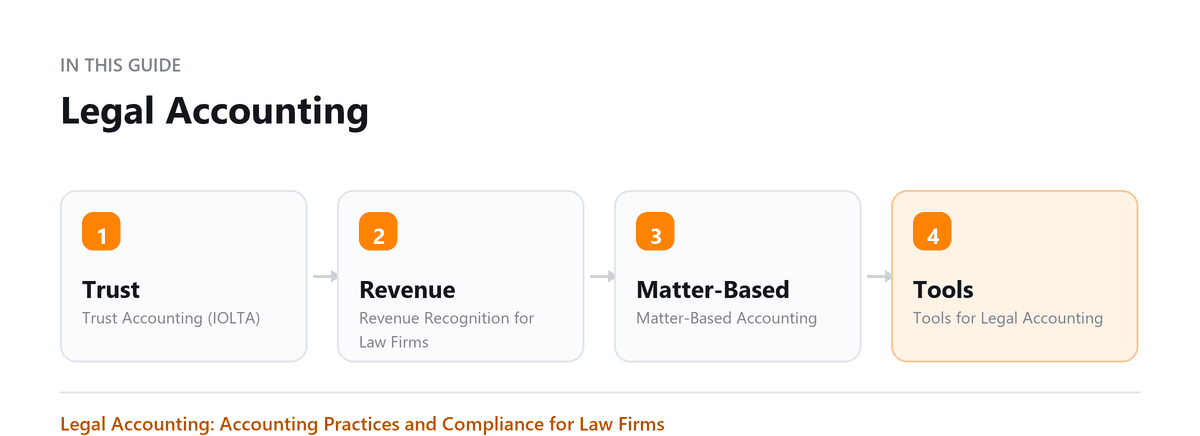
This covers client money accounting and the rules around it, how revenue is recognised in a firm, why matter-level accounting matters, the software built for it, and the compliance risks that come up most often.
Legal accounting involves the same core accounting principles as any other business, plus one critical additional requirement: trust accounting. Mishandling client funds is a bar disciplinary offence that can result in suspension or disbarment.
Trust Accounting (IOLTA)
Interest on Lawyers Trust Accounts (IOLTA) requires attorneys to hold client funds (retainers, settlement proceeds, escrow) in a separate trust account, never commingled with the firm's operating account. Interest on IOLTA accounts goes to the state bar foundation, not the law firm.
Three-Way Reconciliation (Monthly Requirement)
Most state bars require a monthly three-way reconciliation:
- Bank Statement Balance (from the bank)
- Trust Account Ledger Balance (running total in the firm's books)
- Sum of Individual Client Ledger Balances (one ledger per client matter)
All three must agree. Any discrepancy must be investigated and resolved immediately. Failure to reconcile is a disciplinary risk even if the error is innocent.
Whoever moves money out of the client account should not be the person who proves it is correct. In a small firm where that is the same person, the reconciliation has to be reviewed and signed by somebody who did not prepare it, and the review has to be evidenced.
Abhinav Gupta, CPA, CA, MBA · LinkedInRevenue Recognition for Law Firms
| Fee Type | Revenue Recognition Rule |
|---|---|
| Contingency fee | Recognise only when the matter settles or judgement is awarded and the fee is earned |
| Retainer (advanced fee) | Held in trust as unearned, moved to operating account as work is performed and billed |
| Hourly billing | Recognised when the time entry is billed (accrual) or when invoiced (cash) |
| Flat fee | Can be recognised upfront if fully earned upon engagement or spread over the engagement |
Matter-Based Accounting
Law firms track revenue and costs by client matter (file), not just by timekeeper or department. This gives profitability data per case, critical for pricing, staffing, and business development decisions.
- Time entries are assigned to matters; software allocates cost at attorney billing rate
- Hard costs (court filing fees, expert witnesses, travel) are tracked as disbursements per matter
- Matter profitability = fees collected - attorney time cost - disbursements
Tools for Legal Accounting
| Tool | Best For |
|---|---|
| Clio | Small to mid-size firms: trust accounting, billing, matter management |
| MyCase | Small firm all-in-one: intake, billing, trust, document management |
| LEAP | UK/AU/US small firm practice management with compliance |
| QuickBooks Legal (powered by QuickBooks) | QBO integration for firms already using QBO |
| Thomson Reuters eBillingHub | Large firm e-billing and outside counsel management |
Common Bar Compliance Risks
- Commingling client and operating funds in one account
- Using client trust funds to cover firm operating expenses
- Failing to maintain individual client ledgers for each matter
- Disbursing from trust before confirming funds have cleared
- Late or missing three-way reconciliations
Book a free consultation and we will get the numbers straight.
Frequently Asked Questions
What happens if a law firm fails a trust account audit?
Consequences range from a written reprimand to suspension or disbarment, depending on whether the violation was negligent or intentional and whether client funds were misappropriated.
Can law firms use cash basis accounting?
Yes, many small law firms use cash basis for simplicity and tax purposes. However, accrual accounting gives a more accurate picture of work-in-progress and outstanding receivables. Large firms and those with bank covenants typically use accrual.
What is a retainer and how is it treated?
An advanced fee retainer is client money held in trust until the firm earns it through work performed. A non-refundable engagement retainer (earned immediately upon receipt) goes directly to the operating account but must be disclosed clearly in the engagement letter.
How separate does the client money account have to be in practice?
Completely, and the separation is operational as well as nominal. A separate bank account is the start, but it also means no firm money resting in it, no client money resting in the firm account, its own reconciliation each month, and a ledger per client that adds up to the bank balance. The detailed rules vary by jurisdiction, so the governing body's own handbook is the source to work from rather than general guidance.
What makes law firm profitability hard to read from the accounts?
Timing. Work is done in one period, billed in another and collected in a third, and the gap between them can span a year on contingent or long-running matters. A firm can look profitable while its cash is entirely tied up in unbilled time and unpaid bills. Reading work in progress and aged debtors alongside the profit figure, matter by matter, tells you far more than the profit figure alone.

Written by
Abhinav Gupta, CPA, CA, MBA
Abhinav works with business owners across the US on industry-specific bookkeeping, from dental practices and restaurants to construction and e-commerce. He writes about what each trade's books actually need. Connect on LinkedIn
Free consultation
Want Books You Can Rely On?
Book a free consultation and we will get the numbers straight.