
Most early-stage founders could probably tell you their monthly recurring revenue, growth rate, and the number of new customers they obtained last month. But only a few could tell you what it cost them to acquire each of those new customers or how much they are potentially going to spend as a customer and how long will they stay. So their reaction to these figures will be to invest more into growth as last quarter when they had a bigger budget they got more customers.
The LTV:CAC ratio tests this hypothesis. The calculation compares the value of a customer (how much money they bring to the company during their time as a customer or LTV) to how much it costs to acquire that customer (CAC).
If every customer is 3x more valuable than how much the company spent to acquire them then the company should absolutely continue investing into getting more customers as for every dollar they spend they are making money. And if every customer is less valuable than how much the company spends to acquire them then the company is losing money with every dollar they are spending on growth. Any reason to scale back immediately.
The LTV:CAC ratio is most useful for subscription and recurring revenue based companies, as they have to front-load the costs of getting customers and see the value those customers provide gradually month over month. And it is only an approximation based on the inputs you give it, and easiest way to manipulate is to blow up numbers on the top.
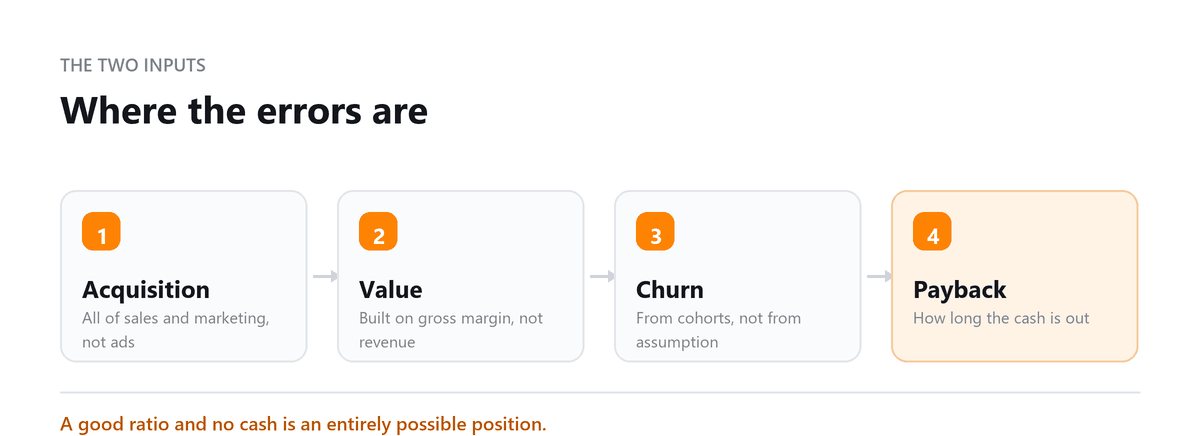
The LTV:CAC mistake I see most from early-stage founders is calculating LTV on revenue and CAC on ad spend alone. Revenue-based LTV ignores what it costs to serve the customer, and ad-only CAC leaves out salespeople, tools, and agency fees. The ratio comes out at 5:1, the founder raises spend, and cash runs down faster than the model predicted.
Recalculated properly, it's often closer to 1.5:1, and the real problem is churn. Before spending another dollar on acquisition, get LTV onto a gross margin basis and put every sales and marketing cost into CAC.
Abhinav Gupta, CPA, CA, MBA · LinkedInKey Definitions
The LTV:CAC ratio (Lifetime Value to Customer Acquisition Cost) is one of the most important metrics for any subscription or recurring-revenue business. It tells you whether acquiring a customer costs less than the value that customer generates, and by how much. An unhealthy LTV:CAC ratio is one of the earliest warning signs that a business model is fundamentally broken.
| Term | Definition | Formula |
|---|---|---|
| LTV (Lifetime Value) | Total revenue (or gross profit) a single customer is expected to generate over their entire relationship with your business | LTV = Average Revenue Per Customer / Churn Rate (or Average Revenue × Average Customer Lifespan) |
| CAC (Customer Acquisition Cost) | Total cost to acquire one new customer, including all sales and marketing spend | CAC = Total Sales & Marketing Spend / Number of New Customers Acquired |
| LTV:CAC Ratio | How many dollars of lifetime value you generate per dollar spent acquiring a customer | LTV / CAC |
How to Calculate LTV:CAC, Worked Example
SaaS startup: project management tool, monthly subscription
| Input | Value |
|---|---|
| Average Monthly Revenue Per Customer (ARPU) | $120 |
| Gross Margin | 75% |
| Monthly Churn Rate | 2% |
| Average Customer Lifespan | 1 / 2% = 50 months |
| LTV (gross profit basis) | $120 × 75% × 50 months = $4,500 |
| Total Sales & Marketing Spend (monthly) | $90,000 |
| New Customers Acquired (monthly) | $30 |
| CAC | $90,000 / 30 = $3,000 |
| LTV:CAC Ratio | $4,500 / $3,000 = 1.5x |
A ratio of 1.5x is below the healthy benchmark (see below). This business is recovering its acquisition cost but not generating enough margin above it.
LTV:CAC Benchmarks
| Ratio | Interpretation | Action |
|---|---|---|
| Below 1:1 | Destroying value, each customer costs more to acquire than they generate | Stop scaling acquisition; fix churn or pricing first |
| 1:1 to 2:1 | Breaking even, acquisition is marginally viable but leaves no room for error | Improve retention or reduce CAC before scaling |
| 3:1 (target) | Healthy, the standard benchmark for SaaS and subscription businesses | Scale acquisition; continue optimising |
| Above 5:1 | May signal under-investment in growth, you could acquire more customers profitably | Consider increasing marketing/sales budget |
CAC Payback Period
The CAC payback period tells you how many months it takes to recover the cost of acquiring a customer:
CAC Payback Period = CAC / (ARPU × Gross Margin)
Example: CAC $3,000 / ($120 × 75%) = 33 months. A 33-month payback is too long for most investors (typically want under 18 months for early-stage SaaS). It means the business is cash-flow negative on each customer for nearly 3 years before breaking even.
How to Improve Your LTV:CAC Ratio
Increase lifetime value
- Reduce churn. Cutting monthly churn from 2% to 1% doubles average customer lifespan, and doubles LTV with it.
- Raise revenue per customer. Price increases, tiered plans, upsells, and add-ons all lift LTV.
- Improve gross margin. Lower hosting, support, and onboarding costs per customer increase the value each one delivers.
- Collect annually. Annual plans often reduce churn and bring cash in upfront, which also shortens payback.
Reduce acquisition cost
- Improve conversion rates. Closing more of the leads you already have lowers CAC without cutting spend.
- Shift to lower-cost channels. Referrals, content, search, and partnerships often cost less per customer than paid ads or outbound sales over time.
- Target better-fit customers. Customers who match your product well convert faster and churn less.
CLIENT QUOTE: “We were increasing our acquisition spend because new customer numbers looked strong, but we weren't tracking LTV closely enough. Profitjets calculated the ratio and found it had fallen to about 1.6:1, largely because churn was higher than we realized. We shifted part of our budget toward onboarding and retention initiatives, improved early customer support, and brought churn down before our cash runway became a bigger constraint.”
Book a free consultation and we will build the cohort view with you.
FAQs
What is a good LTV:CAC ratio?
Around 3:1 is the commonly cited target for subscription businesses. Below 1:1, customers cost more than they return. Well above 3:1 can mean there's room to grow acquisition. Check payback period and cash runway alongside the ratio, because a good ratio with slow payback can still drain cash.
Should LTV be based on revenue or gross profit?
Gross profit. Revenue-based LTV ignores what it costs to serve each customer, so it overstates value, especially in lower-margin businesses. Whichever basis you use, state it clearly, because investors will ask.
What costs belong in CAC?
All sales and marketing costs spent to win new customers. That includes advertising, salaries and commissions for sales and marketing staff, agency and freelancer fees, events, and sales and marketing tools. Leaving out salaries is the most common way CAC gets understated.
How do I calculate LTV if I don't have much churn data yet?
Use your actual churn from the months you do have, but be conservative. Early customers often behave differently from later ones, and a few months of low churn can make LTV look unrealistically high. Some founders cap lifespan at a fixed number of years until they have enough history to rely on.
Does LTV:CAC apply to non-subscription businesses?
Yes, with adjustments. For businesses with repeat purchases, such as ecommerce brands, LTV is based on the average number of orders and gross profit per order over a customer's relationship. The logic is the same: compare what a customer is worth with what they cost to acquire.

Written by
Abhinav Gupta, CPA, CA, MBA
Abhinav works with business owners across the US on industry-specific bookkeeping, from dental practices and restaurants to construction and e-commerce. He writes about what each trade's books actually need. Connect on LinkedIn
Free consultation
Unit Economics Unclear?
Book a free consultation and we will build the cohort view with you.