
What is Offshoring?
Offshoring refers to relocating business operations or processes to another country while the originating company maintains ownership and oversight. In the accounting context, offshoring means establishing or contracting accounting functions in a lower-cost geography most commonly India for U.S. businesses while retaining management control of the financial function. This is distinct from simply outsourcing to an external vendor, though in practice the two models frequently overlap.
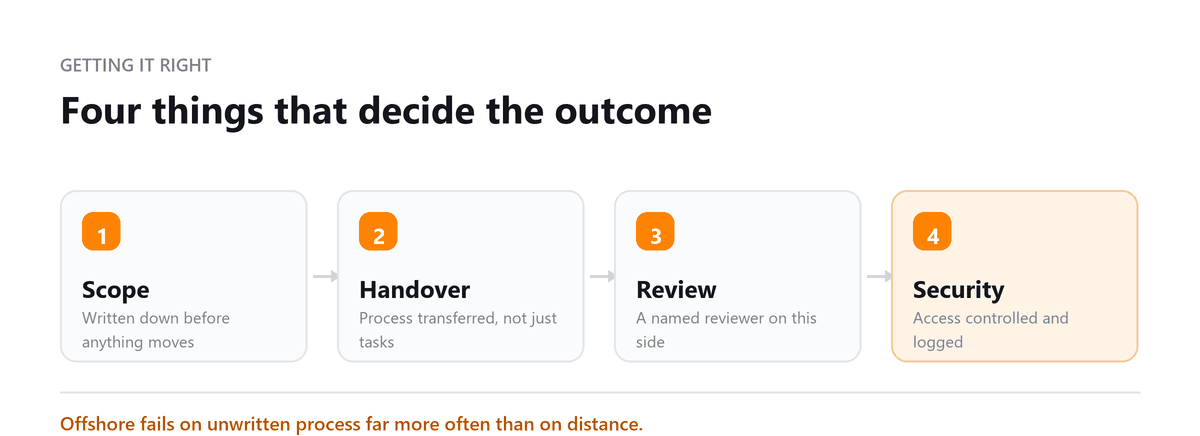
The companies that succeed at offshore accounting treat it as a long-term partnership, not a cost-cutting exercise. The savings are real but they require investment in process documentation, communication protocols, and quality review. Done right, you get exceptional work at 30 to 40 cents on the dollar.
Anu Gupta, CA, EA, B.Tech · LinkedInExpert Quote
How is Offshoring Different from Outsourcing?
The distinction matters for how you structure the engagement. Offshoring means moving operations to another geography while keeping them in-house, a U.S. company that sets up its own accounting team in Hyderabad is offshoring. Outsourcing means transferring work to an external third-party vendor regardless of geography, hiring an accounting firm in New York is outsourcing.
Offshore outsourcing, using a third-party provider in another country, is what most small and mid-size businesses actually do when they say they are 'offshoring their accounting.' Understanding which model you are using matters for contracts, data governance, and compliance obligations.
What Can Be Offshored?
The most commonly offshored accounting functions are those that do not require in-person presence or real-time local knowledge: bookkeeping and transaction recording, accounts payable and receivable management, payroll processing, bank reconciliation, tax return preparation, financial reporting and management accounts, audit support and working paper preparation, and CFO-level reporting packages. Functions typically kept onshore include client-facing advisory work, local regulatory liaison, and decisions requiring real-time knowledge of local market conditions.
Companies That Offshore Accounting
Offshore accounting is not a small-business workaround, it is a mainstream corporate practice. IBM, GE, American Express, and Microsoft are among the major corporations that have established offshore accounting operations or use offshore accounting providers. The practice has migrated steadily down-market: mid-size and small businesses increasingly access the same talent and cost advantage through offshore outsourcing firms, without the capital investment of establishing their own offshore entity.
Why the U.S. Prefers India for Offshore Accounting
| Benefit | Detail |
|---|---|
| Cost savings | 60 to 70% reduction vs. U.S. in-house staff |
| Skilled talent pool | English-speaking CPAs, CAs, and finance professionals with U.S. GAAP training |
| Time zone advantage | 12-hour offset enables overnight turnaround, work submitted end of U.S. business day, returned by morning |
| Scalability | Scale up or down without long-term hiring commitments |
| Security | Leading Indian firms maintain ISO/IEC 27001 certification and SOC 2 compliance |
Checkpoints to Successfully Offshore Your Accounting
1. Data Security and Confidentiality
Financial data is among the most sensitive information a business holds. Before engaging any offshore provider, establish: a comprehensive NDA with specific financial penalties for breach, role-based data access so offshore staff see only the data their function requires, encrypted file transfer protocols for all document exchange, and clarity on data residency, where the data physically lives and which data protection laws apply.
2. Compliance with U.S. Laws
The offshore provider handles the work; U.S. law governs your filing and reporting obligations. Verify that the provider demonstrates working knowledge of U.S. GAAP, IRS requirements for the entity types they serve, and state-specific regulations if multi-state operations are involved. Request documented examples of their U.S. compliance training and how they keep current with regulatory changes.
3. Time Zone Coordination
The 12-hour offset between U.S. and India is an asset, overnight turnaround is genuinely achievable, but it requires deliberate process design. Establish: clear daily handoff protocols specifying what must be submitted and by what time, response time SLAs for queries, and defined overlap hours when U.S. and offshore team members are simultaneously available for real-time communication.
4. Communication and Language
U.S. business communication tends toward directness; Indian professional culture frequently uses more diplomatic framing. This difference creates misalignment on deadlines (a polite 'we will try' can mean 'this is unlikely') and on error acknowledgment. Invest in cultural onboarding for both teams, establish clear escalation paths for when deadlines are at risk, and conduct regular structured check-ins rather than relying on ad-hoc communication.
5. Hidden Costs
The headline rate comparison, U.S. staff vs. offshore rate, understates true total cost. Factor in: initial setup and transition costs, software licensing fees (the offshore team needs access to your accounting platforms), quality review time for U.S. staff, holiday calendar differences that affect availability, and any premium for urgency outside standard SLAs. Build a complete cost model before evaluating the ROI.
Cultural Considerations
Successful offshore accounting relationships require cultural investment, not just contractual protections. U.S. business norms around deadlines, directness, and error acknowledgment differ meaningfully from Indian professional culture. Holiday calendars diverge significantly, Indian holidays are not U.S. holidays, and vice versa. Firms that invest in cultural onboarding, visit the offshore team periodically, and build genuine professional relationships consistently outperform those that treat offshore accounting as purely transactional.
Pricing Reality
| Role | U.S. In-House Rate | Offshore Rate (India) |
|---|---|---|
| Bookkeeper | $20 to $26/hour | $8 to $12/hour |
| Staff Accountant | $28 to $45/hour | $12 to $18/hour |
| Senior Accountant | $45 to $75/hour | $18 to $30/hour |
| Tax Preparer | $50 to $90/hour | $15 to $25/hour |
How Profitjets Helps with Offshore Accounting
We offer offshore accounting teams of certified Chartered Accountants and cloud software experts, who serve as an extension of your in-house finance team. with executive-level CFOs in the US, we provide round-the-clock support to our clients finance teams 24/7, covering everything from daily bank reconciliations to financial reporting in QBO, NetSuite, Xero, and AppFolio.
Our offshore accounting services are designed to alleviate the stress of founders who have attempted to outsource their finance operations to third-party agencies in the past. By contrast, we offer transparent, controlled, and reliable financial management by assigning a lead accountant of your choice in your local time zone and developing localized SOPs specific to your industry. In addition, we guarantee that your books will be closed and ready for your review within five business days each month.
With our two-step CPA auditing process, you can rest assured that all entries have gone through an extensive reliability check before reaching your inbox, giving you accurate and dependable financial statements free of errors without the hassle of managing an in-house accountant.
With our virtual CFO services, you can reduce payroll expenditures for finance managers by up to 60% while enjoying the same high level of accuracy typically delivered by full-time in-house accountants. In fact, our clients report achieving an average of 99.2% accuracy rate for month-end journal entries and financial statements in comparison to traditional offshore accounting providers.
Conclusion
Offshore accounting done well is not a cost-cutting exercise, it is a strategic decision to access world-class accounting talent at market rates that U.S.-based hiring cannot match. The companies that succeed treat the relationship as a long-term partnership: investing in process documentation, communication infrastructure, and quality review systems. Those that approach it purely transactionally, focused only on the hourly rate, typically find the experience frustrating and the savings illusory
Book a free consultation and we will show you how the handover is run.
FAQs
What is offshore accounting and how does it work?
Offshore accounting involves hiring a team in a different country to handle bookkeeping, accounting, tax preparation, and financial reporting while your business retains oversight. Work is typically submitted at end of U.S. business day, processed overnight, and returned the next morning, leveraging the time zone difference.
What types of accounting work can be offshored?
Most non-client-facing accounting work can be offshored: bookkeeping, accounts payable/receivable, payroll, bank reconciliation, tax return preparation, management accounts, financial reporting, audit support, and CFO reporting packages. Work requiring in-person presence or sensitive local regulatory knowledge is typically kept in-house.
What are the risks of offshore accounting and how do I mitigate them?
Key risks include data security breaches (mitigate with NDAs, encrypted transfers, access controls), quality inconsistencies (mitigate with structured review processes and clear standards), communication gaps (mitigate with regular check-ins and documented procedures), and compliance errors (mitigate by verifying U.S. GAAP expertise and ongoing training).
How do I know if an offshore accounting firm is reputable?
Look for: professional certifications (CPA, CA, or equivalent), ISO/IEC 27001 or SOC 2 compliance, verifiable client references, clear SLA commitments, software proficiency (QuickBooks, Xero, NetSuite), and transparent pricing with no hidden fees. Request a trial engagement before committing.
Is offshore accounting compliant with U.S. tax and privacy laws?
Yes, when structured properly. The offshore firm handles the work; U.S. laws govern the filing and reporting obligations of the U.S. business. Key considerations: ensure data transfer agreements comply with applicable privacy regulations, and confirm the provider has demonstrated U.S. GAAP and IRS procedural knowledge. Your CPA or legal counsel can review the engagement structure.

Written by
Anu Gupta, CA, EA, B.Tech
Anu works with US businesses on tax and entity questions at Profitjets, from choosing a structure to the filings that follow it. She writes about the decisions owners make once and then live with for years. Connect on LinkedIn
Free consultation
Considering Offshore?
Book a free consultation and we will show you how the handover is run.