
Whether this pays for itself is a fair question and it is usually answered by comparing the fee against a salary, which is the wrong comparison.
The cost of not having the work done properly is the part that gets left out: filings that are late, discounts not taken, decisions made on numbers that arrived six weeks after the month ended.
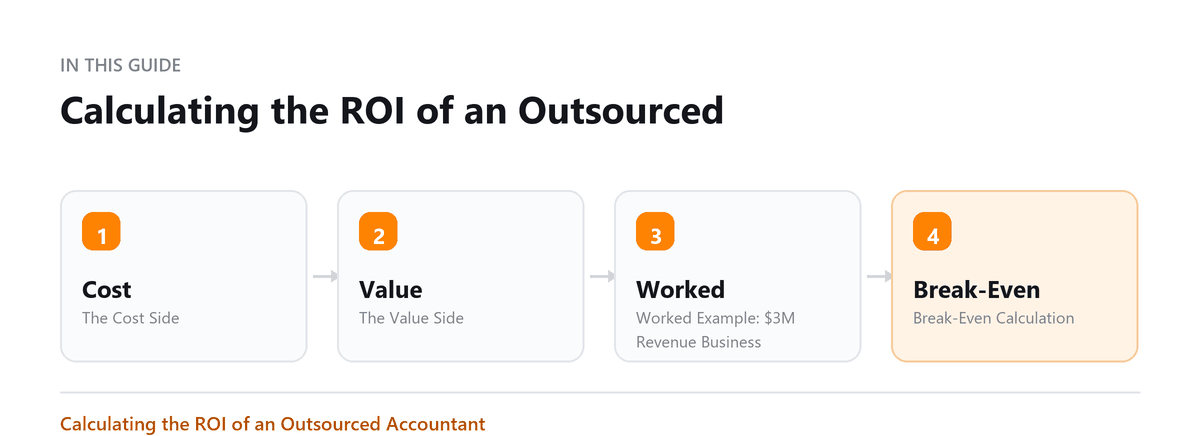
This covers what the arrangement costs, where the value actually comes from, a worked example on a business of a realistic size, and how to calculate the point at which it breaks even.
Business owners ask whether outsourced accounting is worth the cost. The answer requires a proper accounting of both what you pay and what you get. Here is a framework for calculating the ROI of an outsourced accountant, with a worked example.
The Cost Side
| Service Level | Typical Monthly Cost |
|---|---|
| Bookkeeping only | $400 - $1,000/month |
| Full accounting (close + statements) | $1,000 - $2,500/month |
| Full accounting + tax prep | $1,500 - $4,000/month |
| Full accounting + fractional CFO | $4,000 - $10,000/month |
Count the cost of the work nobody is doing, not just the salary you avoid. Late filings, missed discounts, a month closed six weeks after it ended: those are the numbers that usually decide this, and they rarely appear in the comparison.
Abhinav Gupta, CPA, CA, MBA · LinkedInThe Value Side
1. Owner Time Saved
Most small business owners who handle their own books spend 10-20 hours per month on accounting tasks. What is your time worth?
| Owner Hourly Rate | Monthly Value (15 hrs saved) |
|---|---|
| $100/hr | $1,500 |
| $200/hr | $3,000 |
| $500/hr | $7,500 |
Pro Tip: Use your revenue per hour as your opportunity cost rate: if your business generates $1.5M in revenue and you work 2,000 hours/year, your time is worth $750/hour. That math changes the ROI calculation dramatically.
2. Error Prevention
The average cost of an IRS audit for a small business is $4,000-$20,000 in professional fees, plus any additional taxes, penalties, and interest. DIY accounting errors create audit risk that professional bookkeeping largely eliminates.
Payroll tax errors carry automatic penalties: 2-15% of the underpayment depending on how late. A single missed payroll deposit for a business with $50,000/month in payroll can cost $2,500-$7,500 in penalties.
3. Tax Savings
A CPA or tax professional who knows your business will find deductions that a self-prepared return misses. Common missed deductions for small businesses:
- Home office deduction (actual expense method vs standard)
- Vehicle mileage (IRS standard rate: verify current rate)
- Section 179 and bonus depreciation on equipment
- Health insurance premiums for self-employed
- Retirement plan contributions (SEP-IRA, Solo 401(k))
- Business meals (50%) and entertainment (100% for certain events)
4. Faster, Better Decisions
When your financials are accurate and current, you make better decisions about pricing, staffing, and investment. The value of better decisions is harder to quantify but often exceeds all other ROI categories combined.
Worked Example: $3M Revenue Business
| ROI Factor | Annual Value |
|---|---|
| Owner time saved (15 hrs/month x $200/hr) | $36,000 |
| Audit risk reduction (probability-weighted) | $5,000 - $15,000 |
| Incremental tax savings (common missed deductions) | $8,000 - $25,000 |
| Better decisions (conservative estimate) | $20,000 - $100,000+ |
| Total value (conservative) | $69,000 - $176,000 |
| Total cost (full accounting package) | $18,000 - $30,000/year |
| Net ROI (conservative) | 2x - 6x cost |
Break-Even Calculation
At $1,500/month for a full accounting package, you break even if outsourcing saves you 7.5 hours per month of time worth $200/hour, or prevents one small tax error per year worth $1,500, or finds you one additional deduction worth $1,500. Any two of those three more than justify the investment.
Book a free consultation and we will put senior eyes on your numbers.
Frequently Asked Questions
How do I measure ROI if I've never had a professional do my books?
Run the first year as a baseline. Identify the deductions your new accountant finds that you missed. Time your accounting tasks and compare before and after. Ask your CPA to estimate the tax savings from their first return compared to your prior year.
Does the ROI change at different business sizes?
Yes. At small revenue (under $500K), the ROI is primarily owner time and error prevention. At $2M-$10M, tax optimization and decision quality become the dominant factors. Above $10M, the quality of financial reporting for financing and M&A purposes adds a third major value driver.
How does Profitjets measure its value to clients?
Profitjets tracks owner hours recaptured, tax credits identified, and audit-ready compliance maintained for each client. Ask us for specific examples from clients in your industry.
What costs on the in-house side are usually left out of the comparison?
The ones that are not a salary. Recruitment and the time spent recruiting, cover during holidays and sickness, software licences and the hardware, training, the management time spent supervising, and the cost of the gap when the person leaves. None of them appears on a payslip and together they change the answer materially. The comparison is only fair once both sides are stated on a fully loaded basis.
How long before the arrangement pays for itself?
Longer than the first month and sooner than most people fear, and the shape matters more than the timing. The early return comes from things stopping: late filings, errors found by other people, time you spent on work you should not have been doing. The larger return comes later, from decisions made on numbers you trust. Judging it at month two measures the handover, not the arrangement.

Written by
Abhinav Gupta, CPA, CA, MBA
Abhinav works with business owners across the US on industry-specific bookkeeping, from dental practices and restaurants to construction and e-commerce. He writes about what each trade's books actually need. Connect on LinkedIn
Free consultation
Want CFO-Level Clarity?
Book a free consultation and we will put senior eyes on your numbers.