
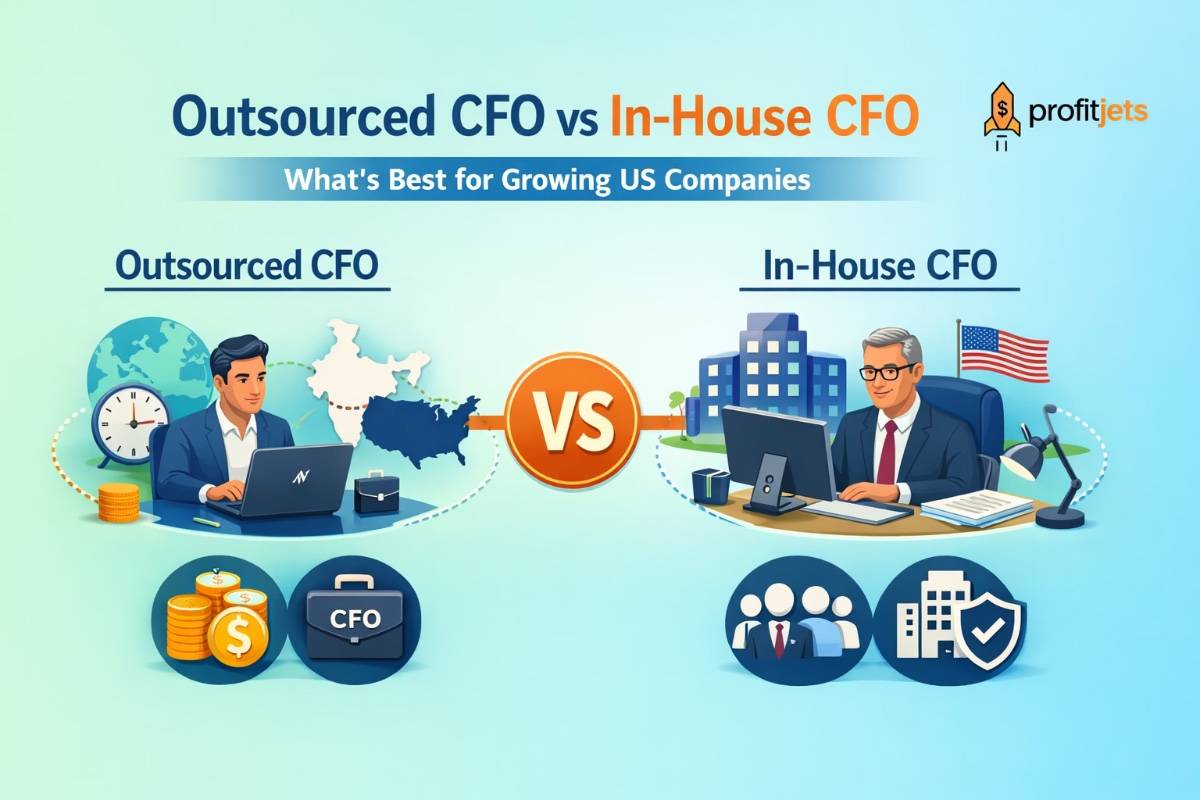
Choosing between an outsourced CFO and an in-house CFO is a strategic decision that directly impacts financial growth, cash flow management, and long-term stability. For growing US companies, startups, and small businesses, hiring a full-time CFO may not always be practical due to high salary costs and overhead expenses. This is where an outsourced CFO becomes a powerful alternative. That provides executive-level financial leadership, forecasting, budgeting, and strategic planning without the burden of a full-time salary.
On the other hand, an in-house CFO offers dedicated, on-site financial management and deep organizational involvement. If you’re searching broadly for the right financial leadership model, the direct answer is this: businesses focused on scalability, cost-efficiency, and flexibility often benefit more from outsourced CFO services, while larger enterprises with complex daily financial operations may justify a full-time hire. Let’s break down both options in detail to help you decide what’s best for your company.
What Is an Outsourced CFO?
An outsourced CFO is an external financial expert who provides high-level financial strategy, reporting oversight, and business advisory support on a part-time, fractional, or contract basis.
Key Features:
- Access to virtual CFO services
- Flexible engagement models (monthly, project-based, or interim)
- Lower cost than a full-time executive hire
- Scalable services aligned with business growth
- Remote CFO consulting with nationwide accessibility
Many growing businesses choose fractional CFO services because they provide executive expertise without committing to a six-figure salary plus benefits. This model is especially popular among startups and small businesses seeking CFO services for startups or expansion planning.
What Is an In-House CFO?
An in-house CFO is a full-time executive employed internally to manage all financial operations, compliance, reporting, investor relations, and long-term strategic planning.
Key Responsibilities of an In-House CFO
- Daily financial oversight
- Internal team management
- Direct board communication
- Full-time strategic planning
- Hands-on financial operations
For large corporations with complex accounting departments, regulatory demands, and continuous investor reporting, an in-house CFO may be essential.
Cost Comparison: Outsourced CFO vs In-House CFO
Cost is often the deciding factor for many US companies.
In-House CFO Costs
- Average salary in the USA: $150,000–$300,000+ annually
- Bonuses and equity packages
- Health insurance and benefits
- Office space and administrative costs
Total cost can exceed $250,000 per year.
Outsourced CFO Costs
- Monthly retainer or hourly billing
- No benefits or long-term employment obligations
- Scalable pricing structure
An outsourced CFO for small business can cost significantly less while delivering strategic financial planning services and executive insights.
For startups and scaling businesses, the ROI of outsourced CFO services often outweighs the expense of a full-time executive.
Flexibility & Scalability
One of the strongest advantages of an outsourced CFO is flexibility:
- Rapid growth phase
- Fundraising preparation
- Cash flow challenges
- Financial restructuring
- Expansion into new markets
With online CFO services and remote CFO consulting, businesses can access expertise across the USA without geographic limitations.
In contrast, an in-house CFO provides stability but may lack scalability during slower business periods.
Strategic Value & Expertise
Both models offer strategic leadership, but the approach differs.
Outsourced CFO Advantages
- Experience across multiple industries
- Exposure to various financial challenges
- Specialized CFO advisory services
- Objective, third-party financial perspective
Professionals work with multiple clients, they often bring broader strategic insight compared to an internal executive focused on a single company.
In-House CFO Advantages
- Deep understanding of company culture
- Daily operational control
- Immediate availability
For organizations with complex financial ecosystems, full-time leadership may be beneficial.
Best Choice for Growing US Companies
For most small and mid-sized US businesses, an outsourced CFO offers:
- Cost-efficiency
- Access to senior-level expertise
- Flexible engagement terms
- Scalable financial leadership
Companies generating under $50 million in revenue often benefit more from part-time or interim CFO services rather than committing to a permanent executive salary.
However, if your company has multiple subsidiaries, international compliance needs, or heavy investor reporting, an in-house CFO could be justified.
Outsourced CFO for Startups
Startups frequently rely on fractional CFO services to:
- Build financial models
- Prepare investor pitch decks
- Manage runway and burn rate
- Implement budgeting systems
- Establish KPIs
CFO services for startups ensure founders make data-driven decisions without overspending on executive payroll.
Risk Management & Compliance
Both models help with compliance and risk mitigation.
An outsourced CFO ensures:
- GAAP compliance
- Tax strategy alignment
- Financial controls implementation
- Cash flow forecasting
In-house CFOs manage ongoing compliance internally, often supported by accounting teams.
For companies seeking strategic financial planning services without expanding payroll, outsourcing provides a balanced solution.
Final Verdict: Which Is Right for You?
If your priority is flexibility, cost savings, and scalable expertise, an outsourced CFO is likely the smarter option. If you need daily, hands-on executive management within a complex enterprise, an in-house CFO may be more appropriate.
Growing US companies increasingly prefer outsourced CFO models because they combine strategic insight with financial efficiency.
Ready to Strengthen Your Financial Strategy?
If you’re considering hiring an outsourced CFO, Profitjets provides expert-level financial leadership tailored to US small businesses and startups.
Let Profitjets help you scale with confidence and strategic clarity.
FAQs
Q1: What does an outsourced CFO do for a small business?
An outsourced CFO provides strategic financial planning, budgeting, cash flow management, forecasting, and executive-level financial guidance without being a full-time employee.
Q2: Is an outsourced CFO cheaper than hiring in-house?
Yes. An outsourced CFO typically costs significantly less than a full-time CFO because businesses avoid salaries, benefits, and long-term commitments.
Q3: When should a company hire an outsourced CFO?
Companies should hire Virtual CFO during growth phases, fundraising, financial restructuring, or when they need strategic expertise without full-time costs.
Q4: Can startups benefit from fractional CFO services?
Absolutely. Fractional CFO services help startups manage burn rate, prepare financial projections, and secure funding efficiently.
Q5: How do I choose between outsourced CFO and in-house CFO?
If your company values flexibility, cost control, and scalable financial expertise, choose Virtual CFO services. Larger enterprises with complex operations may prefer in-house leadership.