
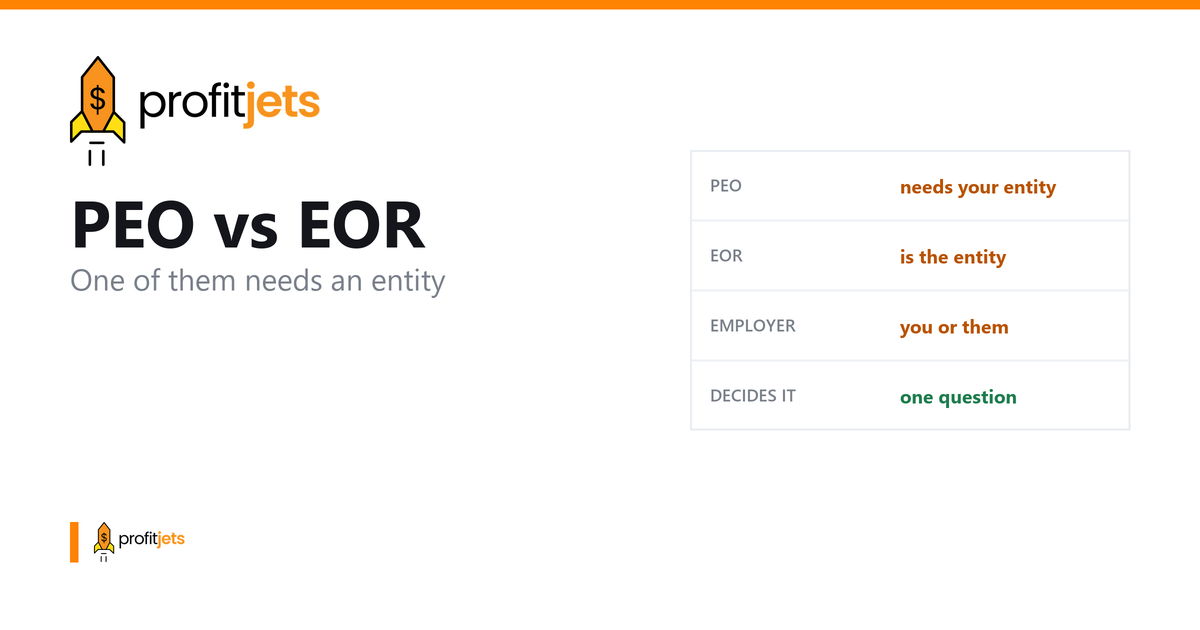
PEO is the Professional Employer Organization, and it refers to a US co-employment company in charge of paying and managing benefits for employees on behalf of another company that has an existing legal entity in the US.
EOR stands for Employer of Record and refers to a legal entity that becomes your hire’s employer in India to make it possible to start hiring without going through the trouble of setting up an entity.
Say you’re a US company that’s looking to hire one engineer in Bengaluru. You’re bound to come across both PEO and EOR in one working day while trying to decide what’s best for you.
The terms might appear similar, but it’s best to understand the concepts behind them. Many overseas companies looking to hire in India tend not to have entities there, so the decision is often made for them.
In the text below, we’ll see what responsibilities each entity has, when an entity is more suitable and which one you can consider using.
The one question that decides it
Do you already have an Indian entity?
If yes, both models are open to you. If no, a PEO is not available and the choice is between an EOR and incorporating. Everything else in this article is detail hanging off that answer.
That is genuinely most of it. A lot of comparison articles work through feature tables before mentioning the thing that rules one option out entirely.
What a PEO is
A professional employer organisation works alongside a company that already exists. It becomes a co-employer: you keep the employment relationship and the legal entity, and the PEO takes on payroll, benefits administration and a share of the HR and compliance work.
A PEO does not remove the need for an entity. It supports one. If you have an Indian subsidiary and do not want to build an HR and payroll function inside it, a PEO is a sensible answer.
What an EOR is
An employer of record already has its own Indian entity, and that entity becomes the legal employer of your people. Its name is on the employment contract. It runs payroll, deducts and deposits provident fund, ESI, professional tax and TDS, files the returns and issues Form 16.
You direct the work, set priorities and manage performance. You do not need an Indian company, because you are using someone else's.
Employer of record vs PEO, side by side
| PEO | EOR | |
|---|---|---|
| Do you need your own Indian entity | Yes, always | No, that is the point |
| Who is the legal employer | You | The provider's Indian entity |
| Who signs the employment contract | Your Indian company | The provider's Indian company |
| Who carries the statutory filings | You, with their help | Them |
| Who owns the compliance risk | You | Largely them |
| Typical reason to choose it | You have an entity and want help running it | You want people in India and no entity |
| Time before the first hire | Only if the entity already exists | Days rather than months |
Companies come to us asking for a PEO in India when what they actually need is an EOR, because they have no Indian entity for a PEO to attach to. It is worth getting the word right early, because it changes which providers can even quote you.
Abhinav Gupta, CPA, CA, MBA · LinkedInWhy the confusion exists
Two reasons, and both are worth knowing.
First, the terms blur by market. In the United States, PEO is the familiar word and is often used loosely for any outsourced employment arrangement. Buyers carry that habit into an India search, where the distinction is sharper.
Second, some providers market both and are not always precise about which one you are buying. If a provider offers you a PEO and you have no Indian entity, ask them directly which legal entity will employ your people. The answer tells you what you are actually being sold.
Which one fits your situation
No Indian entity, and you want a small team
An EOR. It is the only one of the two that works, and for a handful of people it is usually cheaper than incorporating as well.
No Indian entity, and you want to sell in India
Neither, on its own. Selling into India needs your own entity, because an EOR cannot sign Indian customer contracts or raise Indian invoices for you.
You have an Indian entity and a growing team
A PEO, or simply a payroll and compliance provider. The entity is already carrying the fixed costs, so the question is who runs the work inside it.
You have an Indian entity but it is dormant
Worth a conversation. Keeping an entity alive purely to employ two people means an audit, ROC filings and transfer pricing work for very little return.
A note on cost
The two are not really comparable on price, because they are not alternatives for the same buyer. A PEO fee sits on top of the cost of running your entity. An EOR fee replaces it.
If you are weighing an EOR against incorporating, the honest comparison is a monthly per-employee fee against the fixed annual cost of a company: audit, ROC filings, a transfer pricing study and Form 3CEB, payroll compliance and someone's time every month. Our EOR services in India are a flat $75 per employee per month, with salary and statutory contributions billed at cost.
The short version
A PEO is a co-employer that supports an entity you already have. An EOR is the legal employer through an entity you do not have to build.
If you have no Indian company, the PEO question answers itself and the real decision is EOR against incorporating.
Founders often ask us whether they should use a PEO or an employer of record.
A PEO shares the employment role with your own company, so it works when you already have a legal entity in the country. A foreign company with no Indian entity has nothing for a PEO to work with, so it cannot use one. An employer of record is different. It becomes the legal employer, so your people are employed under Indian law from day one.
We tell founders to start with one question: do you have an Indian entity today? If you do, a PEO may be worth a look.
If you do not, an employer of record is the route that works, and we say so up front. That saves weeks of comparing the wrong providers.
Frequently Asked Questions
EOR vs PEO: what is the difference?
A PEO is a co-employer that works alongside your own legal entity, taking on payroll, benefits and part of the HR and compliance work while you remain the employer. An EOR becomes the legal employer itself, through its own entity, so you do not need one. The practical difference is that a PEO requires an entity and an EOR replaces the need for one.
Can I use a PEO in India without an entity?
No. A PEO is a co-employment model that attaches to an existing legal employer. With no Indian company, branch or liaison office, there is nothing for it to attach to, and the model does not apply. An employer of record is the route that works without an entity.
Is an EOR more expensive than a PEO?
They are not really comparable, because they serve different buyers. A PEO fee sits on top of the cost of running your own entity, while an EOR fee replaces that cost. The meaningful comparison for a company with no entity is an EOR against incorporating.
Who is responsible for compliance under each model?
Under a PEO, your entity remains the employer, so the statutory obligations stay with you even though the PEO helps you meet them. Under an EOR, the provider's entity is the employer and carries those obligations, including payroll filings, provident fund, ESI and TDS.
Can I switch from an EOR to a PEO later?
Yes, and it is a natural path. Once you incorporate in India, employees can be transferred from the employer of record onto your own payroll, and a PEO or a payroll provider can support the entity from there. It needs planning around continuity of service, benefits and timing.
Which model do most foreign companies hiring in India use?
It depends almost entirely on whether they already have an Indian entity. Companies hiring their first few people in India generally use an employer of record, because incorporating for two or three employees brings an annual audit, ROC filings and transfer pricing documentation with it.

Written by
Abhinav Gupta, CPA, CA, MBA
Abhinav works with business owners across the US on industry-specific bookkeeping, from dental practices and restaurants to construction and e-commerce. He writes about what each trade's books actually need. Connect on LinkedIn
Free consultation
Not Sure Which One You Need?
Tell us whether you have an Indian entity and how many people you want to hire, and we will tell you which model applies in about a minute.