
Pro forma financial statements are forward-looking projections of a business's financial performance what the income statement, balance sheet, and cash flow statement are expected to look like under a specific set of assumptions. They are used for fundraising, loan applications, scenario planning, and evaluating the financial impact of major business decisions before committing to them.
Every founder has to answer one version or another of the same question from a potential money provider: what happens to your numbers from here? A historical P&L tells you what happened. It can tell you nothing about what happens should you hire three more salespeople, launch a second product line or draw a term loan.
That’s where pro forma statements come in, a projected income statement, balance sheet, and cash flow statement given a set of stated assumptions used for decision making that has not yet occurred.
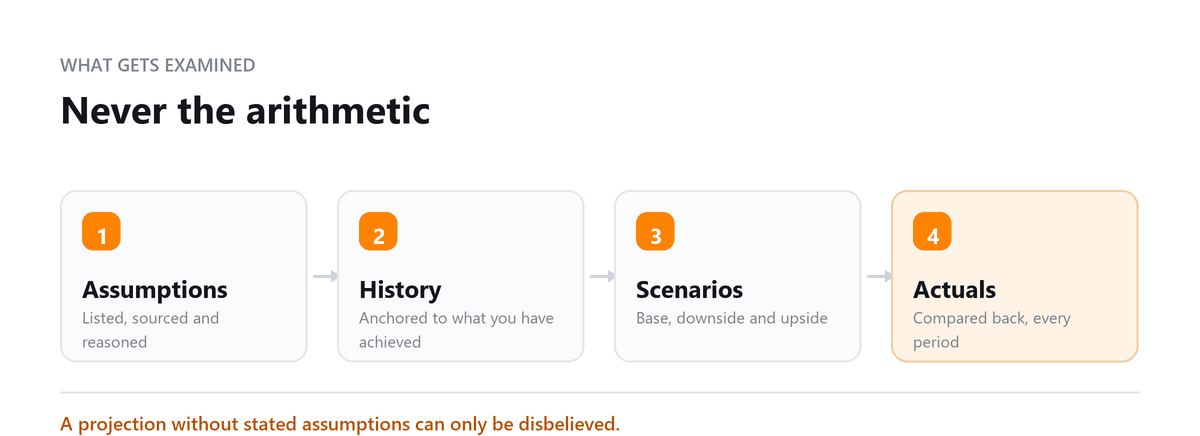
The phrase “pro forma” triggers unease in many, as if it is some sort of con. It is not. It means something else entirely: that this is a formalized projection and nothing more. Nobody is suggesting it reflects reality. The only requirement is that the assumptions used to create it be disclosed and defendable.
What Does 'Pro Forma' Mean?
Pro forma is Latin for 'as a matter of form' in finance, it refers to projections based on hypothetical or assumed conditions rather than historical actuals. Pro forma statements are not predictions; they are structured estimates based on clearly stated assumptions.
The assumption investors push on hardest is almost never the revenue growth rate, it's the customer acquisition cost and how it changes at scale. Founders love to show CAC flat or improving as they grow, and that's usually the first thing that gets picked apart, because it rarely holds without a specific reason. If you can't point to what actually drives that improvement, don't put it in the model.
Abhinav Gupta, CPA, CA, MBA · LinkedInThe Three Pro Forma Statements
| Statement | What It Projects | Key Inputs |
|---|---|---|
| Pro Forma Income Statement | Projected revenue, costs, and profit over a future period | Revenue growth rate, COGS %, operating expense growth, tax rate |
| Pro Forma Balance Sheet | Projected assets, liabilities, and equity at a future date | Working capital changes, debt repayment schedule, capex, retained earnings |
| Pro Forma Cash Flow Statement | Projected cash inflows and outflows | Collections timing, payment terms, loan drawdowns, capex |
When Are Pro Forma Statements Used?
- Fundraising (equity): investors require 3 to 5 year projections showing the growth trajectory and the path to profitability
- Bank loan applications: lenders want to see that projected cash flow can service the proposed debt
- Acquisition analysis: modelling the combined financials of an acquirer and target ('merger pro forma')
- New product launch: projecting the incremental revenue and cost of adding a new product line
- Scenario planning: best case / base case / downside models to stress-test the business against key risks
Profitjets has supported more than 50 fundraising and loan applications with pro forma financial models, helping clients build projections around revenue growth, operating costs, working capital, debt service, and cash requirements.
How to Build a Pro Forma Income Statement
- Step 1, Start with revenue: project revenue by product line, customer segment, or geography. Use a bottom-up approach (unit price × expected units) rather than top-down ('we just need 1% of the market').
- Step 2, Project COGS: express as a % of revenue, or build unit-by-unit. Verify that margins improve as volume scales (economies of scale) or explain why they won't.
- Step 3, Model operating expenses: classify as fixed (salaries, rent, grow by hire plan) vs variable (commissions, hosting, grow with revenue). Do not simply grow all expenses at the same rate as revenue.
- Step 4, Project interest and tax: use the loan schedule for interest; apply the applicable corporate tax rate to taxable profit.
- Step 5, Calculate net income: revenue → gross profit → operating profit → net income. Verify margins are directionally improving as scale increases.
Sample 3-Year Pro Forma Income Statement
| Item | Year 1 | Year 2 | Year 3 |
|---|---|---|---|
| Revenue | $300,000 | $480,000 (+60%) | $720,000 (+50%) |
| COGS (35% of revenue) | $105,000 | $168,000 | $252,000 |
| Gross Profit | $195,000 (65%) | $312,000 (65%) | $468,000 (65%) |
| Operating Expenses | $180,000 | $240,000 (+33%) | $300,000 (+25%) |
| Operating Profit | $15,000 (5%) | $72,000 (15%) | $168,000 (23%) |
| Interest + Tax | $10,000 | $18,000 | $40,000 |
| Net Profit | $5,000 (1.7%) | $54,000 (11.3%) | $128,000 (17.8%) |
This model shows revenue growing through increased sales, while operating expenses grow more slowly (operating leverage). The result is expanding margins in Year 2 and Year 3, the J-curve typical of scaling businesses.
CLIENT QUOTE:
We needed a three-year pro forma model for a $750,000 bank loan, but our original projections didn't account properly for collections timing or the additional payroll the expansion would require. Profitjets rebuilt the model, stress-tested the assumptions under different revenue and cash-flow scenarios, and helped us present a more realistic debt-service plan to the lender. The financing was approved, and we had a clearer view of how much cash the expansion would actually require.
Book a free consultation and we will make them defensible.
FAQs
How accurate does a pro forma actually need to be?
Not perfectly. nobody expects that, and claiming otherwise would hurt your credibility more than help it. What gets evaluated is whether the assumptions are reasonable, supported, and consistent with each other. A simple model with clearly stated assumptions beats a complex one with growth rates nobody can explain.
What's the difference between a budget and a pro forma?
A budget is an internal commitment, a target you manage the business against for the year ahead. A pro forma is built for an external audience or a specific decision: raising money, taking a loan, evaluating a new product or acquisition. Budgets are operational. Pro formas are strategic, and usually temporary built for one purpose, then set aside.
Do I need pro forma statements if I'm not raising money?
If you're evaluating a decision with real financial consequences: a new hire, a new product line, taking on debt, a pro forma is how you find out whether the decision makes sense before you're living with it. It doesn't have to be built for an outside audience to be worth building.
What's the biggest mistake in a first-time pro forma?
Growing every expense line at the same rate as revenue. It's the fastest way to either understate how much cash you'll need (if real costs are lumpier than that) or make the business look worse than it will actually be (if genuine fixed costs don't move at all). Separating fixed from variable costs is the single highest-leverage fix.
Should I update the pro forma once actual results start coming in?
Yes. a pro forma isn't a one-time document you file away after the pitch or the loan closes. Lenders and investors who've already bought in will expect this too being able to show "here's where we're tracking against the model, and here's what changed" is usually more reassuring than the original projection ever was.

Written by
Abhinav Gupta, CPA, CA, MBA
Abhinav works with business owners across the US on industry-specific bookkeeping, from dental practices and restaurants to construction and e-commerce. He writes about what each trade's books actually need. Connect on LinkedIn
Free consultation
Building Projections for a Raise?
Book a free consultation and we will make them defensible.