
Top 7 Signs It's Time to Outsource Bookkeeping Solutions for Your Business
Seven signals that a business has outgrown doing its own books, plus the risks of outsourcing and how to manage them
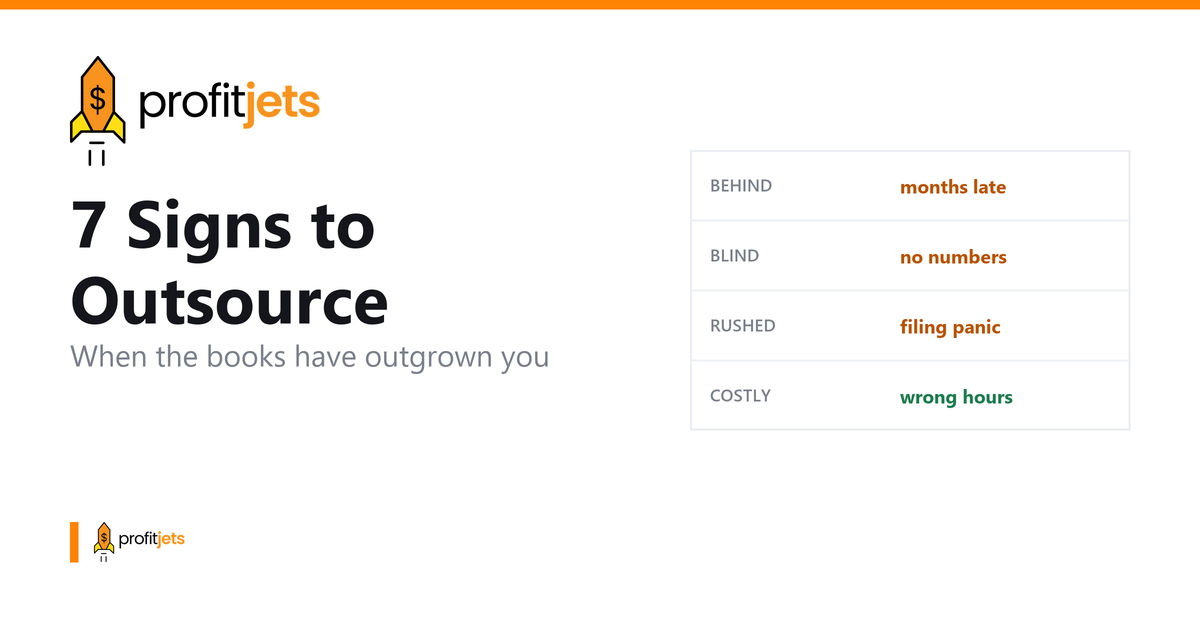
Bookkeeping is the main function for business owners to keep a review of their financial status. Most of the small businesses handle their books initially in spreadsheets. Though the process is standard, they often rely on it for too long even after expanding functions. They think of it as cost cutting practice but in reality this simple framework compounds slowly which is difficult to detect. Now they need to spend more to resolve the errors they’ve created along the way.
Knowing when to make the shift to outsource bookkeeping services is the vital decision for small business owners. When financial activity is becoming complex, with more volumes and inefficiency to handle ongoing tax obligations is when they step into outsourcing bookkeeping services. The guide explains the early indicators that flags when it's time for small business owners to outsource their bookkeeping services.
When I see a business owner reconciling their own bank statements at 11pm on a Sunday, I know it is already time to outsource. That time should be spent on strategy, customers, or rest, not data entry.
Ankit Sarawagi, CPA, CA, MBA · LinkedInWhen to Outsource Bookkeeping: 7 Clear Signs
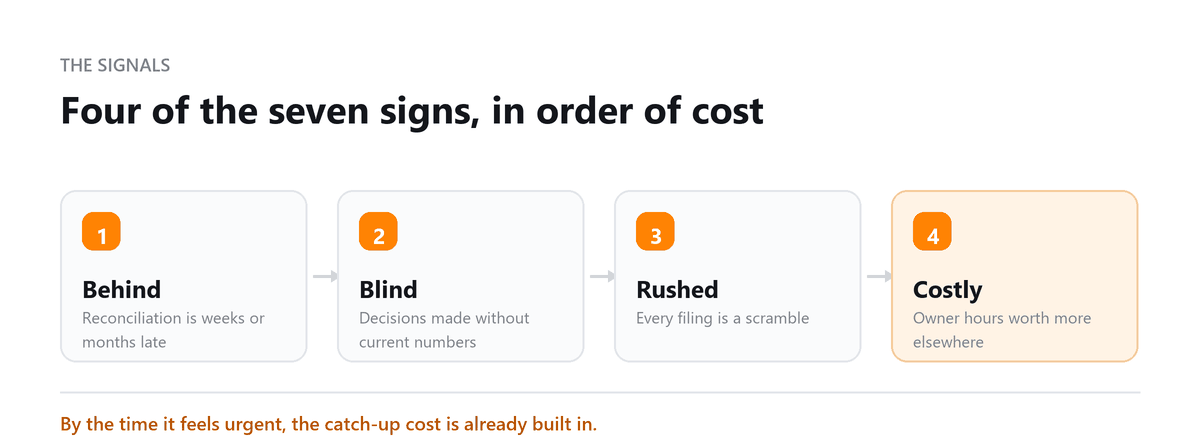
Sign 1: Your Books Are Always Behind
If your financial records are consistently weeks or months out of date, it is a direct signal that your current setup cannot keep pace with your business. Outdated books create cash flow blind spots, make tax filing stressful, and mean you are always making decisions without current financial data.
Sign 2: You Are Spending Too Much Time on Bookkeeping
Your time as a business owner is one of your most valuable assets. If you are regularly spending hours managing receipts, reconciling accounts, and preparing reports, that is time not being spent on revenue, customers, or strategy. Outsourcing returns those hours to the work that actually grows the business.
Sign 3: You Are Facing Compliance Issues
Tax laws, payroll regulations, and accounting standards change frequently. If you are struggling to stay current with deadlines and requirements, or if you have already missed a filing, it is time to hand financial compliance to someone whose job it is to track these changes.
Sign 4: Financial Errors Are Becoming More Frequent
Missing entries, incorrect calculations, miscategorised expenses, and misreported figures are not just administrative problems, they produce unreliable financial statements that lead to bad decisions and, in the worst case, IRS scrutiny. When errors become a regular occurrence, professional bookkeeping is the solution.
Sign 5: Your Business is Growing Quickly
Growth is one of the most common triggers for outsourcing. More customers, more transactions, more employees, and more complexity, all at once, is the scenario that overwhelms in-house or owner-managed bookkeeping fastest. Getting ahead of this before the books become a mess is far easier than fixing them after.
Sign 6: You Lack Meaningful Financial Insights
If your current bookkeeping only tells you what happened, not what it means, you are missing the real value of financial management. Good bookkeeping, done by professionals, produces reports that surface trends, flag issues, and support forward-looking decisions. If your books are not doing that, the process needs upgrading.
Sign 7: You Want to Reduce Costs and Overhead
Employing a full-time in-house bookkeeper involves salary, benefits, training, software, and management overhead. Outsourcing converts all of that into a predictable monthly service fee, typically at a significantly lower total cost. If you are looking to reduce overhead without compromising financial quality, outsourcing delivers both.
How Outsourced Bookkeeping Works
- Onboarding: The provider learns your business structure, accounting software, and reporting needs
- Data Sharing: You securely share financial data via cloud-based platforms, no physical file transfers
- Regular Updates: Transactions are recorded, reconciled, and categorised on the agreed schedule
- Financial Reporting: P&L statements, balance sheets, and cash flow reports delivered on time
- Ongoing Support: Providers assist with compliance, tax preparation, and financial planning
Advantages of Outsourcing
- Focus on core business activities rather than administrative tasks
- Scalability, services adjust as your business grows without staffing decisions
- Access to the latest accounting technology, included in the service
- Reduced financial risk through professional controls and compliance oversight
Risks of Outsourcing and How to Manage Them
- Data security: Choose a provider with encrypted data handling and clear security practices
- Less direct oversight: Establish clear reporting schedules and communication protocols
- Provider dependency: Select a reputable company with a proven track record and client references
Outsourced vs. In-House Bookkeeping: Quick Comparison
| Factor | Outsourced Bookkeeping | In-House Bookkeeping |
|---|---|---|
| Cost | Lower, pay only for what you need | Higher, salary plus benefits and overhead |
| Expertise | Access to specialists | Limited to one employee's skills |
| Flexibility | Easily scalable up or down | Requires new hires to expand |
| Control | Less direct day-to-day oversight | Full in-house control |
When businesses approach us at Profitjets, we often see the early signs that went unnoticed after discovery calls and the first few meetings of understanding their workflow. The pattern that we saw most common among businesses is when they overstrained their bookkeeping with mixed up records, improper reconciliations and inaccurate reporting that they have dealt with for a brief period. It is not because they were lethargic but instead they failed to understand the business standpoint when it comes to capacity of the existing system.
Book a free consultation and we will tell you what catching up involves.
Frequently Asked Questions
Is outsourcing bookkeeping a good idea for small businesses?
Yes. For most small businesses it is more cost-effective and efficient than hiring in-house. You get experienced professionals, accurate records, and flexible pricing, without the employment overhead of a full-time staff member.
Can outsourcing bookkeeping help with tax preparation?
Absolutely. Well-maintained books make tax filing faster, more accurate, and less stressful. Many outsourced bookkeeping services also offer integrated tax preparation support or work directly with your CPA to ensure everything is in order.
What services are typically included in outsourced bookkeeping?
Transaction recording, bank and credit card reconciliation, accounts payable and receivable management, payroll processing, expense tracking, financial reporting, and tax preparation support. Some providers also offer budgeting, forecasting, and inventory tracking.
How much does outsourced bookkeeping cost?
In the US, small businesses typically pay $300 to $2,500 per month depending on transaction volume and service scope. Fixed monthly packages provide more predictable budgeting than hourly billing.
What are the main benefits of outsourcing bookkeeping?
Cost savings, time efficiency, improved accuracy, compliance support, and scalability. You also gain better financial insights through timely professional reports, something owner-managed books rarely deliver consistently.
Conclusion
If you recognise three or more of the seven signs in this post, the question is no longer whether to outsource your bookkeeping, it is how quickly you can make the transition. Professional bookkeeping improves accuracy, frees your time, reduces compliance risk, and gives you financial visibility that supports better decisions. The longer you wait, the more expensive the fix becomes.

Written by
Ankit Sarawagi, CPA, CA, MBA
Ankit leads the finance team at Profitjets, where he has worked with 500+ businesses across the US on bookkeeping, tax and CFO-level strategy. He writes about the habits that keep small business books accurate all year. Connect on LinkedIn
Free consultation
Recognise a Few of These?
Book a free consultation and we will tell you what catching up involves.