
For small businesses, when outsourcing bookkeeping services a lot of questions emerge in terms of the process, access, maintenance and after adoption queries. These questions are valid as the process is vital. Still, for some businesses this looks credible on screen but unable to trust in routine.
A widely known misconception is outsourcing bookkeeping services can make you lose control over your financial data while you’re trusting an external source. While outsourcing in reality enables a clear, real-time reporting of your data which instead increases overall visibility of your finances not otherwise. You can access your clear financial date anytime before making any strategies on business growth. Businesses can streamline efficiency with the right bookkeeping partner on call and build the accurate record to stay investor-ready every time.
If you’re someone wondering how outsourcing bookkeeping services helps optimize your small business when compared to the bookkeeper who has partnered for years.. This blog details the bookkeeping process, guiding you through every phase to know how to step into the process, managing and assessing the correct choice to go with your bookkeeping needs.
The transition to outsourced bookkeeping is simpler than most business owners expect. The setup takes a week or two, and within a month most clients cannot imagine going back to managing it themselves.
Ankit Sarawagi, CPA, CA, MBA · LinkedInWhat is Outsourced Bookkeeping?
Outsourced bookkeeping means hiring an external company or professional to handle your business's financial record-keeping. This includes tracking expenses, managing financial reporting, processing payroll, and preparing records for tax filing. The provider works remotely using cloud-based accounting software that both you and they can access securely in real time.
What Does an Outsourced Bookkeeper Do for Your Business?
| Service | What It Means for Your Business |
|---|---|
| Transaction recording | Every sale, expense, and payment is categorised and logged accurately |
| Bank reconciliation | Your records are matched to bank statements monthly to catch discrepancies |
| Payroll management | Employee pay, deductions, and tax filings handled on schedule |
| Accounts payable/receivable | Invoices managed, payments tracked, collections followed up |
| Financial reporting | Monthly P&L, balance sheet, and cash flow statements delivered on time |
| Tax preparation support | Records maintained in a state ready for your CPA at tax time |
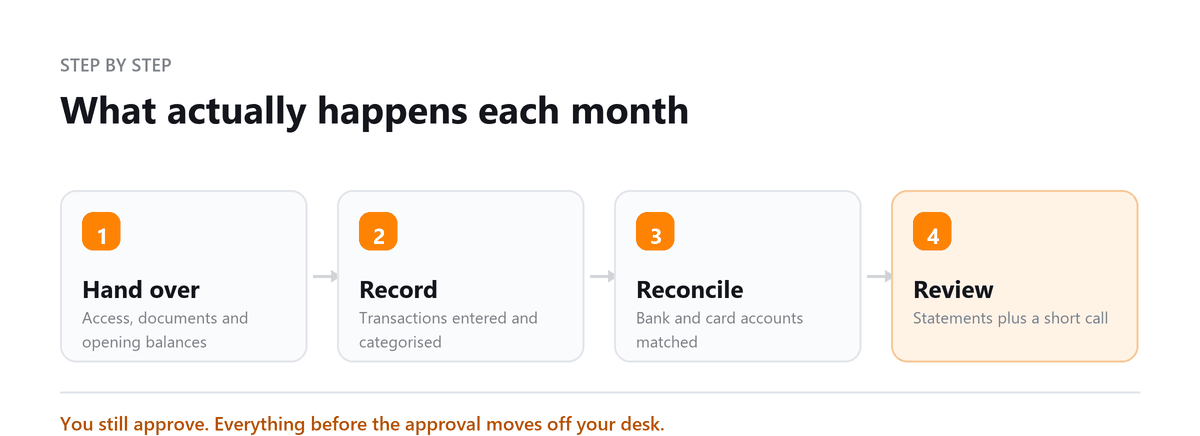
How the Process Works: Step by Step
Step 1: Initial Consultation
You discuss your business structure, current accounting setup, transaction volume, and reporting needs with the provider. They assess what services you need and recommend a package.
Step 2: Software Setup
If you are not already on cloud accounting software, the provider helps set you up on QuickBooks Online, Xero, or a similar platform. Bank feeds are connected so transactions flow in automatically.
Step 3: Data Migration
Historical financial data is imported into the new system. If you have a backlog of unreconciled transactions, a catch-up engagement may be needed before ongoing bookkeeping begins.
Step 4: Ongoing Bookkeeping
The provider manages your books on the agreed schedule, daily, weekly, or monthly. Transactions are categorised, accounts reconciled, and reports prepared and delivered to you.
Step 5: Reporting and Review
You receive regular financial reports, typically monthly, covering profit and loss, balance sheet, and cash flow. Most providers also offer a review call to walk through the numbers.
Why Outsource Your Bookkeeping?
Cost-Effective Solution
Outsourcing provides you with the expertise of a full team without the costs of salaries, benefits, and office space. For most small businesses, outsourced bookkeeping costs significantly less than a part-time in-house hire.
Focus on Core Operations
Every hour you spend on bookkeeping is an hour not spent on growing your business. Outsourcing frees you to focus on strategy, customers, and the work that generates revenue.
Access to Advanced Tools
Professional bookkeeping services use the latest accounting software and automation tools. You benefit from the technology without carrying the cost or responsibility of maintaining it.
What to Consider Before Outsourcing
- What services do you specifically need, basic bookkeeping, payroll, tax prep, or all three?
- What software does the provider use, and does it integrate with your existing tools?
- What are their security and data protection standards?
- What is the communication cadence, how often will you get reports and updates?
- What are the contract terms, month-to-month, or fixed-term commitment?
How Much Does Outsourced Bookkeeping Cost?
Small businesses can generally expect to pay between $500 and $2,500 per month for outsourced bookkeeping and accounting services. This range covers:
- Basic bookkeeping only (transactions, reconciliation, monthly reports): $200 to $800/month
- Full-service packages including payroll, tax prep, and advisory: $800 to $2,500/month
- Enterprise-level or complex multi-entity services: $2,500+/month
Book a free consultation and we will map the first month for you.
Frequently Asked Questions
What is outsourced bookkeeping?
Outsourced bookkeeping is the practice of hiring an external provider to manage your financial record-keeping. The provider handles transactions, reconciliations, payroll, and reporting remotely using cloud-based accounting software.
What services does an outsourced bookkeeping company typically provide?
Core services include transaction recording, bank reconciliation, payroll processing, accounts payable and receivable management, financial reporting, and tax preparation support. Many providers also offer CFO advisory and budgeting services.
How does outsourced bookkeeping actually work day to day?
Your bank feeds connect automatically to the accounting software, transactions flow in and are categorised by your bookkeeper, accounts are reconciled regularly, and financial reports are delivered on schedule. Most of the process runs in the background without requiring your time.
How much does outsourced bookkeeping cost?
For small businesses, typically $500 to $2,500 per month depending on transaction volume and service scope. Fixed monthly packages provide more predictable budgeting than hourly billing.
Why should I outsource rather than manage bookkeeping myself?
Time, accuracy, and compliance. Professional bookkeepers are faster, catch errors you might miss, and stay current on tax regulations. The cost of a professional service is almost always less than the combined value of your time and the risk of errors.
Conclusion
Outsourced bookkeeping works by connecting your financial data to a professional service that manages it accurately, consistently, and on time, without you needing to be involved in the day-to-day. The setup is simpler than most business owners expect, the ongoing management is transparent, and the financial reports you receive are more reliable than most self-managed books. If you are spending meaningful time on your own bookkeeping, the economics of outsourcing are almost certainly in your favour.

Written by
Ankit Sarawagi, CPA, CA, MBA
Ankit leads the finance team at Profitjets, where he has worked with 500+ businesses across the US on bookkeeping, tax and CFO-level strategy. He writes about the habits that keep small business books accurate all year. Connect on LinkedIn
Free consultation
Want to See the Process on Your Books?
Book a free consultation and we will map the first month for you.