
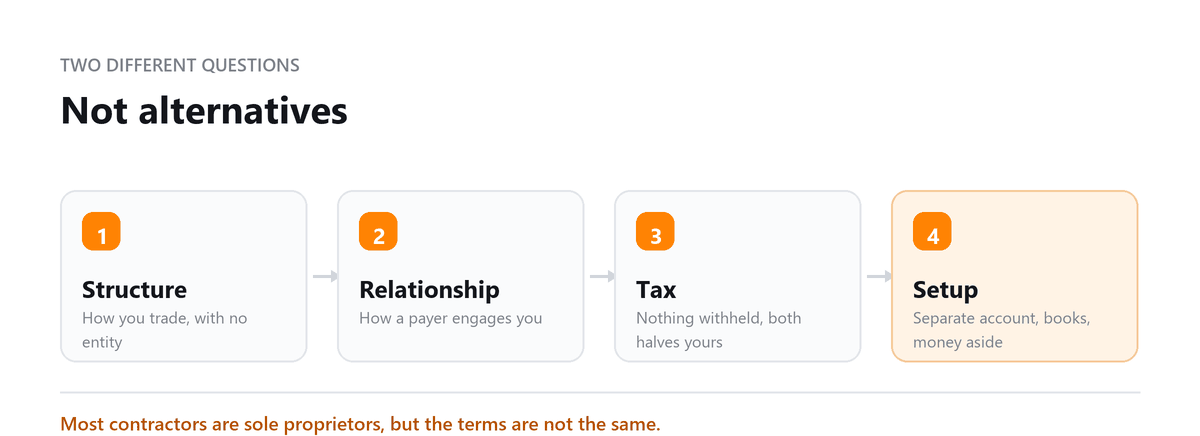
The majority of people asking this question are both and the reason is justified, it's just that they are sometimes used interchangeably and describe different things. Sole proprietorship is a business structure and independent contractor is a classification of how you are employed.
Sole proprietorship is what you are by default if you earn business money and haven't done anything else. It's just a legal term for someone who has incorporated their business or works for themselves as an independent contractor, and it is automatic.
Independent contractor is a classification of how you're employed. It describes your business relationship with a client: you're providing services as opposed to working for them as an employee and therefore they pay your invoice and send you a 1099-NEC form as opposed to withholding tax and sending you a W-2.
A freelance designer who has five clients and no registered entities is both a sole proprietor and an independent contractor, simultaneously, with nothing wrong about that.
Where it actually matters is tax, and there the practical questions are the same either way: payments per quarter, self-employment tax, and whether your classification would survive scrutiny.
The costly misunderstanding is thinking of the 1099 as equivalent to a W-2. On a W-2 your employer withheld tax all year and paid half your payroll tax. On a 1099 nobody withheld anything and you owe both halves, 15.3% on top of income tax, on everything. People discover this in April of their first freelance year, having spent the money, and then face a penalty on top for not paying quarterly. It's the most predictable financial shock in self-employment and almost nobody is warned about it.
Anu Gupta, CA, EA, B.Tech · LinkedInCore Definitions
- Sole Proprietorship: A business structure where there is no legal separation between the owner and the business. No formal registration is required at the federal level. The owner reports all business income and expenses on Schedule C of their personal tax return (Form 1040). They are personally liable for all business debts and obligations.
- Independent Contractor: A classification of how work is performed and compensated. Independent contractors are self-employed, they work for clients on a project or contract basis rather than as W-2 employees. They set their own hours, use their own tools, and may work for multiple clients. They receive 1099-NEC forms (not W-2s) and are responsible for their own taxes.
How They Overlap and Differ
That last row matters and the usual framing gets it wrong. Working for several clients doesn't make you a contractor, and working for one doesn't make you an employee. Classification turns on control and the nature of the relationship, not on how many people pay you.
| Dimension | Sole Proprietor | Independent Contractor |
|---|---|---|
| What It Describes | Business structure, how the business is legally organised | Working relationship, how you engage with clients |
| Who Uses It | Anyone who starts a business without forming an LLC/corporation | Freelancers, consultants, contractors paid for services by multiple clients |
| Legal Registration | Not required (though business name registration may be) | No registration, it is a classification, not a legal structure |
| Tax Filing | Schedule C on personal Form 1040 | 1099-NEC received from clients; income reported on Schedule C |
| Self-Employment Tax | Yes, 15.3% on net profit (Social Security + Medicare) | Yes, same SE tax applies; contractors do not have employer to pay half |
| Benefits | None, no employer contributions to health insurance, retirement | None, contractor must fund own insurance and retirement |
| Liability | Unlimited personal liability | Same as sole proprietor, no liability protection unless you form an LLC |
| Multiple Clients | Can serve multiple clients | Typically serves multiple clients, that is a defining feature of contractor status |
Most Common Scenario
Example: A freelance graphic designer has no formal business entity. They work for five different clients on a project basis. Each client pays them via invoice and sends a 1099-NEC at year-end. This person is BOTH:
- A sole proprietor: they own and operate an unincorporated business (their freelance practice)
- An independent contractor: they are engaged by clients on a services basis, not as an employee
They file Schedule C, pay self-employment tax on net profit, make quarterly estimated tax payments, and have no employer-provided benefits. This is the standard position for most self-employed individuals until they formalise their structure.
The safe harbour, which nobody explains
You don't automatically owe a penalty because you have a balance due at filing. You're generally protected if your quarterly payments totalled either 90% of the current year's tax or 100% of last year's total liability, 110% if your prior-year income exceeded the applicable threshold.
The prior-year option is the useful one. Rather than forecasting a year you haven't finished, you pay in the equivalent of last year's tax and you're covered regardless of how this year turns out.
In your first self-employed year there's no prior-year figure to work from, so estimate conservatively. The practical habit that solves this: move a fixed percentage of every payment received around 25 to 30% for most people into a separate account the day it arrives.
Key Tax Obligations for Both
| Obligation | Details |
|---|---|
| Quarterly Estimated Taxes | Due 4x per year (April, June, September, January). Calculate using Form 1040-ES. If you expect to owe $1,000+ in tax, you must pay quarterly or face underpayment penalties. |
| Self-Employment Tax | 15.3% of net self-employment income (12.4% Social Security + 2.9% Medicare). The employer portion (7.65%) is deductible on Schedule 1. |
| Schedule C | Report all business income and deductible expenses. Net profit is subject to both income tax and SE tax. |
| 1099-NEC Tracking | Each client paying you $600+ in a year must send a 1099-NEC. Keep your own records, 1099s sometimes arrive late or incorrect. |
| Business Deductions | Home office, equipment, software, business travel, professional subscriptions, health insurance premiums, all potentially deductible on Schedule C. |
Are you actually a contractor?
Worth checking, because misclassification is common and the consequences land on both sides.
Classification depends on behavioural control (does the client direct how you do the work, not just what's delivered), financial control (do you have your own investment, your own expenses, the ability to profit or lose), and the relationship itself (permanence, whether the work is core to the client's business, written terms). Signs worth attention: you work set hours the client dictates, use their equipment exclusively, have one client providing almost all your income over a long period, and do work indistinguishable from what their employees do.
If that describes you, you may be a misclassified employee. For you that means paying both halves of payroll tax and receiving no benefits or protections you'd otherwise be entitled to. For the client it means significant exposure to back taxes and penalties which is why this gets challenged.
Not a reason for alarm if you genuinely operate independently. It's a reason to be honest about which you are.
Should you form an LLC?
As a sole proprietor you have no liability protection. Business claims reach your personal assets.
Whether that matters depends on your exposure. A copywriter's worst case is a fee dispute. Anyone selling a physical product, working on someone's property, driving for the business, or handling sensitive data carries meaningfully more risk, and an LLC becomes the minimum rather than an upgrade. We cover the decision in sole proprietorship vs LLC.
On the S-Corp election, which comes up constantly in freelance advice: it can reduce self-employment tax by splitting profit between salary and distributions, but it requires an entity, a defensible salary, payroll processing and a separate business return, realistically a few thousand a year in added cost. It generally starts paying somewhere in the low six figures of profit, not at $50,000. Model your own numbers with an accountant; the arithmetic is in LLC tax rates.
Around 55% of Profitjets freelance clients initially operate as unincorporated sole proprietors, with missed quarterly estimated payments and commingled personal and business transactions among the most common issues identified during onboarding. In one recent review, Profitjets helped resolve approximately $3,200 in accumulated tax and penalty exposure before the client’s records were brought up to date.
I was making good money freelancing, but I hadn't set aside anything for quarterly taxes and was using the same bank account for everything. When I got hit with a $4,100 tax bill, I realized I had no idea what I actually owed or what I could deduct. Profitjets separated the business finances, organized my bookkeeping, and set up a quarterly tax-payment plan so I knew what to set aside each month instead of getting another surprise at tax time.
Book a free consultation and we will set the basics up with you.
Frequently Asked Questions
Do I need to register as a sole proprietor?
Not federally. you become one automatically when you start conducting business. You may need a DBA registration if you trade under a name other than your own, and many cities and counties require a general business licence even for home-based work. That local requirement is the most commonly missed item; one call to your city clerk settles it.
What's the difference between a 1099 contractor and a W-2 employee?
An employee has tax withheld by their employer, who also pays half their payroll tax and typically provides benefits. A contractor gets paid gross, owes the full 15.3% self-employment tax on top of income tax, and funds their own insurance and retirement. For the same headline figure a contractor nets considerably less which is why contractor rates should be higher than equivalent salaries, not the same.
When do I have to start paying quarterly?
Generally once you expect to owe $1,000 or more in tax for the year, which most self-employed people do quickly. Start in the first quarter you're earning rather than catching up later; the penalty is calculated on how much was unpaid and for how long, so late payments still reduce it but don't eliminate it.
What if a client doesn't send me a 1099?
You still report the income. The 1099 is the client's reporting obligation, not the definition of your taxable income, and income under $600 often generates no form at all while remaining fully taxable. Keep your own records of every payment received, they're the authoritative source, and 1099s are frequently late or wrong.
Can I be an employee and a contractor at the same time?
Yes, commonly. a W-2 job plus freelance work on the side. You file both: the W-2 income as usual, the freelance income on Schedule C with self-employment tax. Your employer's withholding can also be adjusted to cover some of the freelance tax, which for many people is simpler than making quarterly payments.

Written by
Anu Gupta, CA, EA, B.Tech
Anu works with US businesses on tax and entity questions at Profitjets, from choosing a structure to the filings that follow it. She writes about the decisions owners make once and then live with for years. Connect on LinkedIn
Free consultation
Going Out on Your Own?
Book a free consultation and we will set the basics up with you.