
Can You Claim Tax Deductions Without Receipts? What the IRS Allows
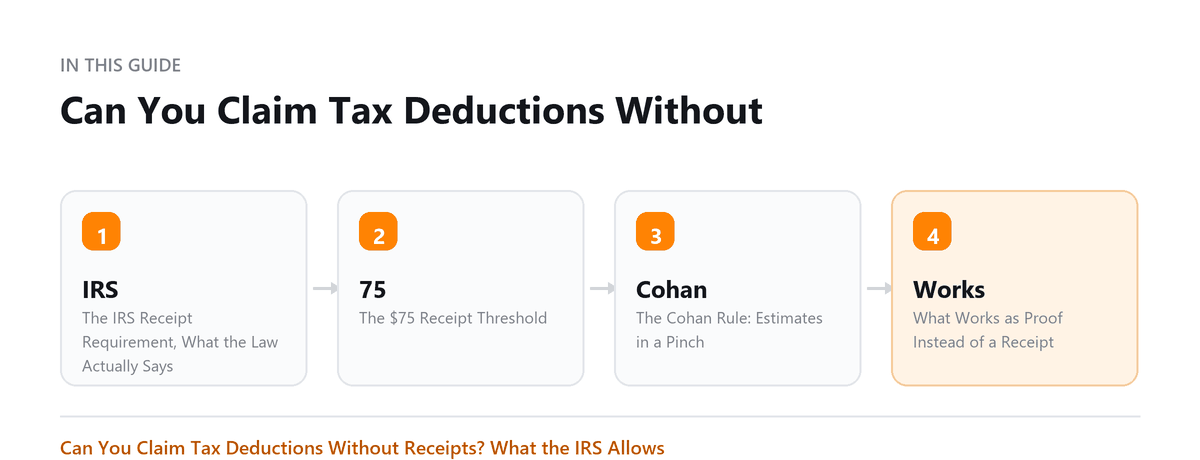
The IRS Receipt Requirement, What the Law Actually Says, The $75 Receipt Threshold, and The Cohan Rule: Estimates in
Receipts go missing. The question is what happens to a genuine business expense when the paperwork behind it cannot be found.
The answer is more encouraging than most people expect and narrower than they hope. Other evidence can support a claim, estimates are sometimes accepted, and certain categories carry heightened requirements that no amount of reconstruction will satisfy.
This covers what the rules actually require, where a lower threshold applies, what can stand in for a receipt, how far a reconstruction can be taken, and the claims that should never rely on one.
The IRS Receipt Requirement, What the Law Actually Says
The IRS requires taxpayers to maintain adequate records to substantiate deductions. However, the law does not specify that a physical receipt is the only acceptable proof. What matters is that you have credible, contemporaneous documentation that establishes:
- The amount of the expense
- The time and place of the expense
- The business purpose
- The business relationship (for meals and entertainment)
Reconstruct what you honestly can, document how you did it, and be straightforward about what is an estimate. Presenting a reconstruction as though it were contemporaneous evidence is what puts the credibility of the whole return at risk, not the missing paperwork itself.
Anu Gupta, CA, EA, B.Tech · LinkedInThe $75 Receipt Threshold
The IRS does require receipts for any individual expense over $75 that falls into certain categories (lodging always requires a receipt regardless of amount). For expenses under $75, other documentation may suffice. This does not mean you should skip receipts under $75, it means the IRS is slightly more lenient about reconstruction.
The Cohan Rule: Estimates in a Pinch
Named after George M. Cohan (the entertainer who successfully argued for estimated deductions in court), the Cohan Rule allows courts to permit estimated deductions when records are lost or destroyed, if the taxpayer can show that expenses were definitely incurred, even if the exact amount is uncertain.
Important caveats:
- The Cohan Rule is a judicial doctrine, the IRS does not apply it proactively in audits; only a tax court would.
- It does NOT apply to listed property (vehicles, computers, entertainment), those have strict substantiation requirements under Section 274.
- Estimates must be reasonable and anchored in evidence (industry norms, comparable expenses).
- The Cohan Rule is a last resort, not a planning strategy.
What Works as Proof Instead of a Receipt
| Alternative Record | What It Proves |
|---|---|
| Bank or credit card statement | Amount paid and date, does not show business purpose |
| Cancelled check | Amount, payee, and date |
| Calendar/appointment record | Date and who you met, supports business meal or travel |
| Email confirmation | Transaction details for online purchases, travel bookings |
| Mileage app log | Date, miles, and route, sufficient for vehicle deductions |
| Photo of purchase/item | Evidence that item exists and was purchased |
| Written contemporaneous note | Jotted at the time of expense, more credible than reconstruction |
The stronger your alternative documentation, the better your position in an audit. A combination of bank statement + calendar entry + email discussing the meeting is far stronger than any single alternative.
Standard Mileage Rate: No Fuel Receipts Needed
When you use the standard mileage rate for vehicle deductions, you do not need to keep fuel, oil, maintenance, or insurance receipts. The rate is designed to cover those costs. You only need a mileage log documenting business trips.
Reconstructed Records: Can You Build Records After the Fact?
Yes, but reconstruct as early as possible, and document your reconstruction process:
- Pull all bank and credit card statements for the year.
- Export transaction data and categorize each expense.
- Supplement with emails, calendar entries, and photos.
- Write a memo explaining the reconstruction and what records were lost (helpful if audited years later).
Reconstruction is credible if done shortly after records are lost. A reconstruction three years later during an audit is far less persuasive.
High-Risk Deductions Without Receipts
- Cash expenses: hardest to prove, the IRS is naturally skeptical of large cash deductions without any paper trail.
- Meals and entertainment: Section 274 requires specific substantiation (who, where, when, business purpose). The Cohan Rule does not apply.
- Vehicle listed property: requires odometer log, not just estimates.
- Home office (actual expense method): requires precise square footage and actual cost documentation.
Best Practice: The Digital Receipt Habit
- Scan every physical receipt immediately with an app (Expensify, Dext, QuickBooks Mobile), they OCR and categorize automatically.
- Forward digital receipts (Amazon, airline confirmations) to a dedicated business email folder.
- Connect your business credit/debit card to your accounting software, transactions import automatically.
- Review and categorize weekly rather than scrambling at year-end.
Pro Tip: The IRS accepts scanned receipts and digital records as valid substantiation. There is no requirement to keep paper originals once you have a legible digital copy.
Book a free consultation and we will take the return off your desk.
Frequently Asked Questions
If I get audited and lack receipts, will all my deductions be disallowed?
Not necessarily. The IRS examiner evaluates the totality of the evidence. Alternative documentation, a credible explanation, and a pattern of legitimate business expenses can support partial or full allowance of deductions. However, deductions with zero supporting evidence are typically disallowed.
Can I estimate business meal expenses if I lost receipts?
This is risky. Section 274 strictly limits the Cohan Rule for meals and entertainment. The IRS may disallow meal deductions entirely without sufficient substantiation. The 50% deductibility limit means the stakes are also lower, it may not be worth the audit risk.
How long should I keep receipts?
The IRS can audit returns up to 3 years after filing (6 years if you omitted more than 25% of income, indefinitely for fraud). Keep business records for at least 7 years to be safe.
What is the practical answer for a business that has lost records?
Reconstruct what you honestly can from other sources, document how you did it, and be straightforward about what is an estimate. Bank and card statements, calendars, mileage logs, supplier duplicates and contracts all help. What does not help is presenting a reconstruction as though it were contemporaneous evidence, because the credibility of the whole return rests on the parts that can be checked.
Which claims should never rely on a reconstruction?
Those where the law requires specific substantiation rather than merely reasonable evidence. Certain categories, including some travel, vehicle and gift-related claims, carry heightened requirements, and an estimate will not satisfy them however plausible. Charitable giving above certain levels needs a specific acknowledgement that cannot be recreated later. For these, missing documentation usually means the claim fails.

Written by
Anu Gupta, CA, EA, B.Tech
Anu works with US businesses on tax and entity questions at Profitjets, from choosing a structure to the filings that follow it. She writes about the decisions owners make once and then live with for years. Connect on LinkedIn
Free consultation
Want the Filing Handled?
Book a free consultation and we will take the return off your desk.