
Tax Filing Tips for Small Business Owners: Avoid Common Mistakes
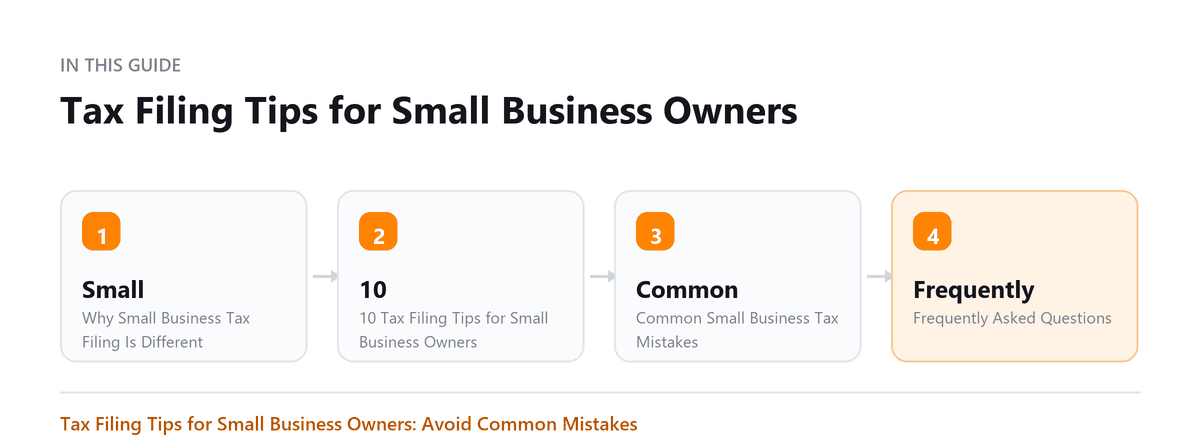
Why Small Business Tax Filing Is Different, 10 Tax Filing Tips for Small Business Owners, and Common Small Business
A small business return is not a personal return with more boxes. It depends on records kept through the year by somebody who had other priorities.
That is why the businesses that find filing season straightforward are not the ones with the simplest affairs. They are the ones that kept a handful of habits going: separate accounts, a monthly reconciliation, contractor details collected before payment, and receipts captured as they arose.
This covers what makes business filing different, the practices that make it manageable, what to assemble before handing anything to a preparer, and the mistakes that recur most often.
Why Small Business Tax Filing Is Different
Small business owners face a more complex tax picture than employees: self-employment tax, quarterly estimates, multiple information returns (1099s, W-2s), potential for audit triggers from business deductions, and entity-level deadlines that are different from personal filing deadlines. Getting it right matters, both to minimize what you owe and to avoid costly IRS notices.
Everything that makes a filing straightforward is a habit rather than an event. Separate accounts, a monthly reconciliation, contractor details collected before payment, receipts captured as they arise. A business doing those four things files easily; one that is not spends the season reconstructing a year.
Anu Gupta, CA, EA, B.Tech · LinkedIn10 Tax Filing Tips for Small Business Owners
1. Separate Business and Personal Accounts, From Day One
Open a dedicated business checking account and business credit card before your first transaction. Commingling funds creates an accounting nightmare, makes audits harder to defend, and can undermine legal entity protections for LLCs and corporations.
2. Track Income and Expenses in Real-Time
Use accounting software (QuickBooks, Xero, FreshBooks, Wave) and connect your bank accounts for automatic transaction import. Reconcile monthly. Year-end scrambles lead to missed deductions and errors.
3. Know Your Entity Filing Deadline
Many business owners think the April 15 deadline applies to them, but partnerships and S-corporations are due March 15. If you miss the March 15 S-corp deadline without an extension, the penalty is $235 per partner/shareholder per month for up to 12 months.
4. Fund Your Retirement Account Before the Deadline
SEP-IRA contributions can be made up to the tax return due date including extensions, making it one of the most flexible last-minute tax reductions available. Solo 401(k) employee deferrals must be elected by December 31 even though the contribution can be made later.
5. Document Every Deduction
Keep receipts, categorize expenses correctly in your accounting software, and note the business purpose. For meals: note who attended and what business was discussed. For travel: keep an itinerary. For vehicle: maintain a mileage log.
6. Reconcile Your Books Before Filing
Reconcile all bank accounts, credit cards, and payroll records to your accounting software before your CPA starts the return. Unexplained differences lead to delays, fees, and potential errors on the return.
7. Send 1099-NEC Forms on Time
If you paid any individual contractor (not a corporation) $600 or more during the year, you must issue a 1099-NEC by January 31. Missing this deadline triggers penalties of $60-$660 per form (amount depends on how late and whether intentional).
Pro Tip: Collect W-9 forms from every vendor before paying them, not at year-end when you need the information. Store W-9s securely.
8. Pay Quarterly Estimated Taxes
Self-employed individuals who expect to owe $1,000 or more must pay quarterly estimates (April 15, June 15, September 15, January 15). Underpaying triggers a penalty even if you pay in full at filing time. Estimate using your prior-year tax as a safe harbor.
9. Hire a CPA if Your Revenue Exceeds $100,000
The complexity of tax planning, entity structure, retirement accounts, QBI deduction, state nexus issues, payroll compliance, generally exceeds what most business owners can optimize on their own above the $100k revenue level. A good CPA typically saves more than they cost.
10. Review Your Return Before Signing
You are legally responsible for the accuracy of your return, even if a CPA prepared it. Review key figures: gross revenue matches your records, all deductions are ones you actually incurred, the entity structure matches what you intended, estimated tax payments are credited correctly.
Common Small Business Tax Mistakes
| Mistake | Consequence |
|---|---|
| Mixing personal and business expenses | Legitimate deductions disallowed; audit red flag; harder to defend in tax court |
| Missing S-corp election deadline | Treated as sole proprietor/partnership, all profit subject to SE tax |
| Ignoring self-employment tax | Surprise tax bill; underpayment penalties; cash flow problems |
| Not tracking home office consistently | Deduction disallowed in audit if use was not regular and exclusive |
| Classifying employees as contractors | Back taxes, penalties, and interest if IRS reclassifies workers |
| Deducting 100% of meals post-2022 | Must be 50%, full deduction expired after 2022 |
| Missing 1099 issuance deadlines | Penalties plus deduction may be challenged if contractor's income unreported |
| Not depreciating correctly | Either over- or under-reporting income; creates basis issues on sale |
Book a free consultation and we will take the return off your desk.
Frequently Asked Questions
Should I file as a sole proprietor or LLC?
A single-member LLC is taxed identically to a sole proprietor by default, same tax forms (Schedule C), same SE tax. The LLC provides legal liability protection, not a tax advantage by itself. To get SE tax savings, you need an S-corp election (can be made on top of the LLC structure).
Can I deduct losses from my business on my personal return?
For pass-through entities (sole proprietors, S-corps, partnerships): yes, to the extent you have basis and the at-risk and passive activity rules allow. Consistent losses can trigger the hobby loss rules (Section 183), the IRS may reclassify the activity as a hobby if profit is not shown in 3 of 5 years.
When does the work for filing season actually start?
At the start of the year it relates to, not at the end of it. Almost everything that makes a filing straightforward is a habit rather than an event: separate accounts, monthly reconciliation, contractor details collected before payment, and receipts captured as they arise. A business that does those four things files easily. One that does not spends the season reconstructing a year.
What should be assembled before going to a preparer?
A closed set of books for the year, the bank and loan statements, the payroll reports, the fixed asset additions and disposals, and any document reporting income to you from a third party. Add a short note of anything unusual that happened during the year. Preparers charge for the time spent assembling this, so the assembly is the cheapest part of the process to do yourself.
What is the single most common mistake?
Leaving personal transactions in the business records, which is both the most frequent and the most consequential. It distorts the figures the return is built on, it makes every deduction harder to support, and where the entity was formed to provide separation it undermines the argument that the separation is real. It is also the easiest thing on this list to fix.

Written by
Anu Gupta, CA, EA, B.Tech
Anu works with US businesses on tax and entity questions at Profitjets, from choosing a structure to the filings that follow it. She writes about the decisions owners make once and then live with for years. Connect on LinkedIn
Free consultation
Want the Filing Handled?
Book a free consultation and we will take the return off your desk.