
An extension buys time to file. It is one of the most useful and most misunderstood tools in the system, because it does not usually buy time to pay.
There are good reasons to use one beyond simply running late: information that has not arrived, a position that deserves more thought, or an election that has to be made on a timely filed return and which the extension preserves.
This covers what an extension is and is not, the dates by entity type, how to request one, how the consequences of filing late differ from those of paying late, and why the state position usually has to be handled separately.
What Is a Tax Extension?
A tax extension gives you additional time to FILE your tax return, it does not give you additional time to PAY any taxes you owe. If you expect to owe, you must estimate and pay by the original deadline to avoid penalties and interest.
Some elections have to be made on a timely filed return, and a valid extension preserves that timing. That is one of the genuinely good reasons to file one, and it is quite different from using an extension simply to postpone the work.
Anu Gupta, CA, EA, B.Tech · LinkedInExtension Deadlines by Entity Type
| Entity Type | Original Deadline / Extended Deadline |
|---|---|
| Individual (Form 1040) | April 15, 2025 / October 15, 2025 (Form 4868) |
| S-Corporation (Form 1120-S) | March 15, 2025 / September 15, 2025 (Form 7004) |
| Partnership (Form 1065) | March 15, 2025 / September 15, 2025 (Form 7004) |
| C-Corporation (Form 1120) | April 15, 2025 / October 15, 2025 (Form 7004) |
| Trust and Estate (Form 1041) | April 15, 2025 / October 15, 2025 (Form 7004) |
| Exempt Organization (Form 990) | May 15, 2025 / November 15, 2025 (Form 8868) |
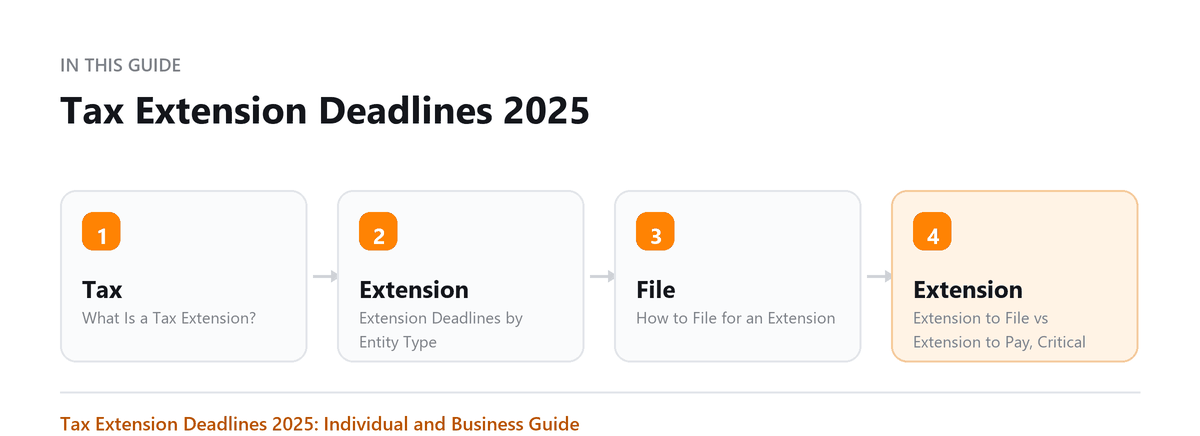
How to File for an Extension
Individual (Form 4868)
- File Form 4868 electronically through IRS Free File, your tax software, or via mail by April 15.
- Estimate your total tax liability for 2024 on the form.
- Pay any balance you estimate you owe with the extension, the IRS does not require exact payment.
- The 6-month extension is automatic, the IRS does not send an approval letter. Filing the form is sufficient.
Business Entities (Form 7004)
- File Form 7004 by the entity's original due date.
- For S-corps and partnerships: file by March 15 for a 6-month extension to September 15.
- For C-corps: file by April 15 for a 6-month extension to October 15.
- No signature required, Form 7004 is automatic upon timely filing.
Extension to File vs Extension to Pay, Critical Distinction
An extension gives you more time to FILE your return. It does NOT give you more time to pay taxes due.
| Scenario | Result |
|---|---|
| You file an extension AND pay estimated balance by April 15 | No penalties, no interest on amount paid. File return by October 15. |
| You file an extension but do NOT pay estimated balance by April 15 | Extension is still valid (you still get to October 15 to file), but late-payment penalty and interest accrue from April 15 on the unpaid balance. |
| You do NOT file an extension AND do NOT file a return by April 15 | Failure-to-file penalty: 5% per month on unpaid tax, up to 25%. This is 10x worse than the failure-to-pay penalty. |
Penalties for Missing Deadlines
| Penalty Type | Rate |
|---|---|
| Failure to file (no extension) | 5% of unpaid tax per month, max 25% |
| Failure to pay | 0.5% of unpaid tax per month, max 25% |
| If both penalties apply | Failure-to-file reduced to 4.5% when failure-to-pay also applies, combined max still 25% |
| Interest on unpaid tax | Federal short-term rate + 3% (changes quarterly) |
Pro Tip: Always file for an extension even if you cannot pay. The failure-to-file penalty is far more expensive than the failure-to-pay penalty. Filing stops the 5%/month clock; only the 0.5% payment penalty continues.
State Tax Extensions
Most states automatically grant an extension if you file a federal extension. However, state rules vary:
- California (FTB): automatic 6-month extension to file; must pay 100% of tax owed by April 15 to avoid penalty.
- New York: automatic extension if federal extension filed; any balance must be paid by April 15.
- Texas, Florida, Nevada: no state income tax, no state extension needed.
- Some states require a separate state extension form even if federal extension is filed.
Common Reasons to File an Extension
- Waiting for K-1s from partnerships or S-corps (often arrive late)
- Missing or corrected 1099 forms
- Complex tax situation requiring more time to optimize
- Life events (medical, family) that delayed document gathering
- CPA capacity constraints during peak filing season
Book a free consultation and we will take the return off your desk.
Frequently Asked Questions
Does filing an extension increase my audit risk?
No. The IRS does not flag extended returns for additional scrutiny. Extensions are extremely common, tens of millions are filed each year.
Can I file for a second extension?
No. For individuals, the October 15 extension is the final deadline, there is no second extension. For certain overseas filers, special rules may allow additional time.
What if I overpaid and expect a refund, should I still file an extension?
If you overpaid and are owed a refund, there is no penalty for filing late. However, your refund is delayed. Also, be aware that the statute of limitations for claiming a refund is 3 years from the original due date (not the extended due date).
Does an extension affect anything other than the return itself?
It can. Some elections have to be made on a timely filed return, and a valid extension generally preserves that timing, which is one of the genuinely good reasons to file one. It also affects when related filings are expected, including statements owed to owners or beneficiaries. Check what else is keyed to the filing date before assuming an extension moves everything.
What should be done immediately after requesting one?
Estimate and pay, then diarise the new date and work back from it. The estimate is the part that is easy to postpone and expensive to get wrong, because the extension moves the paperwork and generally not the payment. Setting a target date a few weeks before the extended deadline is what stops the same rush repeating later in the year with less room to manoeuvre.

Written by
Anu Gupta, CA, EA, B.Tech
Anu works with US businesses on tax and entity questions at Profitjets, from choosing a structure to the filings that follow it. She writes about the decisions owners make once and then live with for years. Connect on LinkedIn
Free consultation
Want the Filing Handled?
Book a free consultation and we will take the return off your desk.